 Add to Chrome
 Add to Firefox
 Add to Edge
StartupBench: Benchmarking General-Purpose Agents on Market-Validated End-to-End Workflows
Aug 18, 2026
Recent advances in Large Language Models(LLMs) and agents have substantially improved the ability of AI systems to execute complex tasks. Yet existing benchmarks largely rely on researcher-selected tasks, leaving uncertain whether such progress extends to the work that real-world users actually demand from AI systems. We introduce \textbf{StartupBench}, an E2E agent benchmark grounded in market-validated AI startup products. Rather than defining tasks from pre-defined assumptions about useful agent capabilities, we systematically study AI products with demonstrated adoption, together with their product workflows and users, to identify real-world tasks for which AI has established practical demand across diverse professional domains. We translate these workflows into complete deliverable-oriented tasks and evaluate them with fine-grained rubrics capturing their complex requirements. Across representative models evaluated under a unified agent harness, even the strongest model successfully completes only approximately 30\% of StartupBench, despite making substantial partial progress on many tasks. Further analysis identifies aspects like complex instruction following and domain-specific expertise as major sources of failure. Our results reveal that many market-validated workflows remain beyond the reliable capabilities of current general-purpose agents, establishing StartupBench as an empirical measure of progress toward E2E completions of real-world user tasks.

Towards Estimating Normal and Shear Interface Pressures in Prosthetic Sockets via Least Squares and Mechanics Modeling
Jun 02, 2026Prosthetic socket fitting remains largely manual and iterative, and objective fit metrics are still limited. Part of the challenge is the lack of long-term real-life pressure data at the residual limb--socket interface. Traditional pressure sensors are prone to drift over time, and capture only normal pressures at sparse locations within the socket, missing a critical component for biomechanical analysis: shear. Although some sensors can report both normal and shear interface stresses, these components are often difficult to decouple because of measurement crosstalk. One potential path forward is to develop models that can augment available measurements. This work introduces a testbed to evaluate model performance under sparse pressure sensing using two complementary validation signals: (i) the global wrench (\ie, total forces and moments expressed in an orthonormal frame) transmitted through the socket, by an artificial residual-limb, and (ii) local interface loads (\ie, decoupled normal and shear pressure components in a right-hand-rule orthogonal frame that lives in each instrumented location) measured by sparse sensing clusters, each composed of four capacitance-sensing channels. Rather than presenting full-field pressure estimates, the focus is on an analysis sequence that quantifies how well candidate mechanical models explain both global and local measurements under controlled conditions. A quasi-static spring--mass contact model is evaluated, and its parameters are identified via a two-stage convex least-squares problem. Validation under static loading shows that estimating constant bias terms reduces steady offsets in the wrench channels and improves agreement with local measurements. A Pareto-front sensitivity analysis further illustrates how the trade-off between global and local objectives changes when bias terms are included.
LipidBERT: A Lipid Language Model Pre-trained on METiS de novo Lipid Library
Aug 12, 2024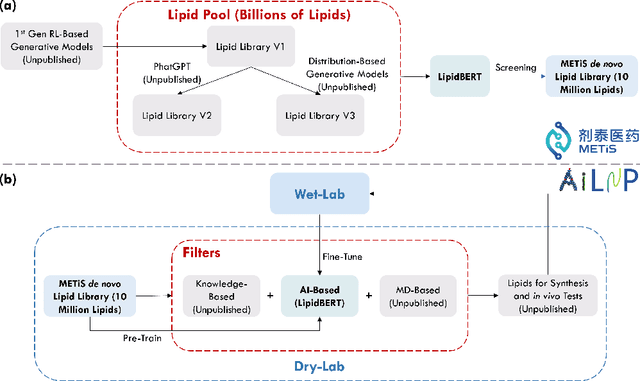
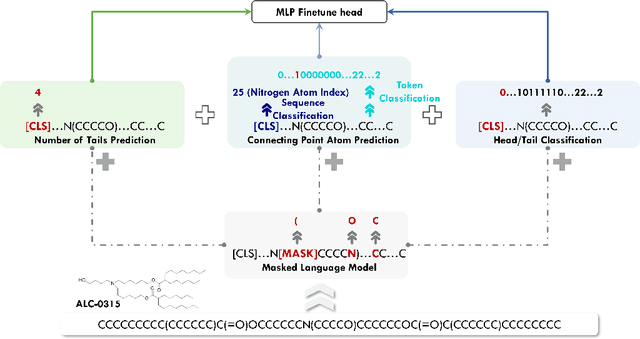
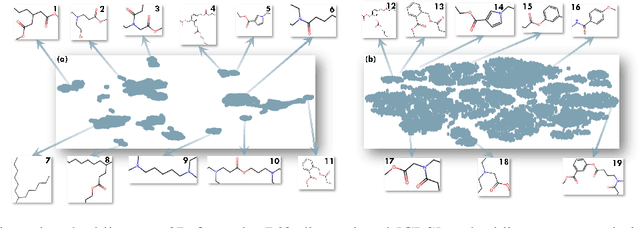
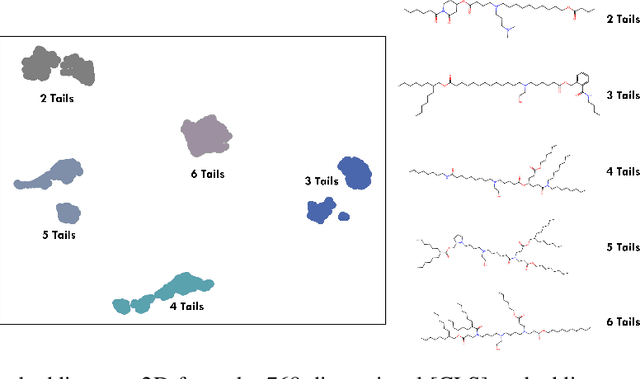
In this study, we generate and maintain a database of 10 million virtual lipids through METiS's in-house de novo lipid generation algorithms and lipid virtual screening techniques. These virtual lipids serve as a corpus for pre-training, lipid representation learning, and downstream task knowledge transfer, culminating in state-of-the-art LNP property prediction performance. We propose LipidBERT, a BERT-like model pre-trained with the Masked Language Model (MLM) and various secondary tasks. Additionally, we compare the performance of embeddings generated by LipidBERT and PhatGPT, our GPT-like lipid generation model, on downstream tasks. The proposed bilingual LipidBERT model operates in two languages: the language of ionizable lipid pre-training, using in-house dry-lab lipid structures, and the language of LNP fine-tuning, utilizing in-house LNP wet-lab data. This dual capability positions LipidBERT as a key AI-based filter for future screening tasks, including new versions of METiS de novo lipid libraries and, more importantly, candidates for in vivo testing for orgran-targeting LNPs. To the best of our knowledge, this is the first successful demonstration of the capability of a pre-trained language model on virtual lipids and its effectiveness in downstream tasks using web-lab data. This work showcases the clever utilization of METiS's in-house de novo lipid library as well as the power of dry-wet lab integration.