 Add to Chrome
 Add to Firefox
 Add to Edge
Seeing Like Radiologists: Context- and Gaze-Guided Vision-Language Pretraining for Chest X-rays
Mar 27, 2026
Despite recent advances in medical vision-language pretraining, existing models still struggle to capture the diagnostic workflow: radiographs are typically treated as context-agnostic images, while radiologists' gaze -- a crucial cue for visual reasoning -- remains largely underexplored by existing methods. These limitations hinder the modeling of disease-specific patterns and weaken cross-modal alignment. To bridge this gap, we introduce CoGaze, a Context- and Gaze-guided vision-language pretraining framework for chest X-rays. We first propose a context-infused vision encoder that models how radiologists integrate clinical context -- including patient history, symptoms, and diagnostic intent -- to guide diagnostic reasoning. We then present a multi-level supervision paradigm that (1) enforces intra- and inter-modal semantic alignment through hybrid-positive contrastive learning, (2) injects diagnostic priors via disease-aware cross-modal representation learning, and (3) leverages radiologists' gaze as probabilistic priors to guide attention toward diagnostically salient regions. Extensive experiments demonstrate that CoGaze consistently outperforms state-of-the-art methods across diverse tasks, achieving up to +2.0% CheXbertF1 and +1.2% BLEU2 for free-text and structured report generation, +23.2% AUROC for zero-shot classification, and +12.2% Precision@1 for image-text retrieval. Code is available at https://github.com/mk-runner/CoGaze.

TruthSR: Trustworthy Sequential Recommender Systems via User-generated Multimodal Content
Apr 26, 2024
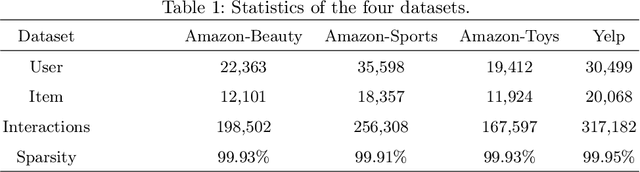
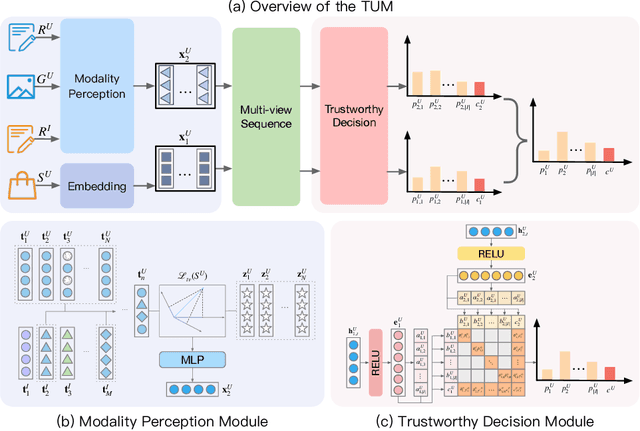
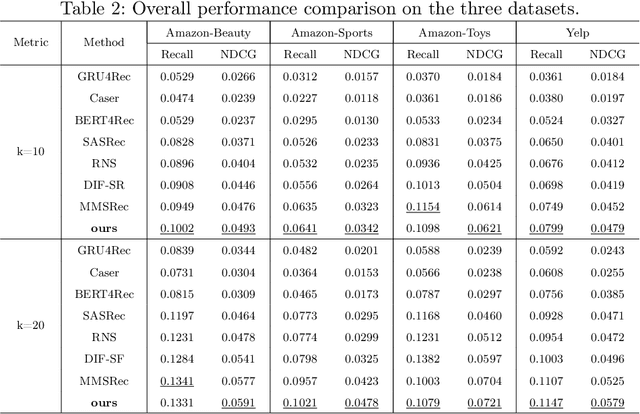
Sequential recommender systems explore users' preferences and behavioral patterns from their historically generated data. Recently, researchers aim to improve sequential recommendation by utilizing massive user-generated multi-modal content, such as reviews, images, etc. This content often contains inevitable noise. Some studies attempt to reduce noise interference by suppressing cross-modal inconsistent information. However, they could potentially constrain the capturing of personalized user preferences. In addition, it is almost impossible to entirely eliminate noise in diverse user-generated multi-modal content. To solve these problems, we propose a trustworthy sequential recommendation method via noisy user-generated multi-modal content. Specifically, we explicitly capture the consistency and complementarity of user-generated multi-modal content to mitigate noise interference. We also achieve the modeling of the user's multi-modal sequential preferences. In addition, we design a trustworthy decision mechanism that integrates subjective user perspective and objective item perspective to dynamically evaluate the uncertainty of prediction results. Experimental evaluation on four widely-used datasets demonstrates the superior performance of our model compared to state-of-the-art methods. The code is released at https://github.com/FairyMeng/TrustSR.
Reliable Conflictive Multi-View Learning
Feb 28, 2024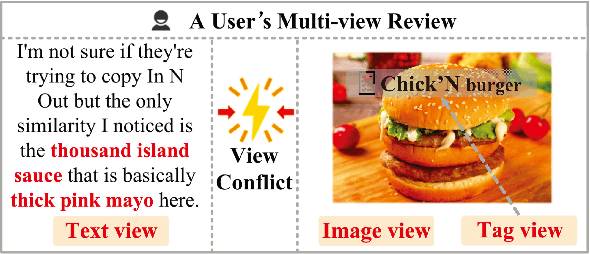
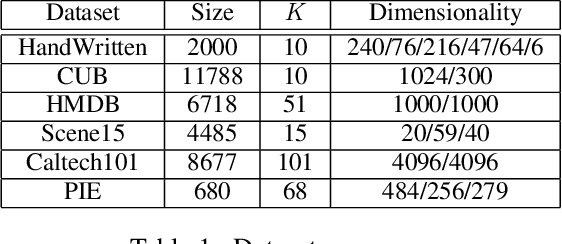
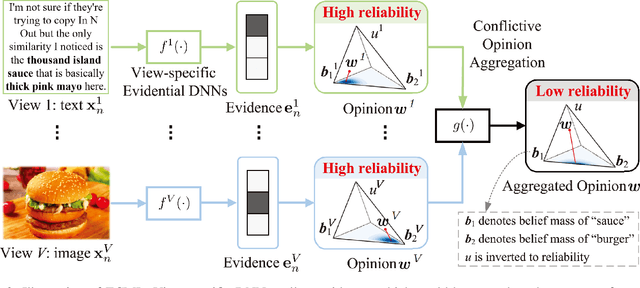

Multi-view learning aims to combine multiple features to achieve more comprehensive descriptions of data. Most previous works assume that multiple views are strictly aligned. However, real-world multi-view data may contain low-quality conflictive instances, which show conflictive information in different views. Previous methods for this problem mainly focus on eliminating the conflictive data instances by removing them or replacing conflictive views. Nevertheless, real-world applications usually require making decisions for conflictive instances rather than only eliminating them. To solve this, we point out a new Reliable Conflictive Multi-view Learning (RCML) problem, which requires the model to provide decision results and attached reliabilities for conflictive multi-view data. We develop an Evidential Conflictive Multi-view Learning (ECML) method for this problem. ECML first learns view-specific evidence, which could be termed as the amount of support to each category collected from data. Then, we can construct view-specific opinions consisting of decision results and reliability. In the multi-view fusion stage, we propose a conflictive opinion aggregation strategy and theoretically prove this strategy can exactly model the relation of multi-view common and view-specific reliabilities. Experiments performed on 6 datasets verify the effectiveness of ECML.