 Add to Chrome
 Add to Firefox
 Add to Edge
UNIBROWSE: A Data-to-Agent Framework for Multimodal BrowseComp
Jul 12, 2026
Multimodal BrowseComp tasks require agents to combine perception, tool use, and long-horizon reasoning over dynamic web content, challenging their ability to handle compositional structure, open-world uncertainty, and multimodal integration across extended interactions. Crucially, real-world multimodal browsing involves three distinct information-flow patterns: text-only, image-to-text, and text-to-image, yet existing data construction methods cover only the text-only and image-to-text patterns, leaving text-to-image largely unaddressed and limiting agent generality and robustness. We introduce UNIBROWSE, a unified data pipeline that for the first time simultaneously generates training data covering all three patterns, augments curated knowledge graphs with live web retrieval for improved fidelity, and introduces a novel metric of exploration degree to filter low-signal instances for efficient reinforcement learning. Through this pipeline, we produce high-quality cold-start tool-use trajectories and exploration-rich QA pairs, and train a 35B-scale agent via supervised fine-tuning and exploration-aware RL.The resulting UNIBROWSE agent achieves state-of-the-art performance on multimodal BrowseComp benchmarks, attaining an average accuracy of 54.4 across five diverse benchmarks -- an improvement of 10.5 points over its base model Qwen3.5-35B-A3B -- and surpassing serveral closed-source agent workflows such as GPT-5 (42.9), Gemini-2.5 Pro (44.8), and Gemini-2.5 Flash (41.3).

PaperBanana: Automating Academic Illustration for AI Scientists
Jan 30, 2026Despite rapid advances in autonomous AI scientists powered by language models, generating publication-ready illustrations remains a labor-intensive bottleneck in the research workflow. To lift this burden, we introduce PaperBanana, an agentic framework for automated generation of publication-ready academic illustrations. Powered by state-of-the-art VLMs and image generation models, PaperBanana orchestrates specialized agents to retrieve references, plan content and style, render images, and iteratively refine via self-critique. To rigorously evaluate our framework, we introduce PaperBananaBench, comprising 292 test cases for methodology diagrams curated from NeurIPS 2025 publications, covering diverse research domains and illustration styles. Comprehensive experiments demonstrate that PaperBanana consistently outperforms leading baselines in faithfulness, conciseness, readability, and aesthetics. We further show that our method effectively extends to the generation of high-quality statistical plots. Collectively, PaperBanana paves the way for the automated generation of publication-ready illustrations.
Chain-of-Thought Matters: Improving Long-Context Language Models with Reasoning Path Supervision
Feb 28, 2025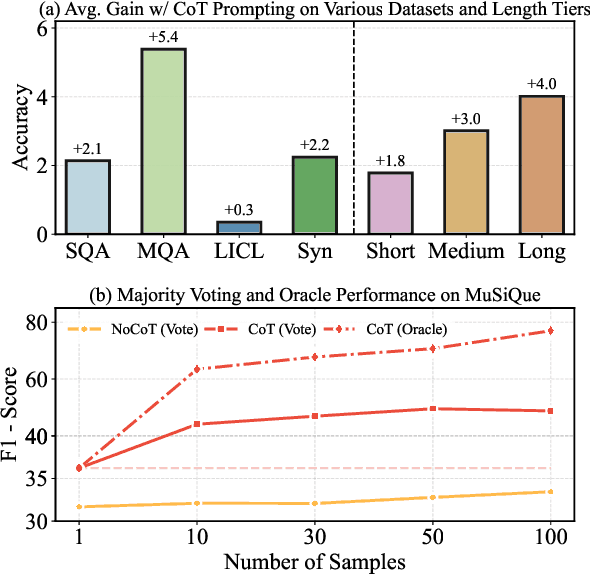
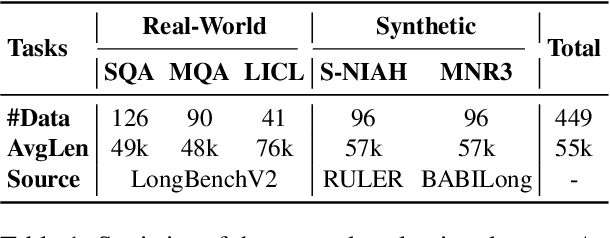
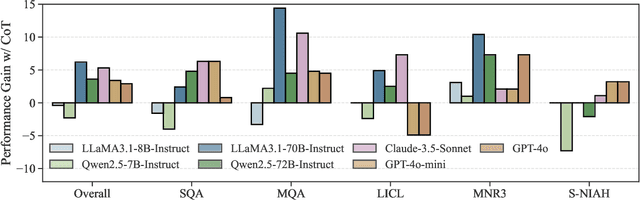
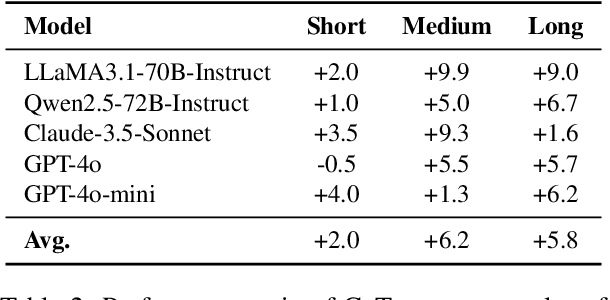
Recent advances in Large Language Models (LLMs) have highlighted the challenge of handling long-context tasks, where models need to reason over extensive input contexts to aggregate target information. While Chain-of-Thought (CoT) prompting has shown promise for multi-step reasoning, its effectiveness for long-context scenarios remains underexplored. Through systematic investigation across diverse tasks, we demonstrate that CoT's benefits generalize across most long-context scenarios and amplify with increasing context length. Motivated by this critical observation, we propose LongRePS, a process-supervised framework that teaches models to generate high-quality reasoning paths for enhanced long-context performance. Our framework incorporates a self-sampling mechanism to bootstrap reasoning paths and a novel quality assessment protocol specifically designed for long-context scenarios. Experimental results on various long-context benchmarks demonstrate the effectiveness of our approach, achieving significant improvements over outcome supervision baselines on both in-domain tasks (+13.6/+3.8 points for LLaMA/Qwen on MuSiQue) and cross-domain generalization (+9.3/+8.1 points on average across diverse QA tasks). Our code, data and trained models are made public to facilitate future research.