 Add to Chrome
 Add to Firefox
 Add to Edge
SEGAR: Selective Enhancement for Generative Augmented Reality
Mar 25, 2026
Generative world models offer a compelling foundation for augmented-reality (AR) applications: by predicting future image sequences that incorporate deliberate visual edits, they enable temporally coherent, augmented future frames that can be computed ahead of time and cached, avoiding per-frame rendering from scratch in real time. In this work, we present SEGAR, a preliminary framework that combines a diffusion-based world model with a selective correction stage to support this vision. The world model generates augmented future frames with region-specific edits while preserving others, and the correction stage subsequently aligns safety-critical regions with real-world observations while preserving intended augmentations elsewhere. We demonstrate this pipeline in driving scenarios as a representative setting where semantic region structure is well defined and real-world feedback is readily available. We view this as an early step toward generative world models as practical AR infrastructure, where future frames can be generated, cached, and selectively corrected on demand.

Computational Teaching for Driving via Multi-Task Imitation Learning
Oct 02, 2024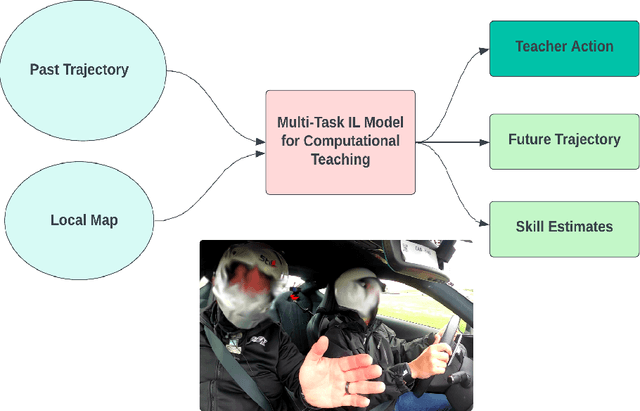
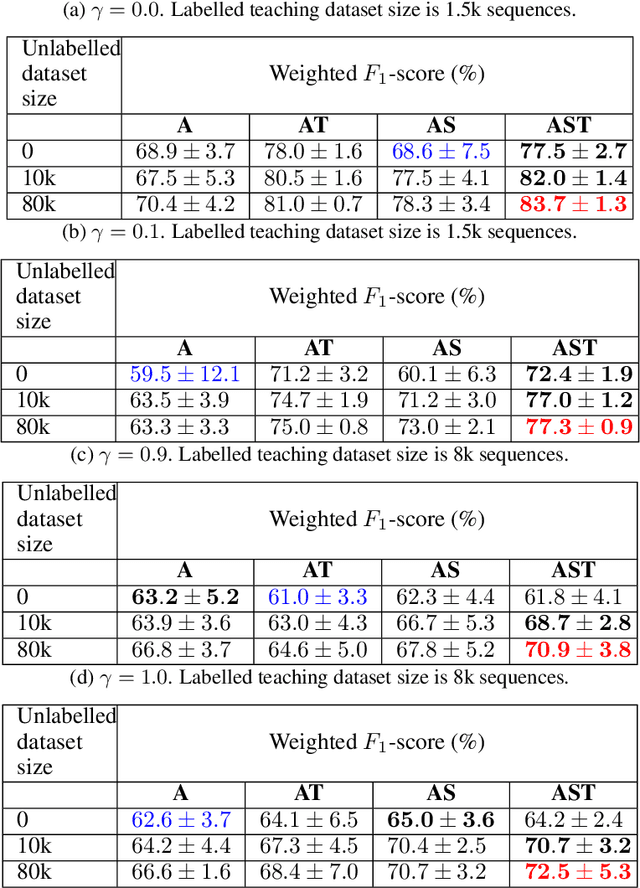

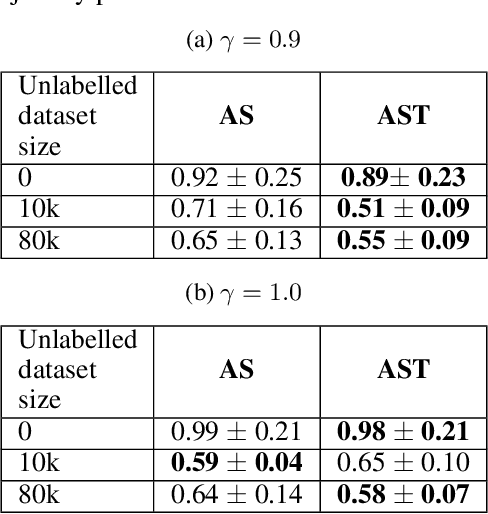
Learning motor skills for sports or performance driving is often done with professional instruction from expert human teachers, whose availability is limited. Our goal is to enable automated teaching via a learned model that interacts with the student similar to a human teacher. However, training such automated teaching systems is limited by the availability of high-quality annotated datasets of expert teacher and student interactions that are difficult to collect at scale. To address this data scarcity problem, we propose an approach for training a coaching system for complex motor tasks such as high performance driving via a Multi-Task Imitation Learning (MTIL) paradigm. MTIL allows our model to learn robust representations by utilizing self-supervised training signals from more readily available non-interactive datasets of humans performing the task of interest. We validate our approach with (1) a semi-synthetic dataset created from real human driving trajectories, (2) a professional track driving instruction dataset, (3) a track-racing driving simulator human-subject study, and (4) a system demonstration on an instrumented car at a race track. Our experiments show that the right set of auxiliary machine learning tasks improves performance in predicting teaching instructions. Moreover, in the human subjects study, students exposed to the instructions from our teaching system improve their ability to stay within track limits, and show favorable perception of the model's interaction with them, in terms of usefulness and satisfaction.