 Add to Chrome
 Add to Firefox
 Add to Edge
MultiPress: A Multi-Agent Framework for Interpretable Multimodal News Classification
Apr 04, 2026
With the growing prevalence of multimodal news content, effective news topic classification demands models capable of jointly understanding and reasoning over heterogeneous data such as text and images. Existing methods often process modalities independently or employ simplistic fusion strategies, limiting their ability to capture complex cross-modal interactions and leverage external knowledge. To overcome these limitations, we propose MultiPress, a novel three-stage multi-agent framework for multimodal news classification. MultiPress integrates specialized agents for multimodal perception, retrieval-augmented reasoning, and gated fusion scoring, followed by a reward-driven iterative optimization mechanism. We validate MultiPress on a newly constructed large-scale multimodal news dataset, demonstrating significant improvements over strong baselines and highlighting the effectiveness of modular multi-agent collaboration and retrieval-augmented reasoning in enhancing classification accuracy and interpretability.

Weaver: Foundation Models for Creative Writing
Jan 30, 2024
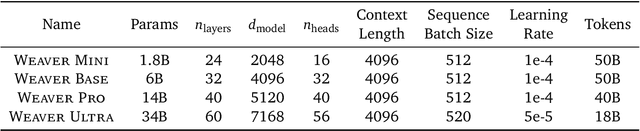
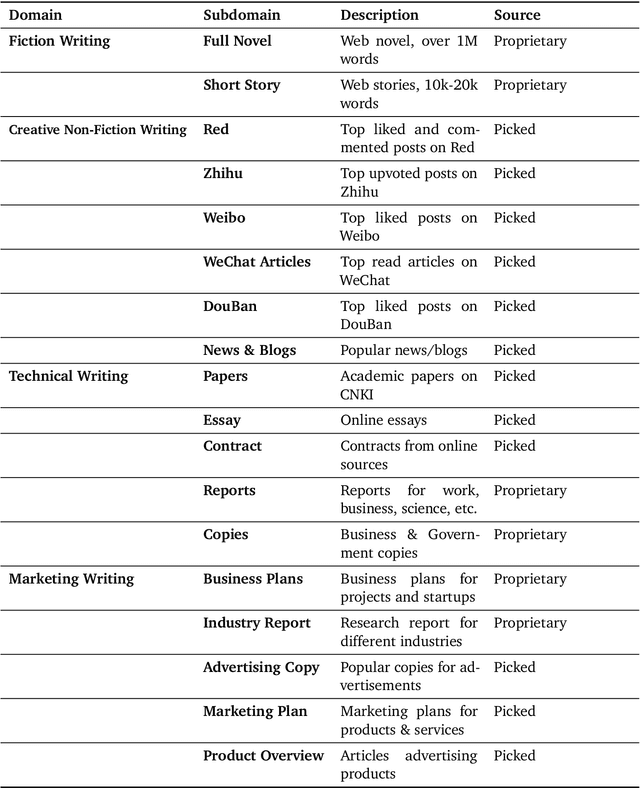
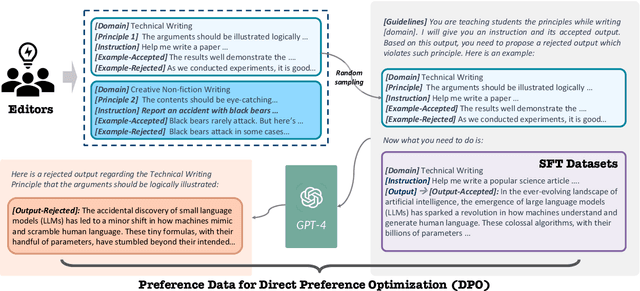
This work introduces Weaver, our first family of large language models (LLMs) dedicated to content creation. Weaver is pre-trained on a carefully selected corpus that focuses on improving the writing capabilities of large language models. We then fine-tune Weaver for creative and professional writing purposes and align it to the preference of professional writers using a suit of novel methods for instruction data synthesis and LLM alignment, making it able to produce more human-like texts and follow more diverse instructions for content creation. The Weaver family consists of models of Weaver Mini (1.8B), Weaver Base (6B), Weaver Pro (14B), and Weaver Ultra (34B) sizes, suitable for different applications and can be dynamically dispatched by a routing agent according to query complexity to balance response quality and computation cost. Evaluation on a carefully curated benchmark for assessing the writing capabilities of LLMs shows Weaver models of all sizes outperform generalist LLMs several times larger than them. Notably, our most-capable Weaver Ultra model surpasses GPT-4, a state-of-the-art generalist LLM, on various writing scenarios, demonstrating the advantage of training specialized LLMs for writing purposes. Moreover, Weaver natively supports retrieval-augmented generation (RAG) and function calling (tool usage). We present various use cases of these abilities for improving AI-assisted writing systems, including integration of external knowledge bases, tools, or APIs, and providing personalized writing assistance. Furthermore, we discuss and summarize a guideline and best practices for pre-training and fine-tuning domain-specific LLMs.