 Add to Chrome
 Add to Firefox
 Add to Edge
Physical probes expose and alleviate chemical-environment collapse in molecular representations
May 11, 2026
Nuclear magnetic resonance (NMR) spectroscopy provides an experimental readout of local chemical environments, but its use in molecular representation learning has been constrained by heterogeneous data and incomplete atom-level assignments. Here we construct complementary high-fidelity experimental and computational 13C NMR resources, which reveal a recurrent form of representational collapse: atoms that are equivalent in molecular topology can remain experimentally distinct in their real chemical environments, whereas explicit 3D descriptions are further limited by static conformations in dynamic regimes. To alleviate this bottleneck, we develop CLAIM (Contrastive Learning for Atom-to-molecule Inference of Molecular NMR), a framework that aligns efficient topological molecular inputs with atom-resolved NMR observables. Through hierarchical chemical priors and cross-level contrastive learning, CLAIM restores lost chemical resolution and markedly improves atom-level molecule-spectrum retrieval. CLAIM remains robust in flexible and tautomeric systems for 13C NMR prediction, improves stereoisomer discrimination without explicit 3D modelling, and transfers to broader molecular property tasks including ADMET prediction and fluorescence estimation. These results establish physically grounded spectral alignment as an effective strategy for alleviating chemical-environment collapse and for guiding experimentally grounded molecular representation learning.

VTutor: An Open-Source SDK for Generative AI-Powered Animated Pedagogical Agents with Multi-Media Output
Feb 06, 2025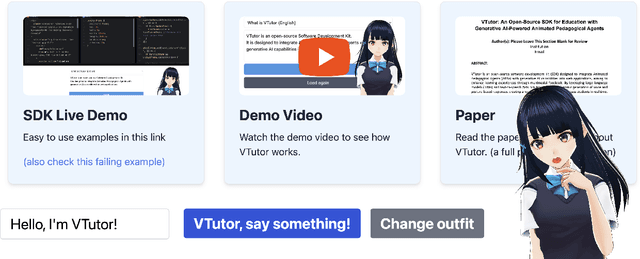
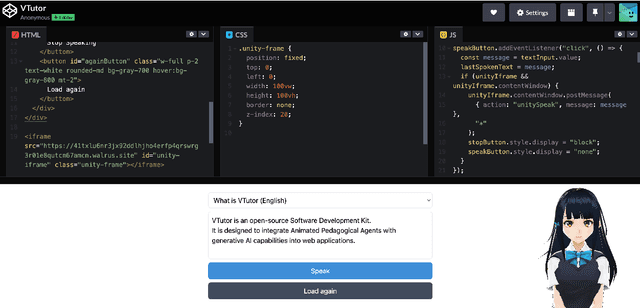
The rapid evolution of large language models (LLMs) has transformed human-computer interaction (HCI), but the interaction with LLMs is currently mainly focused on text-based interactions, while other multi-model approaches remain under-explored. This paper introduces VTutor, an open-source Software Development Kit (SDK) that combines generative AI with advanced animation technologies to create engaging, adaptable, and realistic APAs for human-AI multi-media interactions. VTutor leverages LLMs for real-time personalized feedback, advanced lip synchronization for natural speech alignment, and WebGL rendering for seamless web integration. Supporting various 2D and 3D character models, VTutor enables researchers and developers to design emotionally resonant, contextually adaptive learning agents. This toolkit enhances learner engagement, feedback receptivity, and human-AI interaction while promoting trustworthy AI principles in education. VTutor sets a new standard for next-generation APAs, offering an accessible, scalable solution for fostering meaningful and immersive human-AI interaction experiences. The VTutor project is open-sourced and welcomes community-driven contributions and showcases.
A Survey on Human-AI Teaming with Large Pre-Trained Models
Mar 07, 2024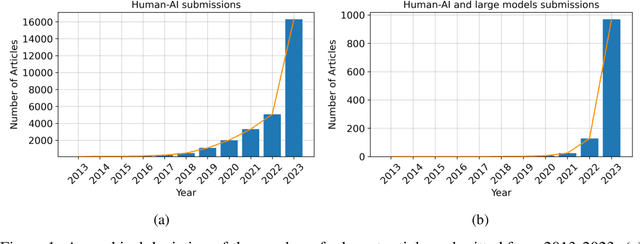
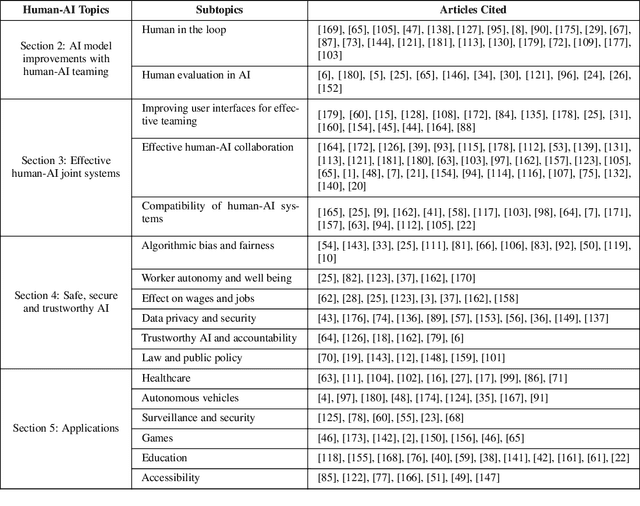
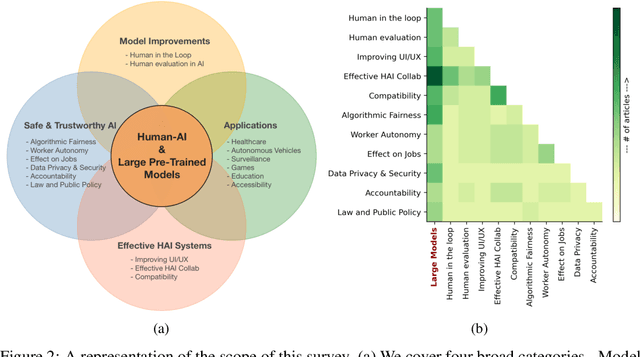
In the rapidly evolving landscape of artificial intelligence (AI), the collaboration between human intelligence and AI systems, known as Human-AI (HAI) Teaming, has emerged as a cornerstone for advancing problem-solving and decision-making processes. The advent of Large Pre-trained Models (LPtM) has significantly transformed this landscape, offering unprecedented capabilities by leveraging vast amounts of data to understand and predict complex patterns. This paper surveys the pivotal integration of LPtMs with HAI, emphasizing how these models enhance collaborative intelligence beyond traditional approaches. It examines the synergistic potential of LPtMs in augmenting human capabilities, discussing this collaboration for AI model improvements, effective teaming, ethical considerations, and their broad applied implications in various sectors. Through this exploration, the study sheds light on the transformative impact of LPtM-enhanced HAI Teaming, providing insights for future research, policy development, and strategic implementations aimed at harnessing the full potential of this collaboration for research and societal benefit.