 Add to Chrome
 Add to Firefox
 Add to Edge
Who Defines Fairness? Target-Based Prompting for Demographic Representation in Generative Models
Apr 22, 2026
Text-to-image(T2I) models like Stable Diffusion and DALL-E have made generative AI widely accessible, yet recent studies reveal that these systems often replicate societal biases, particularly in how they depict demographic groups across professions. Prompts such as 'doctor' or 'CEO' frequently yield lighter-skinned outputs, while lower-status roles like 'janitor' show more diversity, reinforcing stereotypes. Existing mitigation methods typically require retraining or curated datasets, making them inaccessible to most users. We propose a lightweight, inference-time framework that mitigates representational bias through prompt-level intervention without modifying the underlying model. Instead of assuming a single definition of fairness, our approach allows users to select among multiple fairness specifications-ranging from simple choices such as a uniform distribution to more complex definitions informed by a large language model(LLM) that cites sources and provides confidence estimates. These distributions guide the construction of demographic specific prompt variants in the corresponding proportions, and we evaluate alignment by auditing adherence to the declared target and measuring the resulting skin tone distribution rather than assuming uniformity as 'fairness'. Across 36 prompts spanning 30 occupations and 6 non-occupational contexts, our method shifts observed skin-tone outcomes in directions consistent with the declared target, and reduces deviation from targets when the target is defined directly in skin-tone space(fallback). This work demonstrates how fairness interventions can be made transparent, controllable, and usable at inference time, directly empowering users of generative AI.

J-CaPA : Joint Channel and Pyramid Attention Improves Medical Image Segmentation
Nov 25, 2024Medical image segmentation is crucial for diagnosis and treatment planning. Traditional CNN-based models, like U-Net, have shown promising results but struggle to capture long-range dependencies and global context. To address these limitations, we propose a transformer-based architecture that jointly applies Channel Attention and Pyramid Attention mechanisms to improve multi-scale feature extraction and enhance segmentation performance for medical images. Increasing model complexity requires more training data, and we further improve model generalization with CutMix data augmentation. Our approach is evaluated on the Synapse multi-organ segmentation dataset, achieving a 6.9% improvement in Mean Dice score and a 39.9% improvement in Hausdorff Distance (HD95) over an implementation without our enhancements. Our proposed model demonstrates improved segmentation accuracy for complex anatomical structures, outperforming existing state-of-the-art methods.
A Survey on Human-AI Teaming with Large Pre-Trained Models
Mar 07, 2024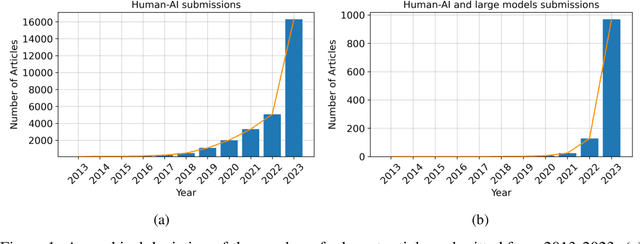
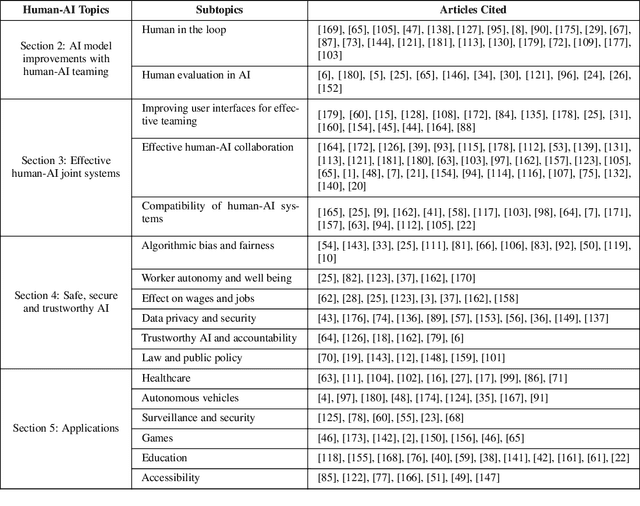
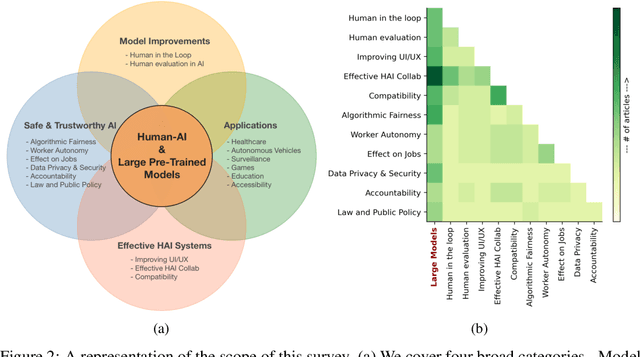
In the rapidly evolving landscape of artificial intelligence (AI), the collaboration between human intelligence and AI systems, known as Human-AI (HAI) Teaming, has emerged as a cornerstone for advancing problem-solving and decision-making processes. The advent of Large Pre-trained Models (LPtM) has significantly transformed this landscape, offering unprecedented capabilities by leveraging vast amounts of data to understand and predict complex patterns. This paper surveys the pivotal integration of LPtMs with HAI, emphasizing how these models enhance collaborative intelligence beyond traditional approaches. It examines the synergistic potential of LPtMs in augmenting human capabilities, discussing this collaboration for AI model improvements, effective teaming, ethical considerations, and their broad applied implications in various sectors. Through this exploration, the study sheds light on the transformative impact of LPtM-enhanced HAI Teaming, providing insights for future research, policy development, and strategic implementations aimed at harnessing the full potential of this collaboration for research and societal benefit.