 Add to Chrome
 Add to Firefox
 Add to Edge
AI+HW 2035: Shaping the Next Decade
Mar 05, 2026
Artificial intelligence (AI) and hardware (HW) are advancing at unprecedented rates, yet their trajectories have become inseparably intertwined. The global research community lacks a cohesive, long-term vision to strategically coordinate the development of AI and HW. This fragmentation constrains progress toward holistic, sustainable, and adaptive AI systems capable of learning, reasoning, and operating efficiently across cloud, edge, and physical environments. The future of AI depends not only on scaling intelligence, but on scaling efficiency, achieving exponential gains in intelligence per joule, rather than unbounded compute consumption. Addressing this grand challenge requires rethinking the entire computing stack. This vision paper lays out a 10-year roadmap for AI+HW co-design and co-development, spanning algorithms, architectures, systems, and sustainability. We articulate key insights that redefine scaling around energy efficiency, system-level integration, and cross-layer optimization. We identify key challenges and opportunities, candidly assess potential obstacles and pitfalls, and propose integrated solutions grounded in algorithmic innovation, hardware advances, and software abstraction. Looking ahead, we define what success means in 10 years: achieving a 1000x improvement in efficiency for AI training and inference; enabling energy-aware, self-optimizing systems that seamlessly span cloud, edge, and physical AI; democratizing access to advanced AI infrastructure; and embedding human-centric principles into the design of intelligent systems. Finally, we outline concrete action items for academia, industry, government, and the broader community, calling for coordinated national initiatives, shared infrastructure, workforce development, cross-agency collaboration, and sustained public-private partnerships to ensure that AI+HW co-design becomes a unifying long-term mission.

A Survey on Human-AI Teaming with Large Pre-Trained Models
Mar 07, 2024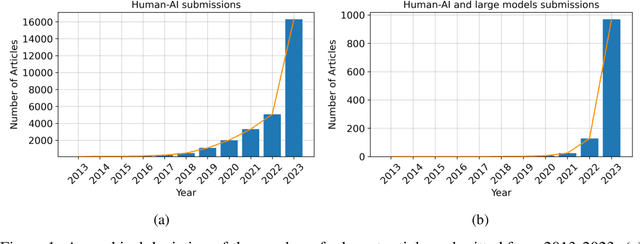
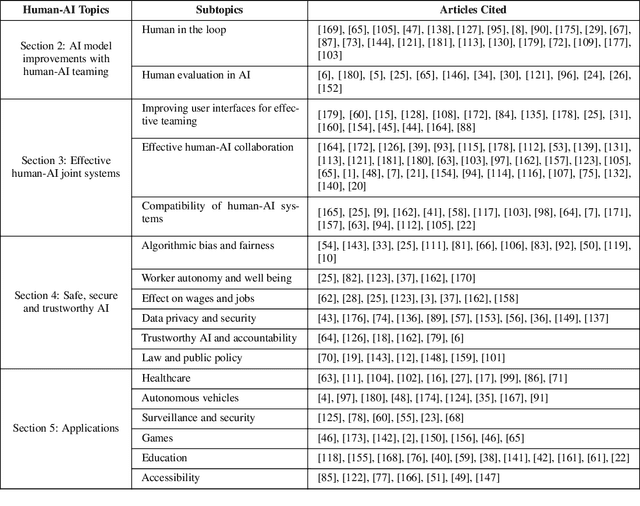
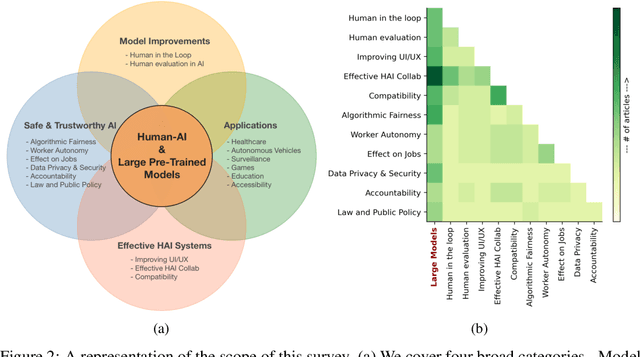
In the rapidly evolving landscape of artificial intelligence (AI), the collaboration between human intelligence and AI systems, known as Human-AI (HAI) Teaming, has emerged as a cornerstone for advancing problem-solving and decision-making processes. The advent of Large Pre-trained Models (LPtM) has significantly transformed this landscape, offering unprecedented capabilities by leveraging vast amounts of data to understand and predict complex patterns. This paper surveys the pivotal integration of LPtMs with HAI, emphasizing how these models enhance collaborative intelligence beyond traditional approaches. It examines the synergistic potential of LPtMs in augmenting human capabilities, discussing this collaboration for AI model improvements, effective teaming, ethical considerations, and their broad applied implications in various sectors. Through this exploration, the study sheds light on the transformative impact of LPtM-enhanced HAI Teaming, providing insights for future research, policy development, and strategic implementations aimed at harnessing the full potential of this collaboration for research and societal benefit.
Chip Placement with Deep Reinforcement Learning
Apr 22, 2020
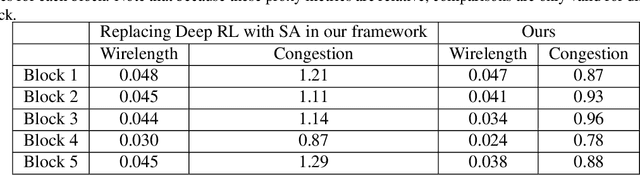
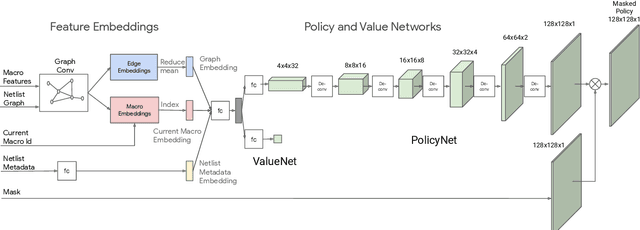
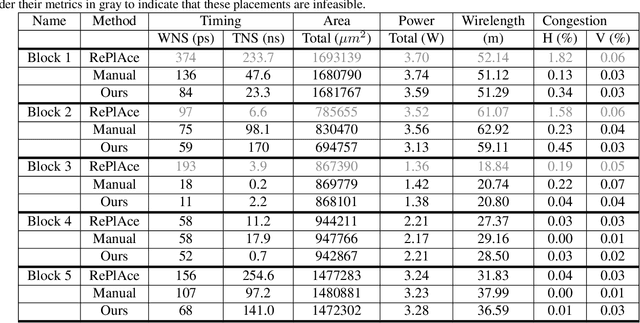
In this work, we present a learning-based approach to chip placement, one of the most complex and time-consuming stages of the chip design process. Unlike prior methods, our approach has the ability to learn from past experience and improve over time. In particular, as we train over a greater number of chip blocks, our method becomes better at rapidly generating optimized placements for previously unseen chip blocks. To achieve these results, we pose placement as a Reinforcement Learning (RL) problem and train an agent to place the nodes of a chip netlist onto a chip canvas. To enable our RL policy to generalize to unseen blocks, we ground representation learning in the supervised task of predicting placement quality. By designing a neural architecture that can accurately predict reward across a wide variety of netlists and their placements, we are able to generate rich feature embeddings of the input netlists. We then use this architecture as the encoder of our policy and value networks to enable transfer learning. Our objective is to minimize PPA (power, performance, and area), and we show that, in under 6 hours, our method can generate placements that are superhuman or comparable on modern accelerator netlists, whereas existing baselines require human experts in the loop and take several weeks.