 Add to Chrome
 Add to Firefox
 Add to Edge
Scaling Domain Data Repetition in LLM Pretraining
Aug 14, 2026
As large language models scale, their training-token budgets must also increase to maintain an appropriate tokens-per-parameter ratio (\(\mathrm{TPP}\)). However, high-quality domain data is much harder to scale than general web data. As model size and the training-token budget increase, its fraction in the training mixture tends to decrease. Repeating the available high-quality data provides an effective way to counteract this dilution, but excessive repetition may lead to overfitting. We study this trade-off under practical LLM scaling, where the training-token budget grows proportionally with model size. For a fixed domain, we first find that, surprisingly at a fixed \(\mathrm{TPP}\), the optimal repetition count mildly increases with model size. Across different domains, we find that the optimal repetition count is strongly negatively correlated with the final validation loss of a domain: domains with lower loss can generally benefit from more repetitions. In contrast, the amount of unique domain data is only weakly related to the optimal repetition count. These findings suggest that repetition counts tuned on smaller proxy models with the same \(\mathrm{TPP}\) can provide a practical estimate for larger models.

Virtual Width Networks
Nov 17, 2025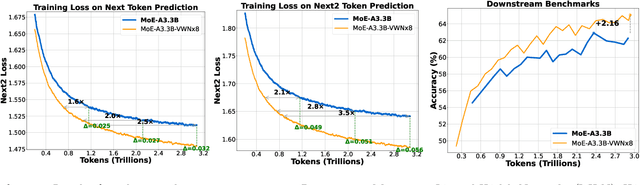
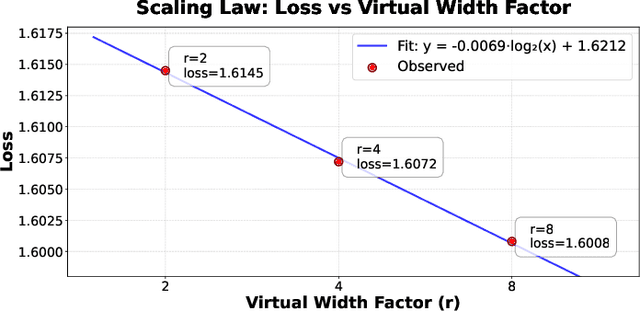
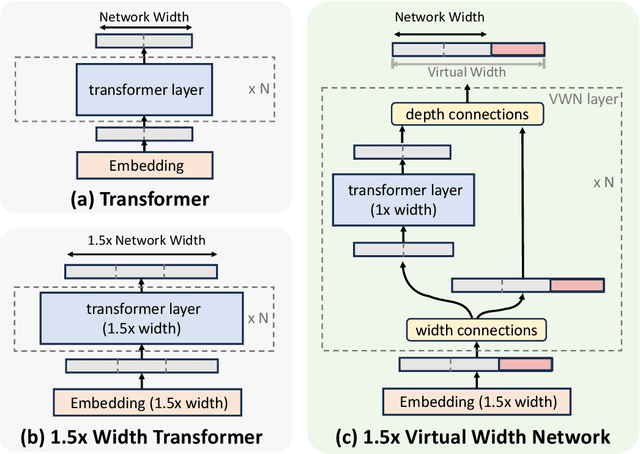
We introduce Virtual Width Networks (VWN), a framework that delivers the benefits of wider representations without incurring the quadratic cost of increasing the hidden size. VWN decouples representational width from backbone width, expanding the embedding space while keeping backbone compute nearly constant. In our large-scale experiment, an 8-times expansion accelerates optimization by over 2 times for next-token and 3 times for next-2-token prediction. The advantage amplifies over training as both the loss gap grows and the convergence-speedup ratio increases, showing that VWN is not only token-efficient but also increasingly effective with scale. Moreover, we identify an approximately log-linear scaling relation between virtual width and loss reduction, offering an initial empirical basis and motivation for exploring virtual-width scaling as a new dimension of large-model efficiency.
MAGA: MAssive Genre-Audience Reformulation to Pretraining Corpus Expansion
Feb 06, 2025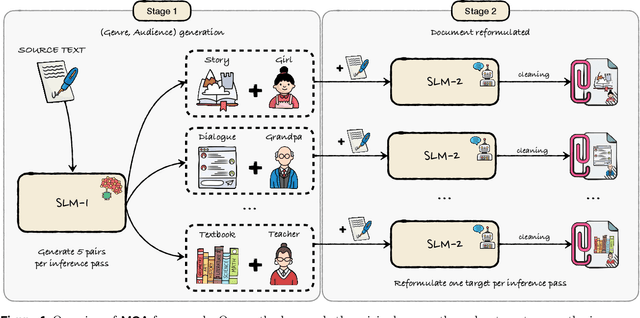


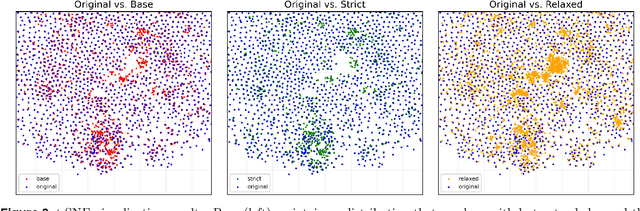
Despite the remarkable capabilities of large language models across various tasks, their continued scaling faces a critical challenge: the scarcity of high-quality pretraining data. While model architectures continue to evolve, the natural language data struggles to scale up. To tackle this bottleneck, we propose \textbf{MA}ssive \textbf{G}enre-\textbf{A}udience~(MAGA) reformulation method, which systematic synthesizes diverse, contextually-rich pretraining data from existing corpus. This work makes three main contributions: (1) We propose MAGA reformulation method, a lightweight and scalable approach for pretraining corpus expansion, and build a 770B tokens MAGACorpus. (2) We evaluate MAGACorpus with different data budget scaling strategies, demonstrating consistent improvements across various model sizes (134M-13B), establishing the necessity for next-generation large-scale synthetic pretraining language models. (3) Through comprehensive analysis, we investigate prompt engineering's impact on synthetic training collapse and reveal limitations in conventional collapse detection metrics using validation losses. Our work shows that MAGA can substantially expand training datasets while maintaining quality, offering a reliably pathway for scaling models beyond data limitations.