 Add to Chrome
 Add to Firefox
 Add to Edge
GVCCTurbo: Rate-Compute Quality Scheduling for Codebook Driven Generative Compression
Aug 04, 2026
Codebook-driven generative compression uses a pretrained image or video generator as a zero-shot visual prior and transmits compact codebook indices to guide reconstruction at ultra-low bitrate. Current codecs tie each finite-rate correction to a fresh prior evaluation, so shortening the sampler also removes correction slots that carry target-dependent information. We propose GVCCTurbo, a BPP-driven scheduler that separates expensive prior refreshes from codebook corrections: after calibrating an atom-count operating point and skip-gap ratio once per protocol, it maps a target codebook-payload bitrate to a trajectory length and refresh period, making BPP a schedule input instead of a fixed consequence of sampler length. The same endpoint-prediction and finite-rate steering interface covers GVCC-style rectified-flow video and DDCM-style diffusion image compression, preserving zero-training deployment and compatibility with future distilled priors. Native 1080p curves position the complete zero-shot codec in the ultra-low-bitrate regime. In a controlled 720p Wan-GVCC study, the scheduler cuts prior evaluations from 20 to 9 for a $\sim\!44\%$ measured decoding-time reduction shared across the whole schedule family, at a small shared LPIPS cost on high-motion content; within that family, uniform refresh thinning (pure-skip) is a boundary point, and the BPP-aware interior point trades $2.9\%$ fewer codebook-payload bits for consistently higher PSNR at comparable LPIPS. These results support BPP-to-compute scheduling as a controllable extension of sampler-length tuning, without requiring the allocated point to dominate every boundary point.

Time Step Generating: A Universal Synthesized Deepfake Image Detector
Nov 20, 2024Currently, high-fidelity text-to-image models are developed in an accelerating pace. Among them, Diffusion Models have led to a remarkable improvement in the quality of image generation, making it vary challenging to distinguish between real and synthesized images. It simultaneously raises serious concerns regarding privacy and security. Some methods are proposed to distinguish the diffusion model generated images through reconstructing. However, the inversion and denoising processes are time-consuming and heavily reliant on the pre-trained generative model. Consequently, if the pre-trained generative model meet the problem of out-of-domain, the detection performance declines. To address this issue, we propose a universal synthetic image detector Time Step Generating (TSG), which does not rely on pre-trained models' reconstructing ability, specific datasets, or sampling algorithms. Our method utilizes a pre-trained diffusion model's network as a feature extractor to capture fine-grained details, focusing on the subtle differences between real and synthetic images. By controlling the time step t of the network input, we can effectively extract these distinguishing detail features. Then, those features can be passed through a classifier (i.e. Resnet), which efficiently detects whether an image is synthetic or real. We test the proposed TSG on the large-scale GenImage benchmark and it achieves significant improvements in both accuracy and generalizability.
Evaluating Large Language Models on Financial Report Summarization: An Empirical Study
Nov 11, 2024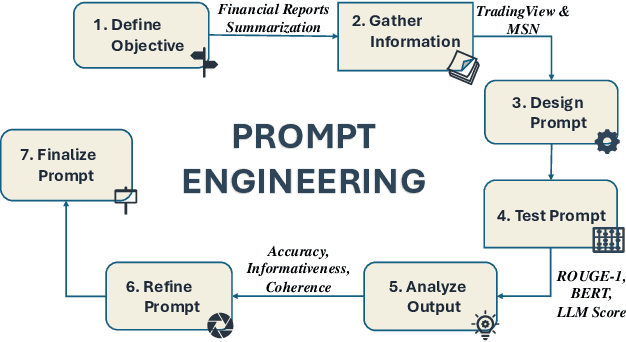
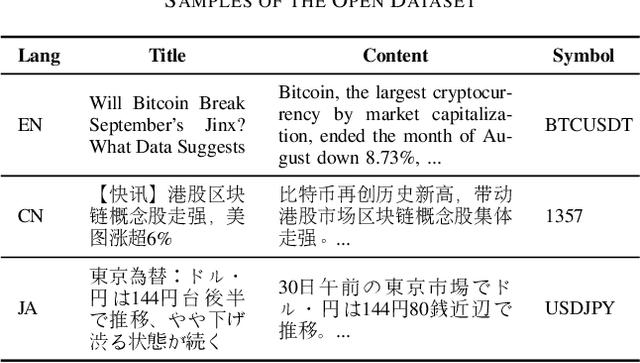
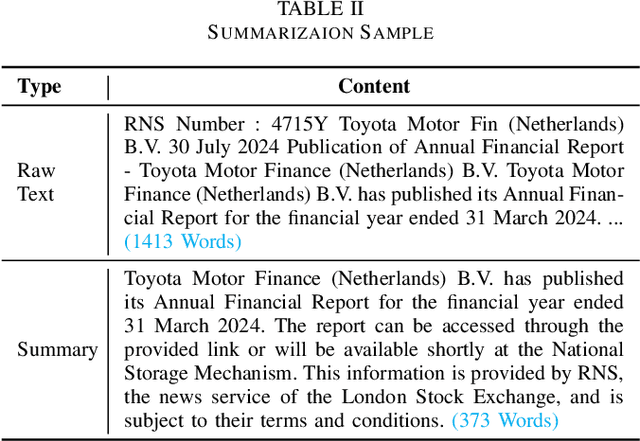
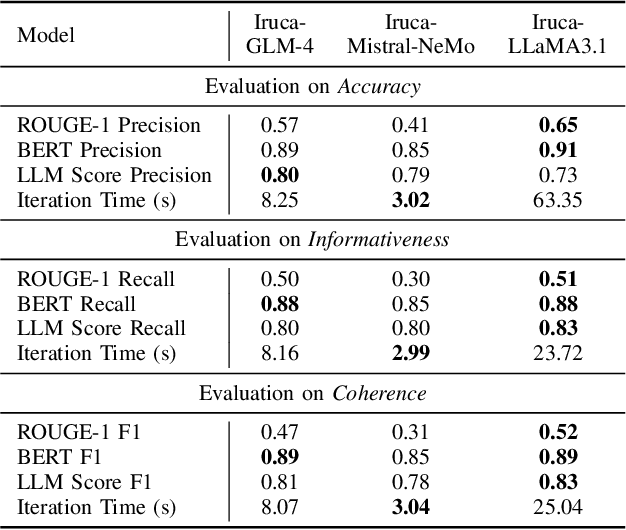
In recent years, Large Language Models (LLMs) have demonstrated remarkable versatility across various applications, including natural language understanding, domain-specific knowledge tasks, etc. However, applying LLMs to complex, high-stakes domains like finance requires rigorous evaluation to ensure reliability, accuracy, and compliance with industry standards. To address this need, we conduct a comprehensive and comparative study on three state-of-the-art LLMs, GLM-4, Mistral-NeMo, and LLaMA3.1, focusing on their effectiveness in generating automated financial reports. Our primary motivation is to explore how these models can be harnessed within finance, a field demanding precision, contextual relevance, and robustness against erroneous or misleading information. By examining each model's capabilities, we aim to provide an insightful assessment of their strengths and limitations. Our paper offers benchmarks for financial report analysis, encompassing proposed metrics such as ROUGE-1, BERT Score, and LLM Score. We introduce an innovative evaluation framework that integrates both quantitative metrics (e.g., precision, recall) and qualitative analyses (e.g., contextual fit, consistency) to provide a holistic view of each model's output quality. Additionally, we make our financial dataset publicly available, inviting researchers and practitioners to leverage, scrutinize, and enhance our findings through broader community engagement and collaborative improvement. Our dataset is available on huggingface.