 Add to Chrome
 Add to Firefox
 Add to Edge
Advancing WordArt-Oriented Scene Text Recognition: Datasets and Methods
Jun 23, 2026
WordArt (artistic text) features highly customized fonts, textures, and layouts, making WordArt-oriented scene TExt Recognition (WATER) substantially more challenging than general Scene Text Recognition (STR). Existing STR datasets and methods, typically built around regular scene text and fixed-template inputs, struggle to scale to WATER. Thus, we aim to advance this task from both data and model perspectives. On the data side, we construct a 2M synthetic dataset, WATER-S, with the scale improved by hundreds of times compared to existing artistic text data. WATER-S consists of two complementary subsets. One rendered by an upgraded rendering pipeline (SynthWordArt), which provides highly accurate and controllable synthetic WordArt data. The other is generated by combining Qwen3-VL for prompt mining and Z-Image for image synthesis, which improves the coverage of realistic and diverse data. On the model side, we propose WATERec. It adopts an visual encoder supporting arbitrary-shaped inputs and an autoregressive decoder to model complex layouts, structurally breaking the bottleneck of fixed-template STR on WordArt. Experiments show that this architecture outperforms prior STR methods, achieving state-of-the-art performance on irregular texts such as WordArt. Together with WATER-R, carefully reorganized from existing real STR data, our strong baseline with the new synthetic data and model design reaches 90.40% accuracy on WordArt-Bench, surpassing both general-purpose and OCR-specialized vision-language models by a large margin. Code and data are available at https://github.com/YesianRohn/WATER.

MuSS: A Large-Scale Dataset and Cinematic Narrative Benchmark for Multi-Shot Subject-to-Video Generation
Apr 26, 2026While video foundation models excel at single-shot generation, real-world cinematic storytelling inherently relies on complex multi-shot sequencing. Further progress is constrained by the absence of datasets that address three core challenges: authentic narrative logic, spatiotemporal text-video alignment conflicts, and the "copy-paste" dilemma prevalent in Subject-to-Video (S2V) generation. To bridge this gap, we introduce MuSS, a large-scale, dual-track dataset tailored for multi-shot video and S2V generation. Sourced from over 3,000 movies, MuSS explicitly supports both complex montage transitions and subject-centric narratives. To construct this dataset, we pioneer a progressive captioning pipeline that eliminates contextual conflicts by ensuring local shot-level accuracy before enforcing global narrative coherence. Crucially, we implement a cross-shot matching mechanism to fundamentally eradicate the S2V copy-paste shortcut. Alongside the dataset, we propose the Cinematic Narrative Benchmark, featuring a visual-logic-driven paradigm and a novel Anti-Copy-Paste Variance (ACP-Var) metric to rigorously assess continuous storytelling and 3D structural consistency. Extensive experiments demonstrate that while current baselines struggle with continuous narrative logic or degenerate into trivial 2D sticker generators, our MuSS-augmented model achieves state-of-the-art narrative effectiveness and cross-shot identity preservation.
ICPR 2026 Competition on Low-Resolution License Plate Recognition
Apr 24, 2026Low-Resolution License Plate Recognition (LRLPR) remains a challenging problem in real-world surveillance scenarios, where long capture distances, compression artifacts, and adverse imaging conditions can severely degrade license plate legibility. To promote progress in this area, we organized the ICPR 2026 Competition on Low-Resolution License Plate Recognition, the first competition specifically dedicated to LRLPR using real low-quality data collected under operationally relevant conditions. The competition was based on the LRLPR-26 dataset, which comprises 20,000 training tracks and 3,000 test tracks; each training track contains five low-resolution and five high-resolution images of the same license plate. Notably, a total of 269 teams from 41 countries registered for the competition, and 99 teams submitted valid entries in the Blind Test Phase. The winning team achieved a Recognition Rate of 82.13%, and four teams surpassed the 80% mark, highlighting both the high level of competition at the top of the leaderboard and the continued difficulty of the task. In addition to presenting the competition design, evaluation protocol, and main results, this paper summarizes the methods adopted by the top-5 teams and discusses current trends and promising directions for future research on LRLPR. The competition webpage is available at https://icpr26lrlpr.github.io/
What Is Wrong with Synthetic Data for Scene Text Recognition? A Strong Synthetic Engine with Diverse Simulations and Self-Evolution
Feb 06, 2026Large-scale and categorical-balanced text data is essential for training effective Scene Text Recognition (STR) models, which is hard to achieve when collecting real data. Synthetic data offers a cost-effective and perfectly labeled alternative. However, its performance often lags behind, revealing a significant domain gap between real and current synthetic data. In this work, we systematically analyze mainstream rendering-based synthetic datasets and identify their key limitations: insufficient diversity in corpus, font, and layout, which restricts their realism in complex scenarios. To address these issues, we introduce UnionST, a strong data engine synthesizes text covering a union of challenging samples and better aligns with the complexity observed in the wild. We then construct UnionST-S, a large-scale synthetic dataset with improved simulations in challenging scenarios. Furthermore, we develop a self-evolution learning (SEL) framework for effective real data annotation. Experiments show that models trained on UnionST-S achieve significant improvements over existing synthetic datasets. They even surpass real-data performance in certain scenarios. Moreover, when using SEL, the trained models achieve competitive performance by only seeing 9% of real data labels.
TextSSR: Diffusion-based Data Synthesis for Scene Text Recognition
Dec 02, 2024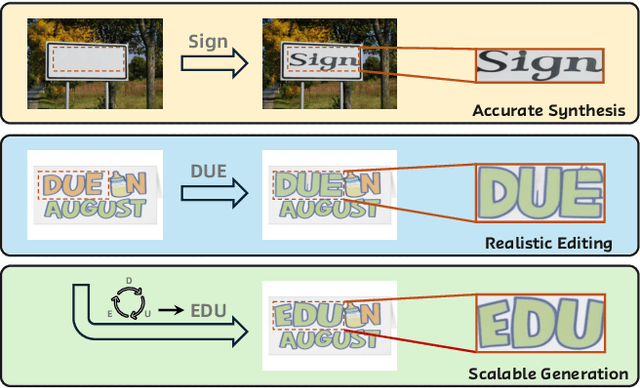
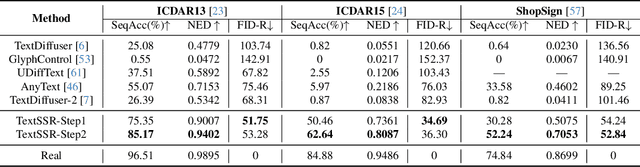
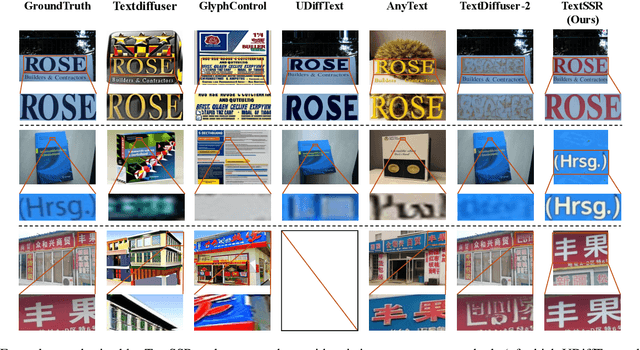
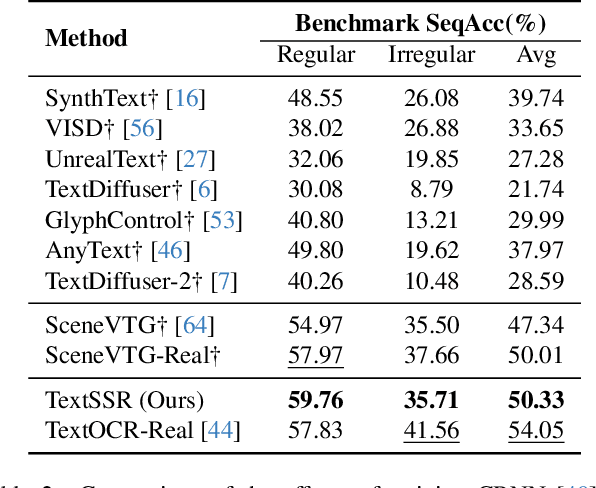
Scene text recognition (STR) suffers from the challenges of either less realistic synthetic training data or the difficulty of collecting sufficient high-quality real-world data, limiting the effectiveness of trained STR models. Meanwhile, despite producing holistically appealing text images, diffusion-based text image generation methods struggle to generate accurate and realistic instance-level text on a large scale. To tackle this, we introduce TextSSR: a novel framework for Synthesizing Scene Text Recognition data via a diffusion-based universal text region synthesis model. It ensures accuracy by focusing on generating text within a specified image region and leveraging rich glyph and position information to create the less complex text region compared to the entire image. Furthermore, we utilize neighboring text within the region as a prompt to capture real-world font styles and layout patterns, guiding the generated text to resemble actual scenes. Finally, due to its prompt-free nature and capability for character-level synthesis, TextSSR enjoys a wonderful scalability and we construct an anagram-based TextSSR-F dataset with 0.4 million text instances with complexity and realism. Experiments show that models trained on added TextSSR-F data exhibit better accuracy compared to models trained on 4 million existing synthetic data. Moreover, its accuracy margin to models trained fully on a real-world dataset is less than 3.7%, confirming TextSSR's effectiveness and its great potential in scene text image synthesis. Our code is available at https://github.com/YesianRohn/TextSSR.
Cross-Modality Safety Alignment
Jun 21, 2024As Artificial General Intelligence (AGI) becomes increasingly integrated into various facets of human life, ensuring the safety and ethical alignment of such systems is paramount. Previous studies primarily focus on single-modality threats, which may not suffice given the integrated and complex nature of cross-modality interactions. We introduce a novel safety alignment challenge called Safe Inputs but Unsafe Output (SIUO) to evaluate cross-modality safety alignment. Specifically, it considers cases where single modalities are safe independently but could potentially lead to unsafe or unethical outputs when combined. To empirically investigate this problem, we developed the SIUO, a cross-modality benchmark encompassing 9 critical safety domains, such as self-harm, illegal activities, and privacy violations. Our findings reveal substantial safety vulnerabilities in both closed- and open-source LVLMs, such as GPT-4V and LLaVA, underscoring the inadequacy of current models to reliably interpret and respond to complex, real-world scenarios.