 Add to Chrome
 Add to Firefox
 Add to Edge
Do Protective Perturbations Really Protect Portrait Privacy under Real-world Image Transformations?
Apr 26, 2026
Proactive defense methods protect portrait images from unauthorized editing or talking face generation (TFG) by introducing pixel-level protective perturbations, and have already attracted increasing attention for privacy protection. In real-world scenarios, images inevitably undergo various transformations during cross-device display and dissemination--such as scale transformations and color compression--that directly alter pixel values. However, it remains unclear whether such pixel-level modifications affect the effectiveness of existing proactive defense methods that rely on pixel-level perturbations. To solve this problem, we conduct a systematic evaluation of representative proactive defenses under image transformation. The evaluated methods are selected to span different generation architectures such as diffusion and GAN-based models, as well as defense scopes covering both portrait and natural images, and are assessed using both qualitative and quantitative metrics for subjective and objective comparison. Experimental results indicate that defense methods based on pixel-level perturbations struggle to withstand common image transformations, posing a risk of defense failure in real-world applications. To further highlight this risk, we propose a simple yet effective purification framework by leveraging the vulnerabilities induced by real-world image transformations. Experimental results demonstrate that the proposed method can efficiently remove protective perturbations with low computational cost, highlighting previously overlooked risks to the research community.

Efficient and Robust Video Defense Framework against 3D-field Personalized Talking Face
Dec 24, 2025State-of-the-art 3D-field video-referenced Talking Face Generation (TFG) methods synthesize high-fidelity personalized talking-face videos in real time by modeling 3D geometry and appearance from reference portrait video. This capability raises significant privacy concerns regarding malicious misuse of personal portraits. However, no efficient defense framework exists to protect such videos against 3D-field TFG methods. While image-based defenses could apply per-frame 2D perturbations, they incur prohibitive computational costs, severe video quality degradation, failing to disrupt 3D information for video protection. To address this, we propose a novel and efficient video defense framework against 3D-field TFG methods, which protects portrait video by perturbing the 3D information acquisition process while maintain high-fidelity video quality. Specifically, our method introduces: (1) a similarity-guided parameter sharing mechanism for computational efficiency, and (2) a multi-scale dual-domain attention module to jointly optimize spatial-frequency perturbations. Extensive experiments demonstrate that our proposed framework exhibits strong defense capability and achieves a 47x acceleration over the fastest baseline while maintaining high fidelity. Moreover, it remains robust against scaling operations and state-of-the-art purification attacks, and the effectiveness of our design choices is further validated through ablation studies. Our project is available at https://github.com/Richen7418/VDF.
Is It Truly Necessary to Process and Fit Minutes-Long Reference Videos for Personalized Talking Face Generation?
Nov 11, 2025Talking Face Generation (TFG) aims to produce realistic and dynamic talking portraits, with broad applications in fields such as digital education, film and television production, e-commerce live streaming, and other related areas. Currently, TFG methods based on Neural Radiated Field (NeRF) or 3D Gaussian sputtering (3DGS) are received widespread attention. They learn and store personalized features from reference videos of each target individual to generate realistic speaking videos. To ensure models can capture sufficient 3D information and successfully learns the lip-audio mapping, previous studies usually require meticulous processing and fitting several minutes of reference video, which always takes hours. The computational burden of processing and fitting long reference videos severely limits the practical application value of these methods.However, is it really necessary to fit such minutes of reference video? Our exploratory case studies show that using some informative reference video segments of just a few seconds can achieve performance comparable to or even better than the full reference video. This indicates that video informative quality is much more important than its length. Inspired by this observation, we propose the ISExplore (short for Informative Segment Explore), a simple-yet-effective segment selection strategy that automatically identifies the informative 5-second reference video segment based on three key data quality dimensions: audio feature diversity, lip movement amplitude, and number of camera views. Extensive experiments demonstrate that our approach increases data processing and training speed by more than 5x for NeRF and 3DGS methods, while maintaining high-fidelity output. Project resources are available at xx.
Facial Features Matter: a Dynamic Watermark based Proactive Deepfake Detection Approach
Nov 22, 2024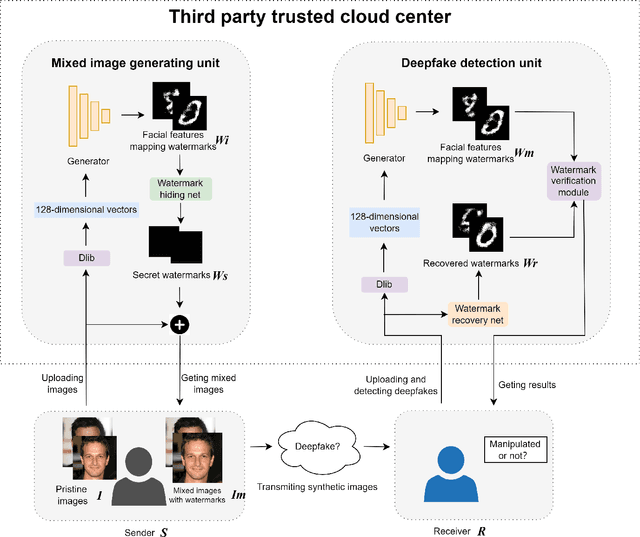

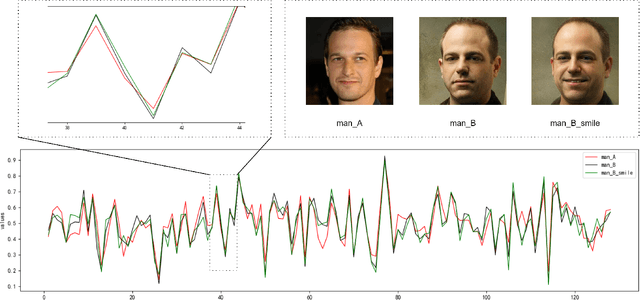
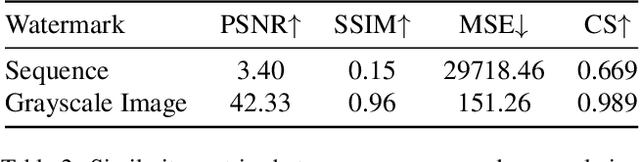
Current passive deepfake face-swapping detection methods encounter significance bottlenecks in model generalization capabilities. Meanwhile, proactive detection methods often use fixed watermarks which lack a close relationship with the content they protect and are vulnerable to security risks. Dynamic watermarks based on facial features offer a promising solution, as these features provide unique identifiers. Therefore, this paper proposes a Facial Feature-based Proactive deepfake detection method (FaceProtect), which utilizes changes in facial characteristics during deepfake manipulation as a novel detection mechanism. We introduce a GAN-based One-way Dynamic Watermark Generating Mechanism (GODWGM) that uses 128-dimensional facial feature vectors as inputs. This method creates irreversible mappings from facial features to watermarks, enhancing protection against various reverse inference attacks. Additionally, we propose a Watermark-based Verification Strategy (WVS) that combines steganography with GODWGM, allowing simultaneous transmission of the benchmark watermark representing facial features within the image. Experimental results demonstrate that our proposed method maintains exceptional detection performance and exhibits high practicality on images altered by various deepfake techniques.