 Add to Chrome
 Add to Firefox
 Add to Edge
SED-FOD: Scattering-Aware Expert Decomposition for Few-Shot Cross-Sensor SAR Object Detection
Aug 19, 2026
Synthetic aperture radar (SAR) object detection is an important part of remote sensing interpretation. However, because of variations in frequency band, resolution, background clutter, and target scattering responses, the performance of existing detectors often degrades when training and testing data are acquired from different SAR domains. Although domain adaptation methods offer a promising paradigm for solving this problem, most of them mainly pursue domain-invariant feature alignment and suppress sensor-dependent scattering characteristics that are useful for object detection. This problem becomes more challenging in few-shot scenarios, where only a few fully annotated target-domain SAR images are available. To address this issue, we propose a scattering-aware shared-specific feature decomposition framework for few-shot SAR domain adaptation object detection. We decompose detection features into a shared path and several soft-gated scattering-specific expert paths. The shared path learns transferable object structural information and is used for asymmetric domain alignment, while the scattering-specific experts adaptively compensate heterogeneous SAR responses. In addition, routing-domain auxiliary loss is introduced to encourage specific experts to capture sensor-dependent routing preferences, and an expert balancing loss is used to prevent routing collapse. Extensive experiments on four bidirectional heterogeneous SAR detection tasks between FARAD-X/FARAD-Ka and MiniSAR under different few-shot settings have been conducted and experimental results demonstrate that the proposed method achieves superior performance in both forward and reverse adaptation directions.

Clutter-Resilient ISAC for Low-Altitude Wireless Networks: A 5G Base Station-Compatible Protocol, Waveform, and Prototype
Mar 15, 2026Integrated sensing and communications (ISAC) has been envisioned as a promising solution to support emerging services in low-altitude wireless networks (LAWNs), where upgrading 5G ground base stations (GBS) toward new active sensing systems with wide coverage, low cost, high accuracy, and favorable spectrum compatibility, is strongly desired. However, such an evolution faces several critical challenges, particularly in the detection and tracking of weak and slow unmanned aerial vehicles (UAVs). These challenges include ISAC waveform design, clutter cancellation resilient to high clutter-to-noise ratios (CNRs), and efficient Doppler separation between UAVs and clutter. To that end, we summarize potential solutions and raise a comprehensive framework on implementing the 5Gadvanced (5G-A) GBS. Outfield experiments demonstrate that the developed 5G-A GBS can effectively track weak and slow targets at distances exceeding 1 kilometer, while incurring only a 1.2% downlink rate loss relative to commercial 5G-A GBS.
The First Airborne Experiment of Sparse Microwave Imaging: Prototype System Design and Result Analysis
Oct 20, 2021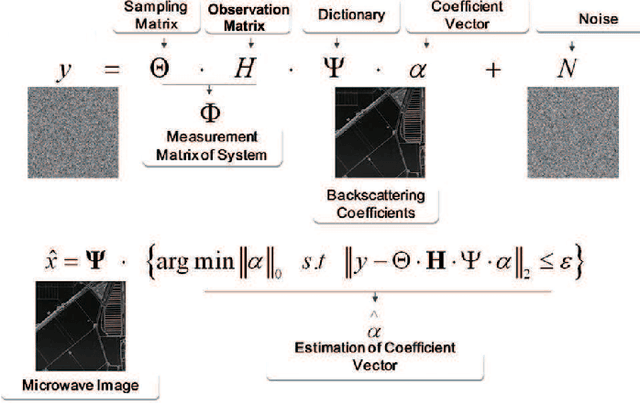
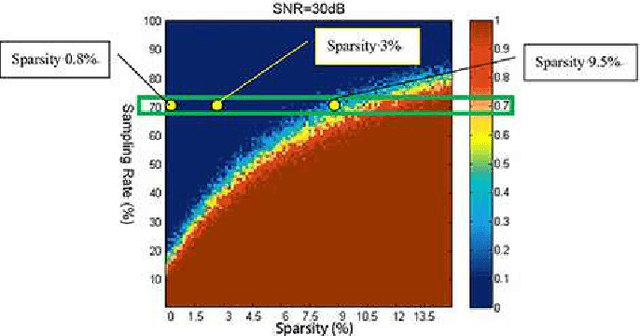
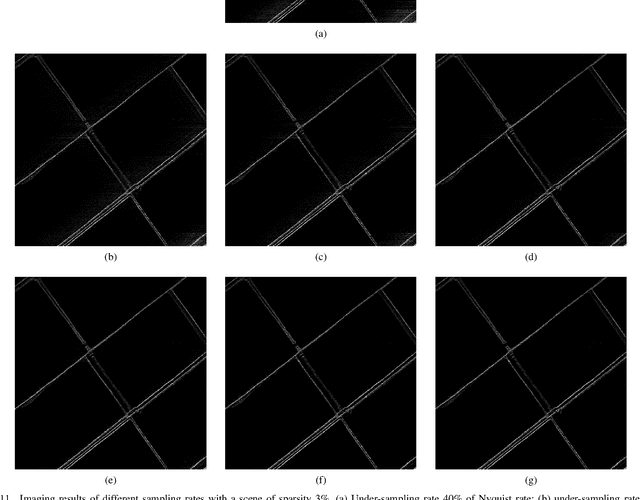
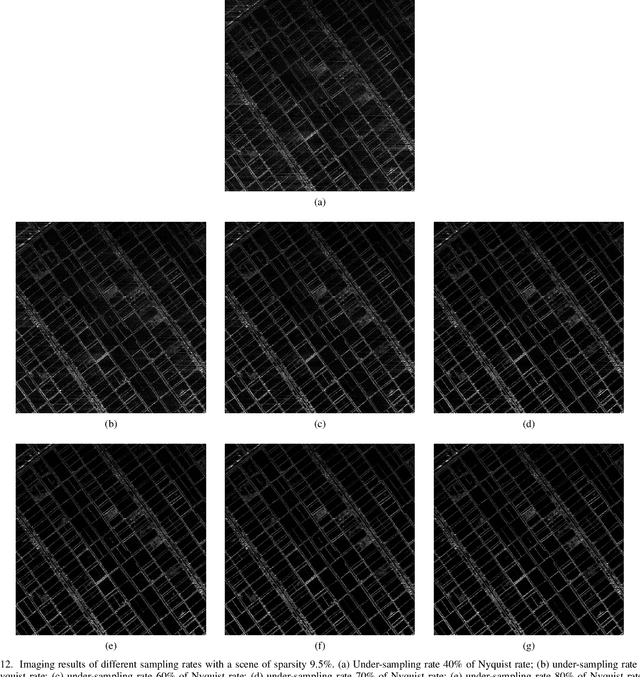
In this paper we report the first airborne experiments of sparse microwave imaging, conducted in September 2013 and May 2014, using our prototype sparse microwave imaging radar system. This is the first reported imaging radar system and airborne experiment that specially designed for sparse microwave imaging. Sparse microwave imaging is a novel concept of radar imaging, it is mainly the combination of traditional radar imaging technology and newly developed sparse signal processing theory, achieving benefits in both improving the imaging quality of current microwave imaging systems and designing optimized sparse microwave imaging radar system to reduce system sampling rate towards the sparse target scenes. During recent years, many researchers focus on related topics of sparse microwave imaging, but rarely few paid attention to prototype system design and experiment. We introduce our prototype sparse microwave imaging radar system, including its system design, hardware considerations and signal processing methods. Several design principles should be considered during the system designing, including the sampling scheme, antenna, SNR, waveform, resolution, etc. We select jittered sampling in azimuth and uniform sampling in range to balance the system complexity and performance. The imaging algorithm is accelerated $\ell_q$ regularization algorithm. To test the prototype radar system and verify the effectiveness of sparse microwave imaging framework, airborne experiments are carried out using our prototype system and we achieve the first sparse microwave image successfully. We analyze the imaging performance of prototype sparse microwave radar system with different sparsities, sampling rates, SNRs and sampling schemes, using three-dimensional phase transit diagram as the evaluation tool.