 Add to Chrome
 Add to Firefox
 Add to Edge
4KDehazeFlow: Ultra-High-Definition Image Dehazing via Flow Matching
Nov 12, 2025
Ultra-High-Definition (UHD) image dehazing faces challenges such as limited scene adaptability in prior-based methods and high computational complexity with color distortion in deep learning approaches. To address these issues, we propose 4KDehazeFlow, a novel method based on Flow Matching and the Haze-Aware vector field. This method models the dehazing process as a progressive optimization of continuous vector field flow, providing efficient data-driven adaptive nonlinear color transformation for high-quality dehazing. Specifically, our method has the following advantages: 1) 4KDehazeFlow is a general method compatible with various deep learning networks, without relying on any specific network architecture. 2) We propose a learnable 3D lookup table (LUT) that encodes haze transformation parameters into a compact 3D mapping matrix, enabling efficient inference through precomputed mappings. 3) We utilize a fourth-order Runge-Kutta (RK4) ordinary differential equation (ODE) solver to stably solve the dehazing flow field through an accurate step-by-step iterative method, effectively suppressing artifacts. Extensive experiments show that 4KDehazeFlow exceeds seven state-of-the-art methods. It delivers a 2dB PSNR increase and better performance in dense haze and color fidelity.

Ultra-High-Definition Dynamic Multi-Exposure Image Fusion via Infinite Pixel Learning
Dec 16, 2024
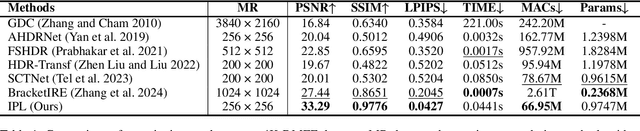
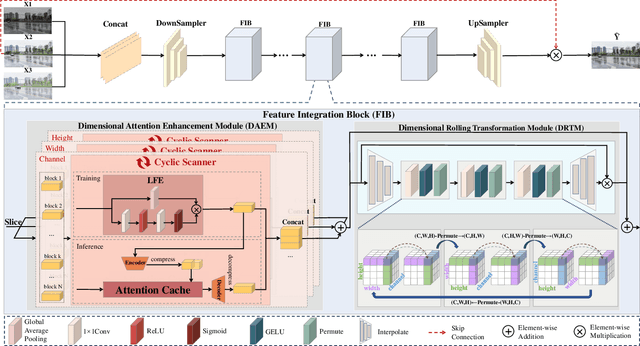
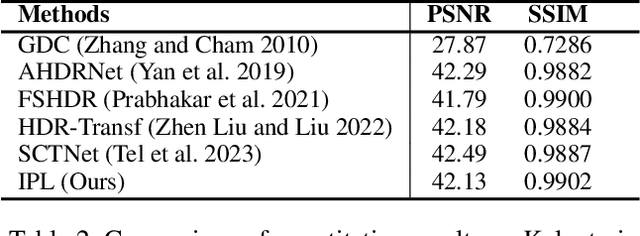
With the continuous improvement of device imaging resolution, the popularity of Ultra-High-Definition (UHD) images is increasing. Unfortunately, existing methods for fusing multi-exposure images in dynamic scenes are designed for low-resolution images, which makes them inefficient for generating high-quality UHD images on a resource-constrained device. To alleviate the limitations of extremely long-sequence inputs, inspired by the Large Language Model (LLM) for processing infinitely long texts, we propose a novel learning paradigm to achieve UHD multi-exposure dynamic scene image fusion on a single consumer-grade GPU, named Infinite Pixel Learning (IPL). The design of our approach comes from three key components: The first step is to slice the input sequences to relieve the pressure generated by the model processing the data stream; Second, we develop an attention cache technique, which is similar to KV cache for infinite data stream processing; Finally, we design a method for attention cache compression to alleviate the storage burden of the cache on the device. In addition, we provide a new UHD benchmark to evaluate the effectiveness of our method. Extensive experimental results show that our method maintains high-quality visual performance while fusing UHD dynamic multi-exposure images in real-time (>40fps) on a single consumer-grade GPU.