 Add to Chrome
 Add to Firefox
 Add to Edge
HUGIN: Enhancing Vision-Language Planning for Autonomous Logistics Sorting
Aug 12, 2026
Autonomous logistics sorting systems (ALSS) are an important industrial application of embodied AI, which requires joint planning over spatially disjoint camera views. We formulate this setting as Joint Multi-Scene Understanding (JMSU). With open-world visual understanding and task-planning capabilities, vision-language models (VLMs) are promising candidates for JMSU. However, directly applying existing VLMs to JMSU is non-trivial due to scarce cross-scene supervision and attention dispersion caused by long visual context in JMSU. To address these challenges, we propose HUGIN, a training framework with two complementary components. Endogenous Data Augmentation recombines verified atomic facts under operating constraints, while Global Context Ranking aligns the instruction representation more strongly with the complete visual context than with a partial visual context. To support ongoing research, we construct a high-quality industrial sorting dataset and benchmark named SortingBench from four layouts of autonomous logistics sorting systems. Across five open VLMs, HUGIN consistently outperforms matched baselines; for example, the accuracy on SortingBench of Qwen3-VL-8B increases from 63.6% to 78.8%. Additional experiments verify the effectiveness of each component and JMSU's spillover benefits in embodied tasks. Deployment tests involving more than 15,000 packages support the practical viability of VLM-based planning for autonomous logistics sorting.

Motion-as-Prompt: Enhancing Motion Reasoning in Multimodal Large Language Models via Motion-Guided Cross-Frame Visual Prompting
Aug 12, 2026Motion-centric video reasoning is fundamental to interactive applications such as robotic manipulation and autonomous navigation. However, multimodal large language models (MLLMs) typically process videos through sparse uniform sampling to control visual-token and attention costs. This strategy may discard critical transitions between sampled frames, limiting reasoning about object movement, collisions, and causal interactions. To mitigate this issue, we propose Motion-as-Prompt (MaP), a track-guided cross-frame visual prompting framework. MaP recovers dense point trajectories, selects motion-informative frames, and marks the trajectories accumulated between consecutive sampled frames directly onto the visual inputs, making otherwise hidden displacement, direction changes, and interactions observable to frozen MLLMs. Experiments on CLEVRER and Something-Something-v2 show that MaP consistently improves average motion-reasoning accuracy, yielding gains of 4.2% and 8.9% for GPT-5.5, respectively. Notably, these improvements are obtained without degrading non-motion understanding, highlighting the robustness of MaP. These results demonstrate that MaP provides a simple and effective solution for enhancing motion-centric video reasoning without model training or architectural modification. Project page:https://github.com/SunVictor23/MaP.
SynSeg: Feature Synergy for Multi-Category Contrastive Learning in Open-Vocabulary Semantic Segmentation
Aug 08, 2025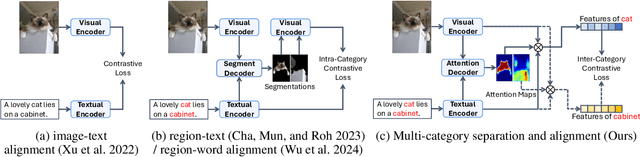
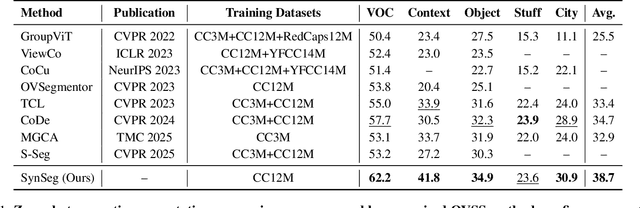
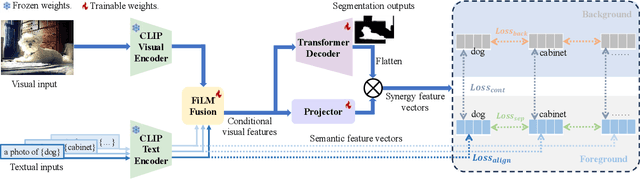
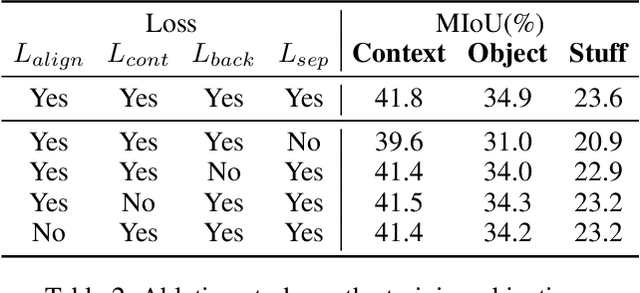
Semantic segmentation in open-vocabulary scenarios presents significant challenges due to the wide range and granularity of semantic categories. Existing weakly-supervised methods often rely on category-specific supervision and ill-suited feature construction methods for contrastive learning, leading to semantic misalignment and poor performance. In this work, we propose a novel weakly-supervised approach, SynSeg, to address the challenges. SynSeg performs Multi-Category Contrastive Learning (MCCL) as a stronger training signal with a new feature reconstruction framework named Feature Synergy Structure (FSS). Specifically, MCCL strategy robustly combines both intra- and inter-category alignment and separation in order to make the model learn the knowledge of correlations from different categories within the same image. Moreover, FSS reconstructs discriminative features for contrastive learning through prior fusion and semantic-activation-map enhancement, effectively avoiding the foreground bias introduced by the visual encoder. In general, SynSeg effectively improves the abilities in semantic localization and discrimination under weak supervision. Extensive experiments on benchmarks demonstrate that our method outperforms state-of-the-art (SOTA) performance. For instance, SynSeg achieves higher accuracy than SOTA baselines by 4.5\% on VOC, 8.9\% on Context, 2.6\% on Object and 2.0\% on City.
Palantir: Towards Efficient Super Resolution for Ultra-high-definition Live Streaming
Aug 12, 2024Neural enhancement through super-resolution deep neural networks opens up new possibilities for ultra-high-definition live streaming over existing encoding and networking infrastructure. Yet, the heavy SR DNN inference overhead leads to severe deployment challenges. To reduce the overhead, existing systems propose to apply DNN-based SR only on selected anchor frames while upscaling non-anchor frames via the lightweight reusing-based SR approach. However, frame-level scheduling is coarse-grained and fails to deliver optimal efficiency. In this work, we propose Palantir, the first neural-enhanced UHD live streaming system with fine-grained patch-level scheduling. In the presented solutions, two novel techniques are incorporated to make good scheduling decisions for inference overhead optimization and reduce the scheduling latency. Firstly, under the guidance of our pioneering and theoretical analysis, Palantir constructs a directed acyclic graph (DAG) for lightweight yet accurate quality estimation under any possible anchor patch set. Secondly, to further optimize the scheduling latency, Palantir improves parallelizability by refactoring the computation subprocedure of the estimation process into a sparse matrix-matrix multiplication operation. The evaluation results suggest that Palantir incurs a negligible scheduling latency accounting for less than 5.7% of the end-to-end latency requirement. When compared to the state-of-the-art real-time frame-level scheduling strategy, Palantir reduces the energy overhead of SR-integrated mobile clients by 38.1% at most (and 22.4% on average) and the monetary costs of cloud-based SR by 80.1% at most (and 38.4% on average).