 Add to Chrome
 Add to Firefox
 Add to Edge
US-VLA: An Ultrasound Vision-Language-Action Model for Embodied Abdomina
Aug 17, 2026
Artificial intelligence-assisted ultrasound scanning enhances diagnostic reliability and efficiency by providing real-time guidance for standardized image acquisition and reducing operator dependence. However, existing reinforcement learning and learning-assisted ultrasound scanning methods typically rely on carefully designed reward functions or extensive interaction data, which limits their generalization ability and stability across different devices, patient populations, and complex clinical scenarios. To address these challenges, we propose an ultrasound vision-language-action model (US-VLA) for automated ultrasound scanning that explicitly encodes clinical semantic goals and generates sequential probe manipulation actions under real-time ultrasound feedback. In particular, we first design an ultrasound-aware expert fusion module to jointly integrate ultrasound observations with auxiliary contextual information, enabling semantic ultrasound feedback to effectively guide the scanning process. Then, we construct US-VLA-Data, a real-world dataset covering liver and kidney examinations, which includes five clinically defined standard planes and comprises 320 expert scanning trajectories with approximately 80,000 synchronized timesteps. Extensive experiments demonstrate that US-VLA achieves competitive performance in ultrasound probe manipulation tasks, indicating its effectiveness and promising generalization within the evaluated abdominal ultrasound setting. The source code is available at https://github.com/VMVLab/US-VLA.

ForceU-VLA: A Force-Aware Vision-Language-Action Model for Embodied Ultrasound Scanning
Aug 15, 2026Embodied intelligent ultrasound scanning enables the automation and standardization of the ultrasound examination process by integrating perception, decision-making, and execution capabilities. However, existing methods suffer from loosely coupled modeling between force and ultrasound modalities and lack awareness of scanning stages, which limits their ability to capture dynamic probe-tissue interactions. To address these issues, we propose ForceU-VLA, a force-aware Vision-Language-Action model for autonomous embodied ultrasound scanning, which leverages force signals and ultrasound image feedback throughout the scanning process to enable accurate and high-quality ultrasound acquisition. Firstly, we propose a Force-Ultrasound Synergistic Fusion Module (FUSFM) that synergistically fuses ultrasound visual and force-feedback information to provide stable, reliable guidance for probe motion. Secondly, a Stage-Adaptive Modulation Mechanism (SAMM) is proposed to accommodate the task requirements across different scanning stages by adaptively modulating multimodal features to enhance their representation quality. Additionally, we introduce ForceU-VLA-Data, a real-world, force-aware embodied ultrasound dataset that integrates visual, force, and action signals, including data from two organs across five representative clinical scanning views, and comprising 450 expert-collected trajectories with approximately 100,000 synchronized multimodal frames. Extensive experimental results demonstrate that ForceU-VLA significantly improves contact stability and probe pressure regulation in embodied ultrasound scanning, thereby effectively enhancing task execution quality and overall system reliability. The source code is available at https://github.com/VMVLab/ForceU-VLA.
Shared and Private Information Learning in Multimodal Sentiment Analysis with Deep Modal Alignment and Self-supervised Multi-Task Learning
May 15, 2023Designing an effective representation learning method for multimodal sentiment analysis tasks is a crucial research direction. The challenge lies in learning both shared and private information in a complete modal representation, which is difficult with uniform multimodal labels and a raw feature fusion approach. In this work, we propose a deep modal shared information learning module based on the covariance matrix to capture the shared information between modalities. Additionally, we use a label generation module based on a self-supervised learning strategy to capture the private information of the modalities. Our module is plug-and-play in multimodal tasks, and by changing the parameterization, it can adjust the information exchange relationship between the modes and learn the private or shared information between the specified modes. We also employ a multi-task learning strategy to help the model focus its attention on the modal differentiation training data. We provide a detailed formulation derivation and feasibility proof for the design of the deep modal shared information learning module. We conduct extensive experiments on three common multimodal sentiment analysis baseline datasets, and the experimental results validate the reliability of our model. Furthermore, we explore more combinatorial techniques for the use of the module. Our approach outperforms current state-of-the-art methods on most of the metrics of the three public datasets.
Multimodal Sentiment Analysis: A Survey
May 12, 2023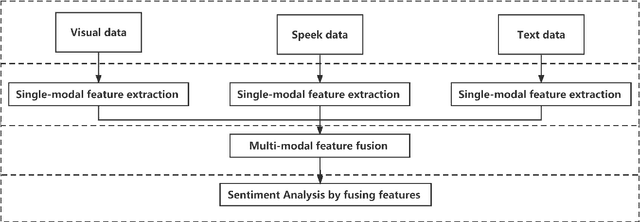
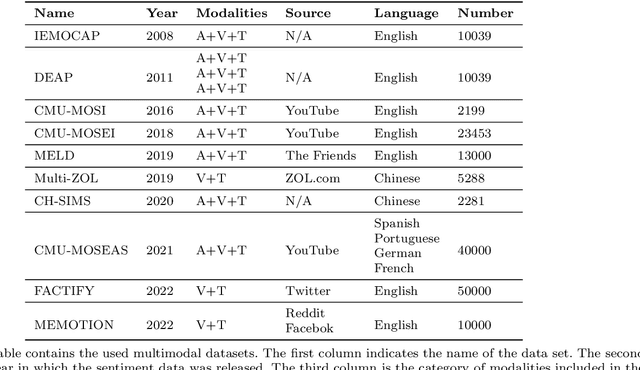
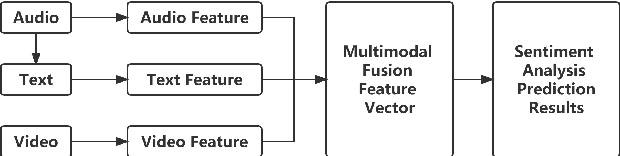
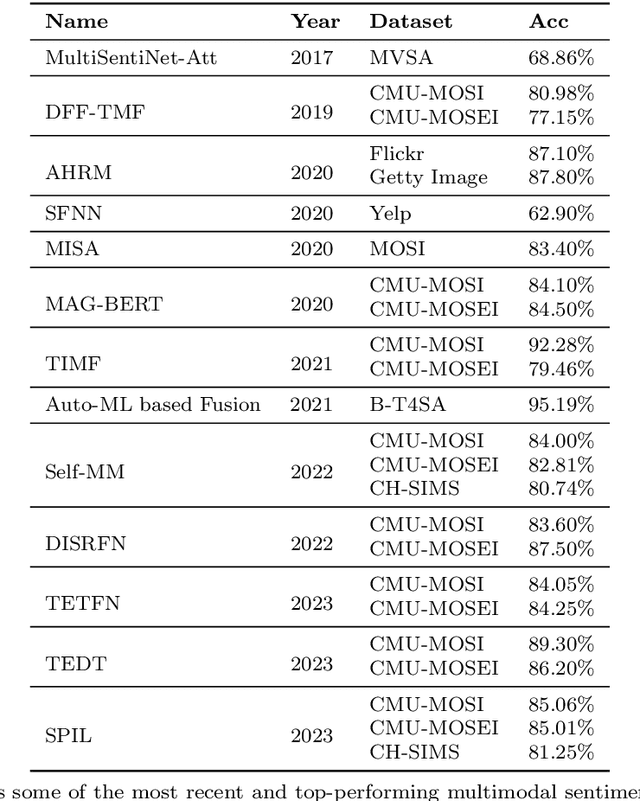
Multimodal sentiment analysis has become an important research area in the field of artificial intelligence. With the latest advances in deep learning, this technology has reached new heights. It has great potential for both application and research, making it a popular research topic. This review provides an overview of the definition, background, and development of multimodal sentiment analysis. It also covers recent datasets and advanced models, emphasizing the challenges and future prospects of this technology. Finally, it looks ahead to future research directions. It should be noted that this review provides constructive suggestions for promising research directions and building better performing multimodal sentiment analysis models, which can help researchers in this field.