 Add to Chrome
 Add to Firefox
 Add to Edge
Heterogeneous SAR-optical fusion for near-real-time land use and land cover mapping under cloud contamination: A novel framework and global benchmark dataset
Jun 16, 2026
Optical remote sensing imagery is frequently degraded by cloud and cloud-shadow contamination, which limits its reliability for near-real-time land use and land cover (LULC) mapping. Although synthetic aperture radar (SAR) can provide cloud-penetrating structural information, existing SAR-optical fusion methods often assume reliable optical observations and insufficiently address the semantic uncertainty introduced by cloud contamination. To address this issue, we propose CloudLULC-Net, an end-to-end heterogeneous SAR-optical fusion framework that directly predicts LULC maps from cloud-contaminated Sentinel-2 imagery and temporally adjacent Sentinel-1 SAR observations. The proposed network incorporates optical reliability modulation to suppress unreliable optical responses, heterogeneous information adaptive aggregation to model high-order spatial-channel interactions between optical and SAR representations, and a unified semantic mapping transformer to organize fused features in a LULC-oriented latent space. A semantic anchor-guided optimization strategy is further introduced to improve the consistency of intermediate semantic representations. To support this task, we construct CloudLULC-Set, a large-scale benchmark dataset containing 40,223 curated SAR-optical-label triplets with pixel-level LULC annotations across diverse geographic regions and cloud conditions. Experimental results show that CloudLULC-Net achieves an OA of 86.60%, an F1-score of 83.29%, and an mIoU of 73.51%, outperforming representative heterogeneous reconstruction-first and end-to-end SAR-optical mapping methods. Comparisons with existing global LULC products and analyses under different cloud-cover levels further demonstrate the robustness and practical value of CloudLULC-Net for target-date LULC mapping in cloud-prone regions.The project is publicly available at: https://github.com/RSIIPAC/CloudLULC

A Data-Center FPGA Acceleration Platform for Convolutional Neural Networks
Sep 17, 2019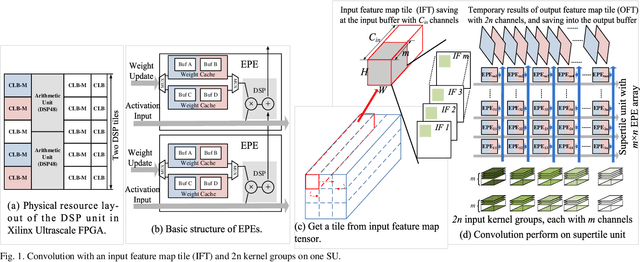
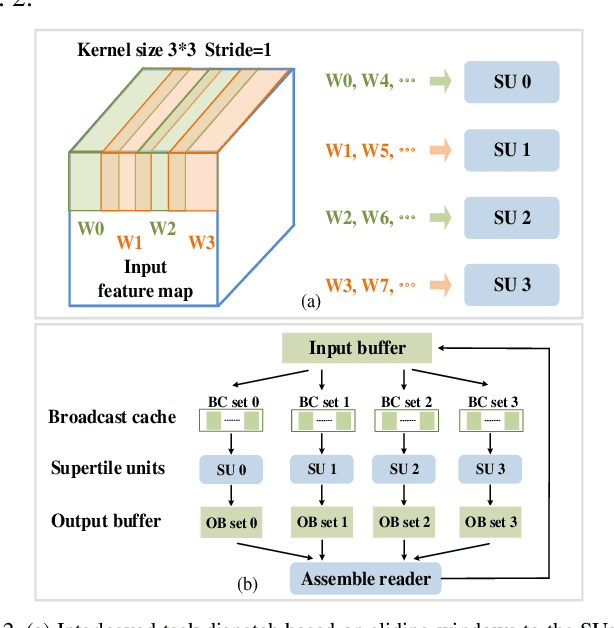
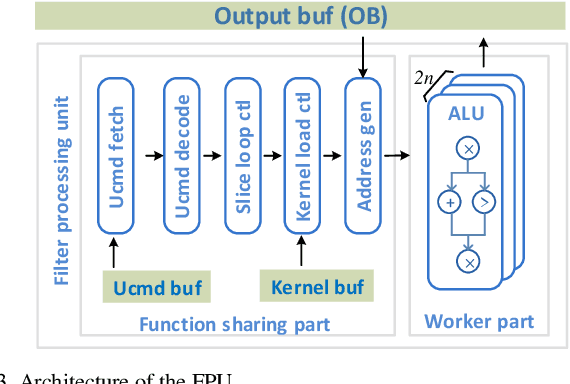
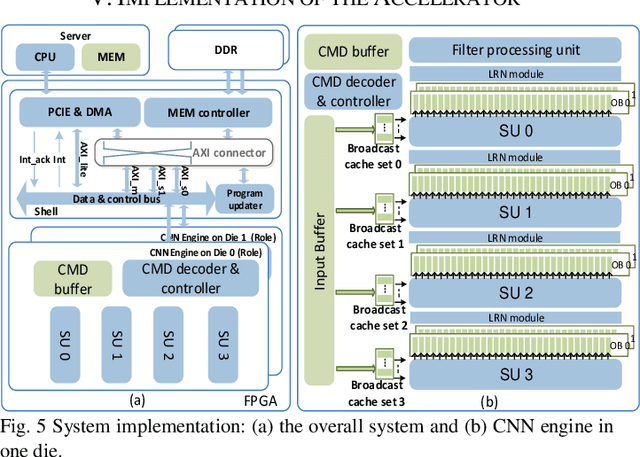
Intensive computation is entering data centers with multiple workloads of deep learning. To balance the compute efficiency, performance, and total cost of ownership (TCO), the use of a field-programmable gate array (FPGA) with reconfigurable logic provides an acceptable acceleration capacity and is compatible with diverse computation-sensitive tasks in the cloud. In this paper, we develop an FPGA acceleration platform that leverages a unified framework architecture for general-purpose convolutional neural network (CNN) inference acceleration at a data center. To overcome the computation bound, 4,096 DSPs are assembled and shaped as supertile units (SUs) for different types of convolution, which provide up to 4.2 TOP/s 16-bit fixed-point performance at 500 MHz. The interleaved-task-dispatching method is proposed to map the computation across the SUs, and the memory bound is solved by a dispatching-assembling buffering model and broadcast caches. For various non-convolution operators, a filter processing unit is designed for general-purpose filter-like/pointwise operators. In the experiment, the performances of CNN models running on server-class CPUs, a GPU, and an FPGA are compared. The results show that our design achieves the best FPGA peak performance and a throughput at the same level as that of the state-of-the-art GPU in data centers, with more than 50 times lower latency.