 Add to Chrome
 Add to Firefox
 Add to Edge
CCKS: Consensus-based Communication and Knowledge Sharing
Jun 10, 2026
In Decentralized Training and Decentralized Execution (DTDE) for cooperative Multi-Agent Reinforcement Learning (MARL), action-advising-based knowledge sharing promotes interpretable and scalable cooperation among agents. However, current action advising approaches often adhere too much to the teacher's guidance without evaluating teacher-student compatibility, which causes excessive advising, suboptimal stability, and degraded performance. To overcome these challenges, this paper presents a Consensus-based Communication and Knowledge Sharing (CCKS) framework, which allows agents to adopt recommendations based on consensus-derived constraints and to follow the teacher's instructions more smartly. This mechanism enables agents to balance exploration and learning from experienced teachers, improving overall performance. The key is the consensus model construction, for which we propose to employ contrastive learning to construct consensus models based on local observations in the agents' training phase. In action selection, agents score and choose actions based on consensus and shared knowledge. Designed as a plug-and-play solution, CCKS integrates seamlessly with existing DTDE algorithms. Experiments conducted in the Google Research Football environment and the complex StarCraft II Multi-Agent Challenge demonstrate that the integration with CCKS significantly improves cooperation efficiency, learning speed, and overall performance compared with current DTDE baselines. The code is available at https://github.com/yuanxpy/CCKS.

DecisionLLM: Large Language Models for Long Sequence Decision Exploration
Jan 15, 2026Long-sequence decision-making, which is usually addressed through reinforcement learning (RL), is a critical component for optimizing strategic operations in dynamic environments, such as real-time bidding in computational advertising. The Decision Transformer (DT) introduced a powerful paradigm by framing RL as an autoregressive sequence modeling problem. Concurrently, Large Language Models (LLMs) have demonstrated remarkable success in complex reasoning and planning tasks. This inspires us whether LLMs, which share the same Transformer foundation, but operate at a much larger scale, can unlock new levels of performance in long-horizon sequential decision-making problem. This work investigates the application of LLMs to offline decision making tasks. A fundamental challenge in this domain is the LLMs' inherent inability to interpret continuous values, as they lack a native understanding of numerical magnitude and order when values are represented as text strings. To address this, we propose treating trajectories as a distinct modality. By learning to align trajectory data with natural language task descriptions, our model can autoregressively predict future decisions within a cohesive framework we term DecisionLLM. We establish a set of scaling laws governing this paradigm, demonstrating that performance hinges on three factors: model scale, data volume, and data quality. In offline experimental benchmarks and bidding scenarios, DecisionLLM achieves strong performance. Specifically, DecisionLLM-3B outperforms the traditional Decision Transformer (DT) by 69.4 on Maze2D umaze-v1 and by 0.085 on AuctionNet. It extends the AIGB paradigm and points to promising directions for future exploration in online bidding.
360-LLaMA-Factory: Plug & Play Sequence Parallelism for Long Post-Training
May 28, 2025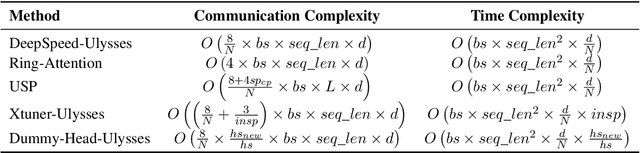
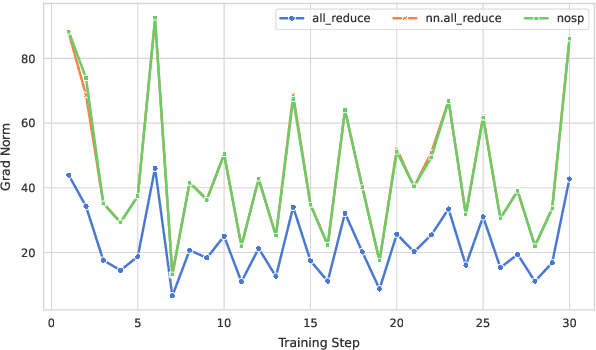
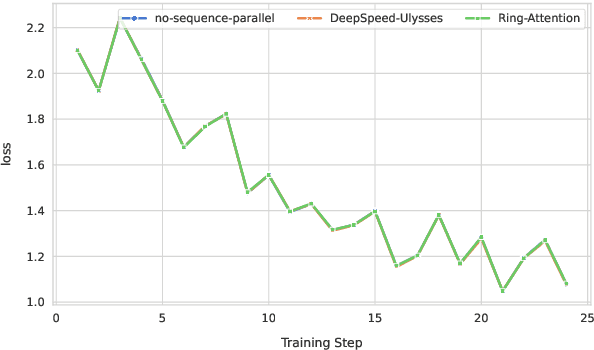
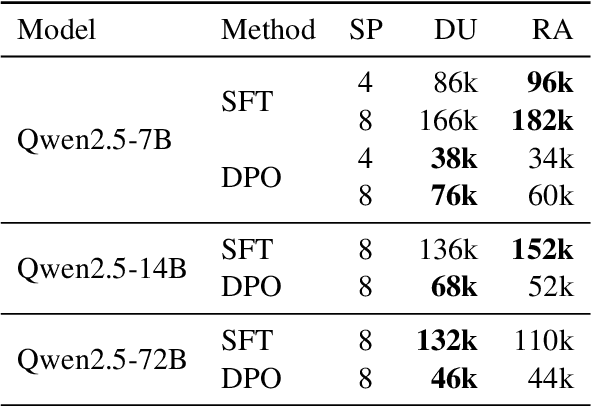
Adding sequence parallelism into LLaMA-Factory, we open-sourced 360-LLaMA-Factory at https://github.com/Qihoo360/360-LLaMA-Factory. 360-LLaMA-Factory has received wide recognition and used in models such as Light-R1 arXiv:2503.10460, TinyR1 arXiv:2503.04872, Kaggle AIMO math models and also in large companies' training frameworks. This technical report delves deeper into the different sequence parallel modes behind 360-LLaMA-Factory and discusses our implementation insights.
Light-R1: Curriculum SFT, DPO and RL for Long COT from Scratch and Beyond
Mar 13, 2025This paper presents our work on the Light-R1 series, with models, data, and code all released. We first focus on training long COT models from scratch, specifically starting from models initially lacking long COT capabilities. Using a curriculum training recipe consisting of two-stage SFT and semi-on-policy DPO, we train our model Light-R1-32B from Qwen2.5-32B-Instruct, resulting in superior math performance compared to DeepSeek-R1-Distill-Qwen-32B. Despite being trained exclusively on math data, Light-R1-32B shows strong generalization across other domains. In the subsequent phase of this work, we highlight the significant benefit of the 3k dataset constructed for the second SFT stage on enhancing other models. By fine-tuning DeepSeek-R1-Distilled models using this dataset, we obtain new SOTA models in 7B and 14B, while the 32B model, Light-R1-32B-DS performed comparably to QwQ-32B and DeepSeek-R1. Furthermore, we extend our work by applying reinforcement learning, specifically GRPO, on long-COT models to further improve reasoning performance. We successfully train our final Light-R1-14B-DS with RL, achieving SOTA performance among 14B parameter models in math. With AIME24 & 25 scores of 74.0 and 60.2 respectively, Light-R1-14B-DS surpasses even many 32B models and DeepSeek-R1-Distill-Llama-70B. Its RL training also exhibits well expected behavior, showing simultaneous increase in response length and reward score. The Light-R1 series of work validates training long-COT models from scratch, showcases the art in SFT data and releases SOTA models from RL.