 Add to Chrome
 Add to Firefox
 Add to Edge
ELICITED: EHR-grounded Longitudinal Interactive Conversations for Information-seeking Triage Evaluation and Decision-making
Aug 10, 2026
Emergency-department (ED) triage requires clinicians to rapidly identify patients who need immediate attention, determine who can safely wait, and prioritize limited clinical resources. At presentation, however, information may be limited to a chief complaint and initial vital signs. Clinically important details, including symptom onset and progression, associated symptoms, medical history, and medication use, are often obtained through focused conversation. Effective triage therefore requires clinicians to identify information gaps, ask appropriate follow-up questions, and update their assessment as new evidence becomes available. Most existing ED benchmarks evaluate acuity prediction from a fixed clinical snapshot. Although this formulation measures predictive performance after patient information has been assembled, it does not capture the interactive process through which triage-relevant evidence is elicited and interpreted. Existing medical dialogue datasets support the study of clinical communication, but dialogue statements are not always linked to temporally ordered events in the electronic health record (EHR). We introduce EHR2Dial-Triage, an agentic conversation-generation framework and benchmark grounded in MIMIC-IV-ED. The framework constructs triage conversations under explicit role-based and temporal information boundaries. Each accepted patient disclosure is linked to its supporting EHR event and the first dialogue turn at which it becomes available. EHR2Dial-Triage enables controlled evaluation of information elicitation, evidence use, five-level Emergency Severity Index prediction, and patient-facing communication across models and patient personas. It provides a structured setting for studying conversational triage as a dynamic process of clinical information acquisition, reasoning, and communication.

Knowing your FATE: Friendship, Action and Temporal Explanations for User Engagement Prediction on Social Apps
Jun 15, 2020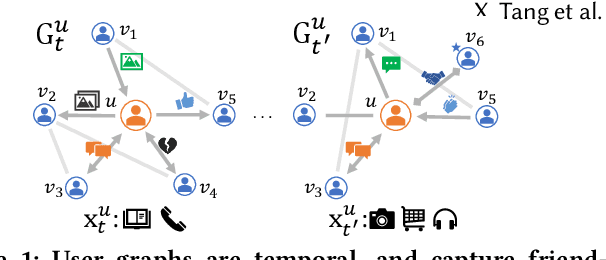
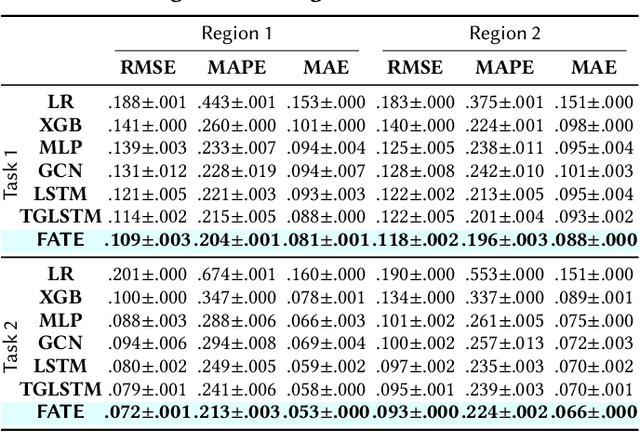
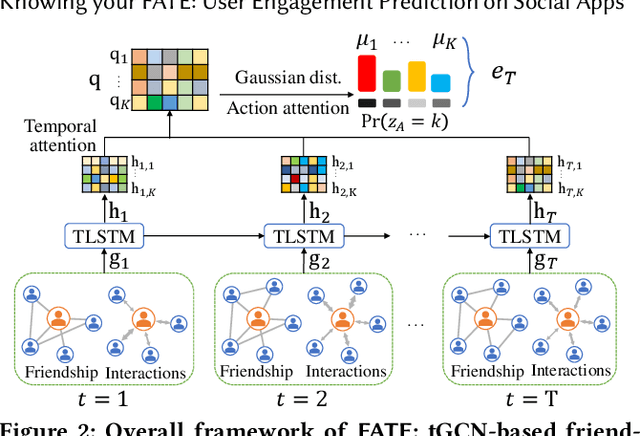
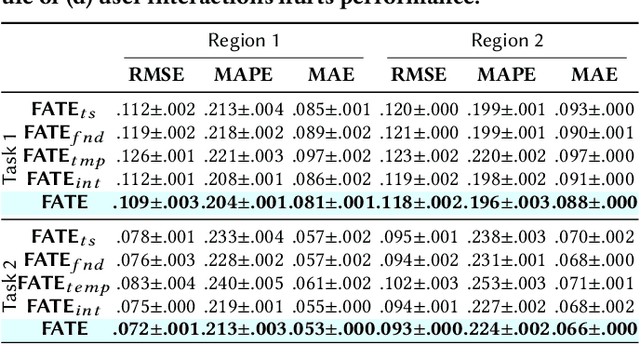
With the rapid growth and prevalence of social network applications (Apps) in recent years, understanding user engagement has become increasingly important, to provide useful insights for future App design and development. While several promising neural modeling approaches were recently pioneered for accurate user engagement prediction, their black-box designs are unfortunately limited in model explainability. In this paper, we study a novel problem of explainable user engagement prediction for social network Apps. First, we propose a flexible definition of user engagement for various business scenarios, based on future metric expectations. Next, we design an end-to-end neural framework, FATE, which incorporates three key factors that we identify to influence user engagement, namely friendships, user actions, and temporal dynamics to achieve explainable engagement predictions. FATE is based on a tensor-based graph neural network (GNN), LSTM and a mixture attention mechanism, which allows for (a) predictive explanations based on learned weights across different feature categories, (b) reduced network complexity, and (c) improved performance in both prediction accuracy and training/inference time. We conduct extensive experiments on two large-scale datasets from Snapchat, where FATE outperforms state-of-the-art approaches by ${\approx}10\%$ error and ${\approx}20\%$ runtime reduction. We also evaluate explanations from FATE, showing strong quantitative and qualitative performance.
I Know You'll Be Back: Interpretable New User Clustering and Churn Prediction on a Mobile Social Application
Sep 29, 2019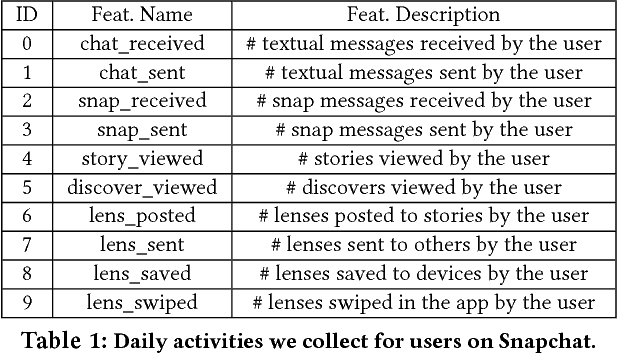
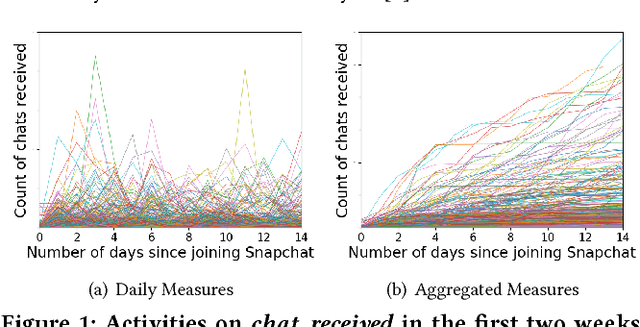
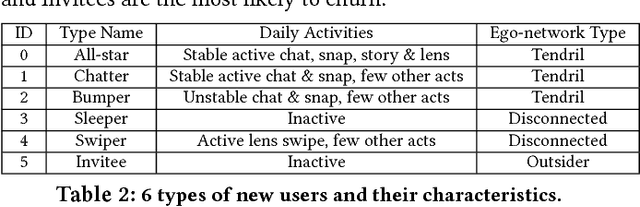
As online platforms are striving to get more users, a critical challenge is user churn, which is especially concerning for new users. In this paper, by taking the anonymous large-scale real-world data from Snapchat as an example, we develop \textit{ClusChurn}, a systematic two-step framework for interpretable new user clustering and churn prediction, based on the intuition that proper user clustering can help understand and predict user churn. Therefore, \textit{ClusChurn} firstly groups new users into interpretable typical clusters, based on their activities on the platform and ego-network structures. Then we design a novel deep learning pipeline based on LSTM and attention to accurately predict user churn with very limited initial behavior data, by leveraging the correlations among users' multi-dimensional activities and the underlying user types. \textit{ClusChurn} is also able to predict user types, which enables rapid reactions to different types of user churn. Extensive data analysis and experiments show that \textit{ClusChurn} provides valuable insight into user behaviors, and achieves state-of-the-art churn prediction performance. The whole framework is deployed as a data analysis pipeline, delivering real-time data analysis and prediction results to multiple relevant teams for business intelligence uses. It is also general enough to be readily adopted by any online systems with user behavior data.
Characterizing and Forecasting User Engagement with In-app Action Graph: A Case Study of Snapchat
Jun 02, 2019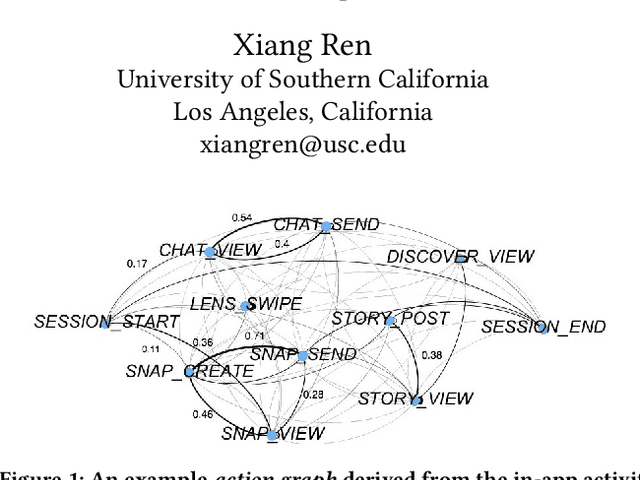


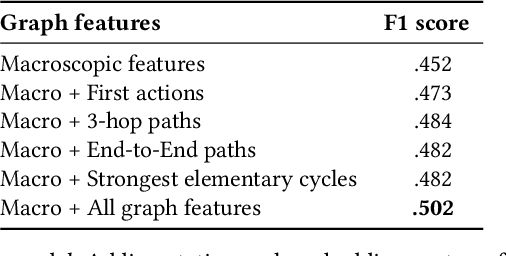
While mobile social apps have become increasingly important in people's daily life, we have limited understanding on what motivates users to engage with these apps. In this paper, we answer the question whether users' in-app activity patterns help inform their future app engagement (e.g., active days in a future time window)? Previous studies on predicting user app engagement mainly focus on various macroscopic features (e.g., time-series of activity frequency), while ignoring fine-grained inter-dependencies between different in-app actions at the microscopic level. Here we propose to formalize individual user's in-app action transition patterns as a temporally evolving action graph, and analyze its characteristics in terms of informing future user engagement. Our analysis suggested that action graphs are able to characterize user behavior patterns and inform future engagement. We derive a number of high-order graph features to capture in-app usage patterns and construct interpretable models for predicting trends of engagement changes and active rates. To further enhance predictive power, we design an end-to-end, multi-channel neural model to encode temporal action graphs, activity sequences, and other macroscopic features. Experiments on predicting user engagement for 150k Snapchat new users over a 28-day period demonstrate the effectiveness of the proposed models. The prediction framework is deployed at Snapchat to deliver real world business insights. Our proposed framework is also general and can be applied to other social app platforms.