 Add to Chrome
 Add to Firefox
 Add to Edge
DiffPixelFormer: Differential Pixel-Aware Transformer for RGB-D Indoor Scene Segmentation
Nov 17, 2025
Indoor semantic segmentation is fundamental to computer vision and robotics, supporting applications such as autonomous navigation, augmented reality, and smart environments. Although RGB-D fusion leverages complementary appearance and geometric cues, existing methods often depend on computationally intensive cross-attention mechanisms and insufficiently model intra- and inter-modal feature relationships, resulting in imprecise feature alignment and limited discriminative representation. To address these challenges, we propose DiffPixelFormer, a differential pixel-aware Transformer for RGB-D indoor scene segmentation that simultaneously enhances intra-modal representations and models inter-modal interactions. At its core, the Intra-Inter Modal Interaction Block (IIMIB) captures intra-modal long-range dependencies via self-attention and models inter-modal interactions with the Differential-Shared Inter-Modal (DSIM) module to disentangle modality-specific and shared cues, enabling fine-grained, pixel-level cross-modal alignment. Furthermore, a dynamic fusion strategy balances modality contributions and fully exploits RGB-D information according to scene characteristics. Extensive experiments on the SUN RGB-D and NYUDv2 benchmarks demonstrate that DiffPixelFormer-L achieves mIoU scores of 54.28% and 59.95%, outperforming DFormer-L by 1.78% and 2.75%, respectively. Code is available at https://github.com/gongyan1/DiffPixelFormer.

Progressive Bird's Eye View Perception for Safety-Critical Autonomous Driving: A Comprehensive Survey
Aug 11, 2025Bird's-Eye-View (BEV) perception has become a foundational paradigm in autonomous driving, enabling unified spatial representations that support robust multi-sensor fusion and multi-agent collaboration. As autonomous vehicles transition from controlled environments to real-world deployment, ensuring the safety and reliability of BEV perception in complex scenarios - such as occlusions, adverse weather, and dynamic traffic - remains a critical challenge. This survey provides the first comprehensive review of BEV perception from a safety-critical perspective, systematically analyzing state-of-the-art frameworks and implementation strategies across three progressive stages: single-modality vehicle-side, multimodal vehicle-side, and multi-agent collaborative perception. Furthermore, we examine public datasets encompassing vehicle-side, roadside, and collaborative settings, evaluating their relevance to safety and robustness. We also identify key open-world challenges - including open-set recognition, large-scale unlabeled data, sensor degradation, and inter-agent communication latency - and outline future research directions, such as integration with end-to-end autonomous driving systems, embodied intelligence, and large language models.
Contrastive Disentangled Learning on Graph for Node Classification
Jun 20, 2023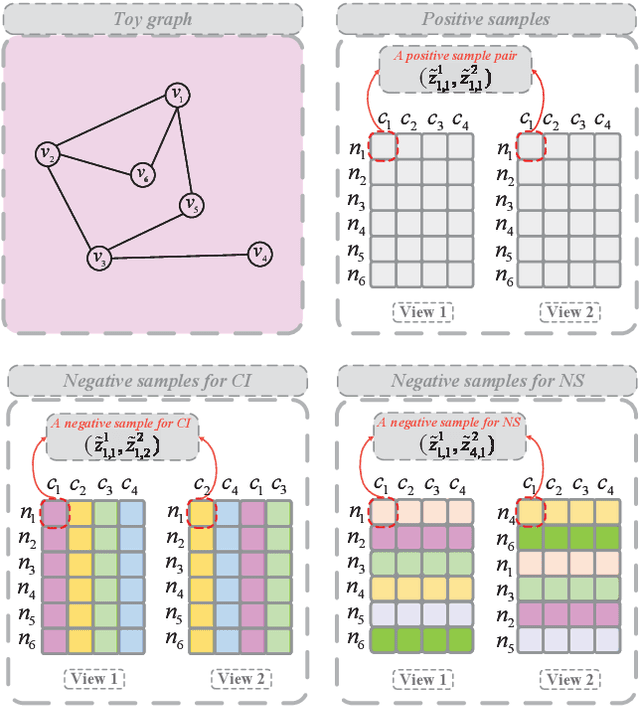
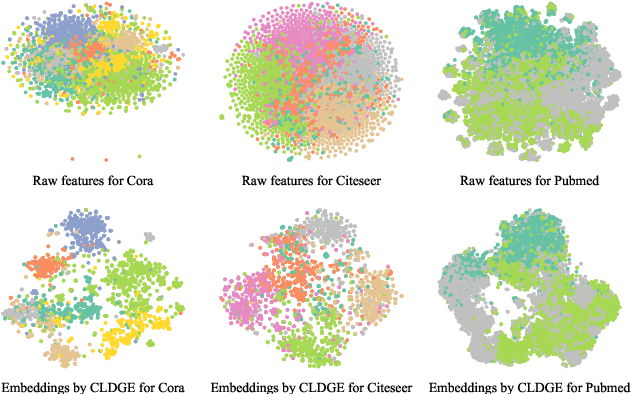
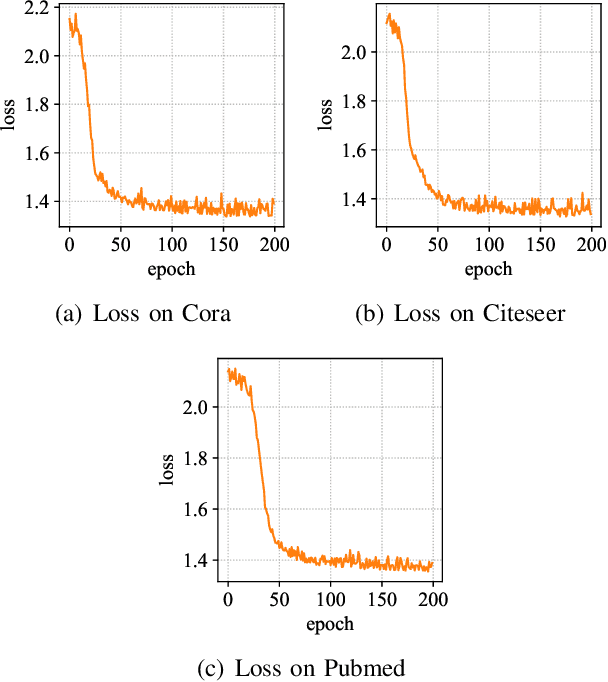
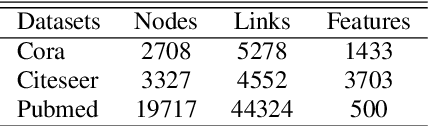
Contrastive learning methods have attracted considerable attention due to their remarkable success in analyzing graph-structured data. Inspired by the success of contrastive learning, we propose a novel framework for contrastive disentangled learning on graphs, employing a disentangled graph encoder and two carefully crafted self-supervision signals. Specifically, we introduce a disentangled graph encoder to enforce the framework to distinguish various latent factors corresponding to underlying semantic information and learn the disentangled node embeddings. Moreover, to overcome the heavy reliance on labels, we design two self-supervision signals, namely node specificity and channel independence, which capture informative knowledge without the need for labeled data, thereby guiding the automatic disentanglement of nodes. Finally, we perform node classification tasks on three citation networks by using the disentangled node embeddings, and the relevant analysis is provided. Experimental results validate the effectiveness of the proposed framework compared with various baselines.
Variational Disentangled Graph Auto-Encoders for Link Prediction
Jun 20, 2023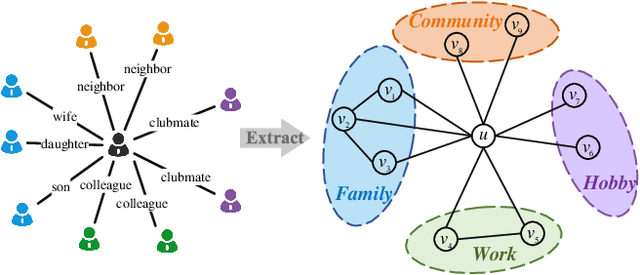
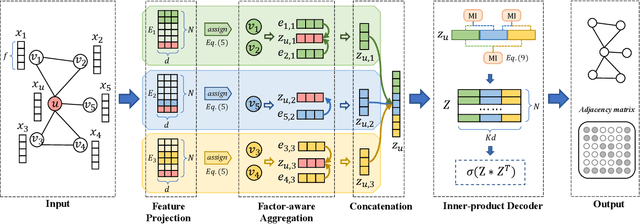
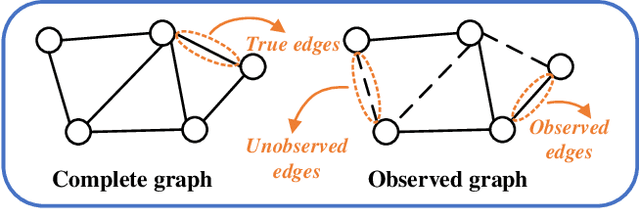
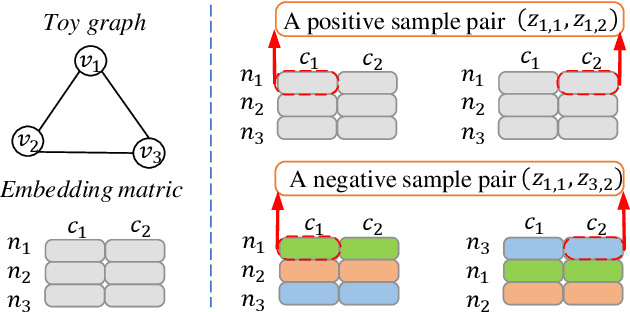
With the explosion of graph-structured data, link prediction has emerged as an increasingly important task. Embedding methods for link prediction utilize neural networks to generate node embeddings, which are subsequently employed to predict links between nodes. However, the existing embedding methods typically take a holistic strategy to learn node embeddings and ignore the entanglement of latent factors. As a result, entangled embeddings fail to effectively capture the underlying information and are vulnerable to irrelevant information, leading to unconvincing and uninterpretable link prediction results. To address these challenges, this paper proposes a novel framework with two variants, the disentangled graph auto-encoder (DGAE) and the variational disentangled graph auto-encoder (VDGAE). Our work provides a pioneering effort to apply the disentanglement strategy to link prediction. The proposed framework infers the latent factors that cause edges in the graph and disentangles the representation into multiple channels corresponding to unique latent factors, which contributes to improving the performance of link prediction. To further encourage the embeddings to capture mutually exclusive latent factors, we introduce mutual information regularization to enhance the independence among different channels. Extensive experiments on various real-world benchmarks demonstrate that our proposed methods achieve state-of-the-art results compared to a variety of strong baselines on link prediction tasks. Qualitative analysis on the synthetic dataset also illustrates that the proposed methods can capture distinct latent factors that cause links, providing empirical evidence that our models are able to explain the results of link prediction to some extent. All code will be made publicly available upon publication of the paper.