 Add to Chrome
 Add to Firefox
 Add to Edge
Structural Action Transformer for 3D Dexterous Manipulation
Mar 04, 2026
Achieving human-level dexterity in robots via imitation learning from heterogeneous datasets is hindered by the challenge of cross-embodiment skill transfer, particularly for high-DoF robotic hands. Existing methods, often relying on 2D observations and temporal-centric action representation, struggle to capture 3D spatial relations and fail to handle embodiment heterogeneity. This paper proposes the Structural Action Transformer (SAT), a new 3D dexterous manipulation policy that challenges this paradigm by introducing a structural-centric perspective. We reframe each action chunk not as a temporal sequence, but as a variable-length, unordered sequence of joint-wise trajectories. This structural formulation allows a Transformer to natively handle heterogeneous embodiments, treating the joint count as a variable sequence length. To encode structural priors and resolve ambiguity, we introduce an Embodied Joint Codebook that embeds each joint's functional role and kinematic properties. Our model learns to generate these trajectories from 3D point clouds via a continuous-time flow matching objective. We validate our approach by pre-training on large-scale heterogeneous datasets and fine-tuning on simulation and real-world dexterous manipulation tasks. Our method consistently outperforms all baselines, demonstrating superior sample efficiency and effective cross-embodiment skill transfer. This structural-centric representation offers a new path toward scaling policies for high-DoF, heterogeneous manipulators.

Primary-Fine Decoupling for Action Generation in Robotic Imitation
Feb 25, 2026Multi-modal distribution in robotic manipulation action sequences poses critical challenges for imitation learning. To this end, existing approaches often model the action space as either a discrete set of tokens or a continuous, latent-variable distribution. However, both approaches present trade-offs: some methods discretize actions into tokens and therefore lose fine-grained action variations, while others generate continuous actions in a single stage tend to produce unstable mode transitions. To address these limitations, we propose Primary-Fine Decoupling for Action Generation (PF-DAG), a two-stage framework that decouples coarse action consistency from fine-grained variations. First, we compress action chunks into a small set of discrete modes, enabling a lightweight policy to select consistent coarse modes and avoid mode bouncing. Second, a mode conditioned MeanFlow policy is learned to generate high-fidelity continuous actions. Theoretically, we prove PF-DAG's two-stage design achieves a strictly lower MSE bound than single-stage generative policies. Empirically, PF-DAG outperforms state-of-the-art baselines across 56 tasks from Adroit, DexArt, and MetaWorld benchmarks. It further generalizes to real-world tactile dexterous manipulation tasks. Our work demonstrates that explicit mode-level decoupling enables both robust multi-modal modeling and reactive closed-loop control for robotic manipulation.
GaussNav: Gaussian Splatting for Visual Navigation
Mar 20, 2024In embodied vision, Instance ImageGoal Navigation (IIN) requires an agent to locate a specific object depicted in a goal image within an unexplored environment. The primary difficulty of IIN stems from the necessity of recognizing the target object across varying viewpoints and rejecting potential distractors. Existing map-based navigation methods largely adopt the representation form of Bird's Eye View (BEV) maps, which, however, lack the representation of detailed textures in a scene. To address the above issues, we propose a new Gaussian Splatting Navigation (abbreviated as GaussNav) framework for IIN task, which constructs a novel map representation based on 3D Gaussian Splatting (3DGS). The proposed framework enables the agent to not only memorize the geometry and semantic information of the scene, but also retain the textural features of objects. Our GaussNav framework demonstrates a significant leap in performance, evidenced by an increase in Success weighted by Path Length (SPL) from 0.252 to 0.578 on the challenging Habitat-Matterport 3D (HM3D) dataset. Our code will be made publicly available.
Instance-aware Exploration-Verification-Exploitation for Instance ImageGoal Navigation
Feb 25, 2024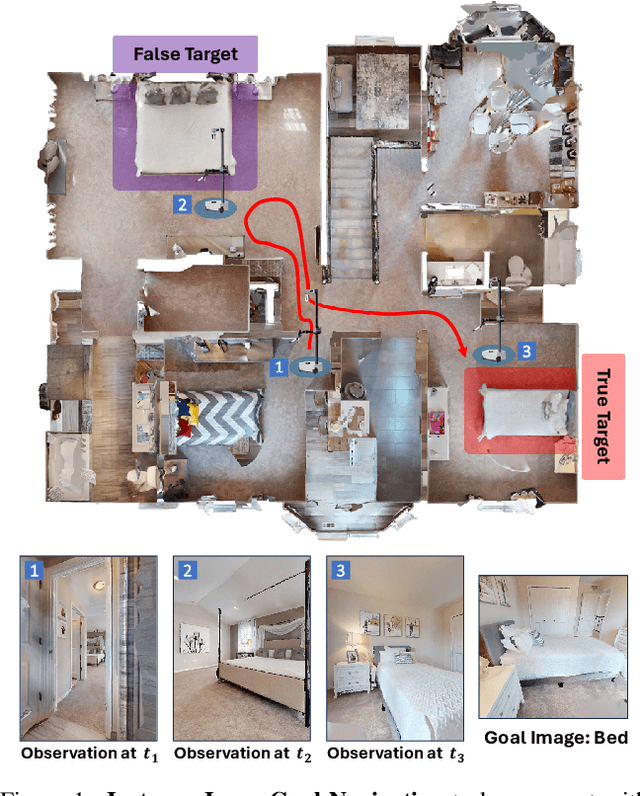
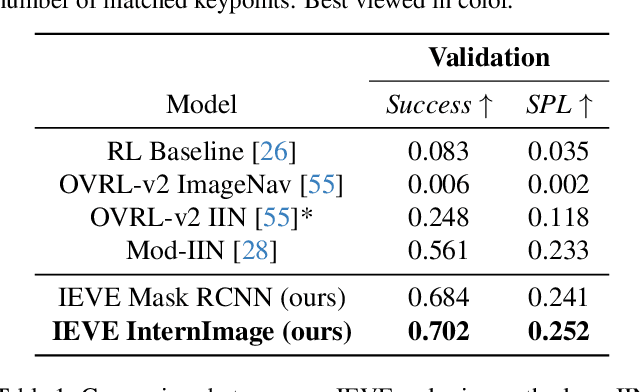
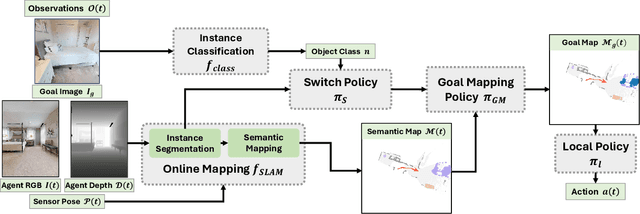
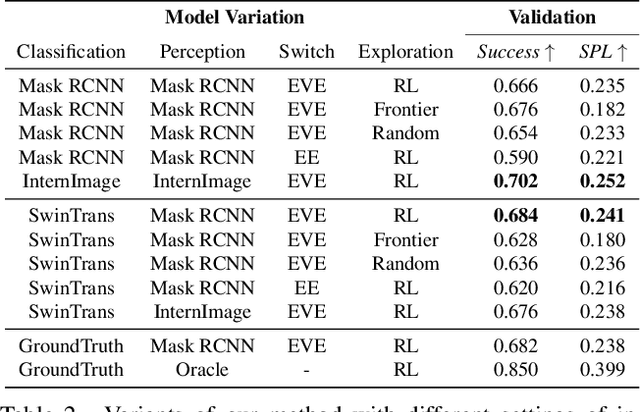
As a new embodied vision task, Instance ImageGoal Navigation (IIN) aims to navigate to a specified object depicted by a goal image in an unexplored environment. The main challenge of this task lies in identifying the target object from different viewpoints while rejecting similar distractors. Existing ImageGoal Navigation methods usually adopt the simple Exploration-Exploitation framework and ignore the identification of specific instance during navigation. In this work, we propose to imitate the human behaviour of ``getting closer to confirm" when distinguishing objects from a distance. Specifically, we design a new modular navigation framework named Instance-aware Exploration-Verification-Exploitation (IEVE) for instance-level image goal navigation. Our method allows for active switching among the exploration, verification, and exploitation actions, thereby facilitating the agent in making reasonable decisions under different situations. On the challenging HabitatMatterport 3D semantic (HM3D-SEM) dataset, our method surpasses previous state-of-the-art work, with a classical segmentation model (0.684 vs. 0.561 success) or a robust model (0.702 vs. 0.561 success). Our code will be made publicly available at https://github.com/XiaohanLei/IEVE.