 Add to Chrome
 Add to Firefox
 Add to Edge
Physics-Driven Semantic Scattering Structure Understanding of Aircraft Target in SAR Images
Jun 05, 2026
Synthetic aperture radar (SAR) has become indispensable for target interpretation owing to its all-day and all-weather observation capability. In SAR target interpretation, electromagnetic scattering information provides a physically grounded cue beyond visual texture and has been widely exploited for target interpretation. However, existing methods remain dominated by local scattering center representations. Such unordered and component-agnostic representations are highly unstable for aircraft targets. As a result, physically existing components with weak scattering responses are often missed, resulting in the incomplete reconstructed topology structure. To address this limitation, we establish Semantic Scattering Structure Understanding as a new paradigm for SAR aircraft interpretation. Semantic scattering keypoints are defined to associate local electromagnetic responses with physically meaningful aircraft components, while visibility-aware attributes are introduced to retain weakly observable yet physically existed components. The keypoints are further organized into a stable semantic scattering structure. Build upon this, we propose S3U-SAR, a physics-driven framework to localize semantic scattering keypoints and construct the complete representation constrained by multi-dimensional physical priors containing scattering heterogeneity, rigid-body topology, speckle uncertainty. A confidence-gated joint supervision strategy is further introduced to alleviate optimization conflicts. We construct KP-SAR-Aircraft-1.0, the first fine-grained benchmark for semantic scattering structure understanding. Extensive experiments demonstrate that S3U-SAR achieves the best performance compared with baselines. Cross-category and cross-dataset evaluations further verify its robustness and transferability.

Cross-ethnicity Face Anti-spoofing Recognition Challenge: A Review
Apr 23, 2020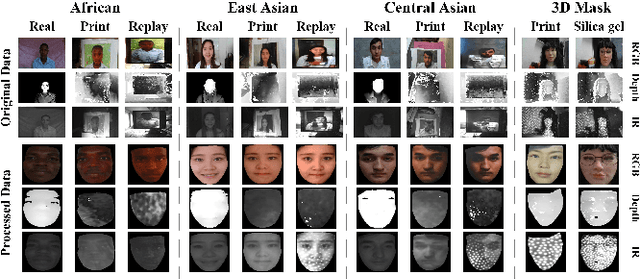
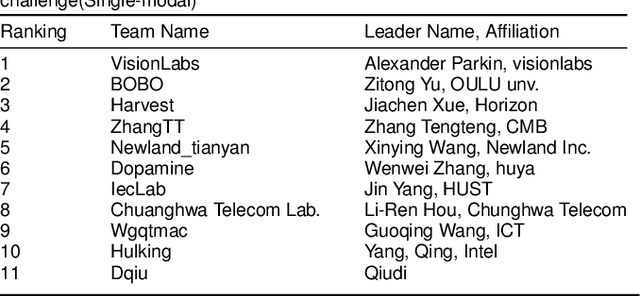
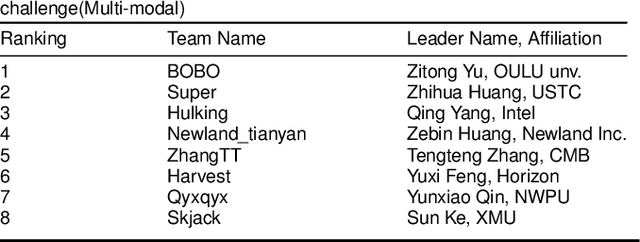
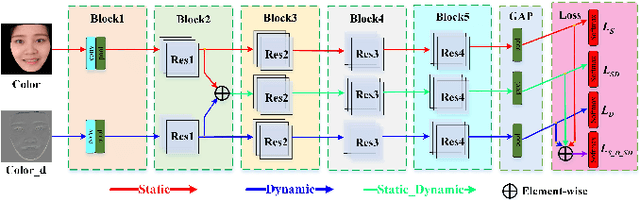
Face anti-spoofing is critical to prevent face recognition systems from a security breach. The biometrics community has %possessed achieved impressive progress recently due the excellent performance of deep neural networks and the availability of large datasets. Although ethnic bias has been verified to severely affect the performance of face recognition systems, it still remains an open research problem in face anti-spoofing. Recently, a multi-ethnic face anti-spoofing dataset, CASIA-SURF CeFA, has been released with the goal of measuring the ethnic bias. It is the largest up to date cross-ethnicity face anti-spoofing dataset covering $3$ ethnicities, $3$ modalities, $1,607$ subjects, 2D plus 3D attack types, and the first dataset including explicit ethnic labels among the recently released datasets for face anti-spoofing. We organized the Chalearn Face Anti-spoofing Attack Detection Challenge which consists of single-modal (e.g., RGB) and multi-modal (e.g., RGB, Depth, Infrared (IR)) tracks around this novel resource to boost research aiming to alleviate the ethnic bias. Both tracks have attracted $340$ teams in the development stage, and finally 11 and 8 teams have submitted their codes in the single-modal and multi-modal face anti-spoofing recognition challenges, respectively. All the results were verified and re-ran by the organizing team, and the results were used for the final ranking. This paper presents an overview of the challenge, including its design, evaluation protocol and a summary of results. We analyze the top ranked solutions and draw conclusions derived from the competition. In addition we outline future work directions.