 Add to Chrome
 Add to Firefox
 Add to Edge
AlphaEval: Evaluating Agents in Production
Apr 14, 2026
The rapid deployment of AI agents in commercial settings has outpaced the development of evaluation methodologies that reflect production realities. Existing benchmarks measure agent capabilities through retrospectively curated tasks with well-specified requirements and deterministic metrics -- conditions that diverge fundamentally from production environments where requirements contain implicit constraints, inputs are heterogeneous multi-modal documents with information fragmented across sources, tasks demand undeclared domain expertise, outputs are long-horizon professional deliverables, and success is judged by domain experts whose standards evolve over time. We present AlphaEval, a production-grounded benchmark of 94 tasks sourced from seven companies deploying AI agents in their core business, spanning six O*NET (Occupational Information Network) domains. Unlike model-centric benchmarks, AlphaEval evaluates complete agent products -- Claude Code, Codex, etc. -- as commercial systems, capturing performance variations invisible to model-level evaluation. Our evaluation framework covers multiple paradigms (LLM-as-a-Judge, reference-driven metrics, formal verification, rubric-based assessment, automated UI testing, etc.), with individual domains composing multiple paradigms. Beyond the benchmark itself, we contribute a requirement-to-benchmark construction framework -- a systematic methodology that transforms authentic production requirements into executable evaluation tasks in minimal time. This framework standardizes the entire pipeline from requirement to evaluation, providing a reproducible, modular process that any organization can adopt to construct production-grounded benchmarks for their own domains.

Few-shot Adaptation of Multi-modal Foundation Models: A Survey
Jan 04, 2024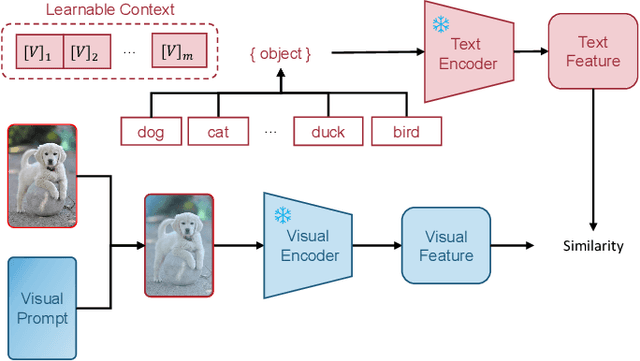
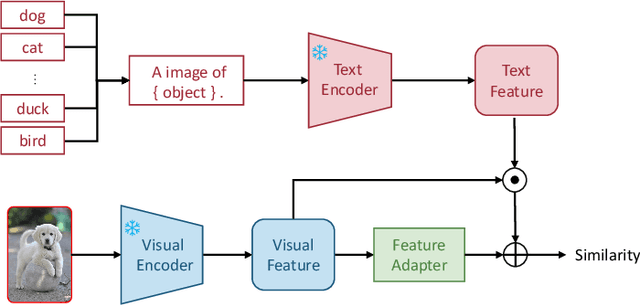
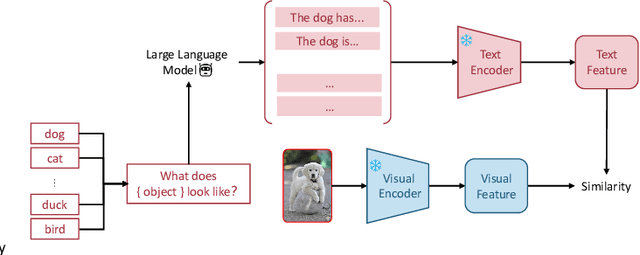
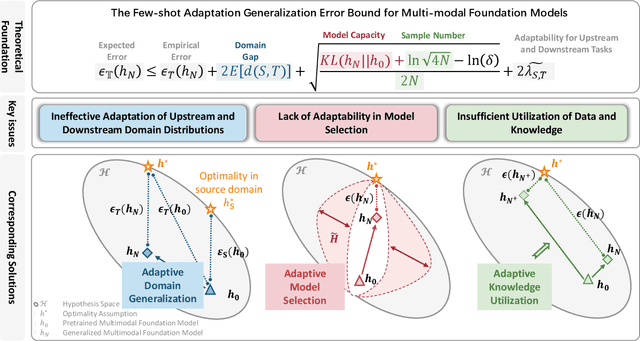
Multi-modal (vision-language) models, such as CLIP, are replacing traditional supervised pre-training models (e.g., ImageNet-based pre-training) as the new generation of visual foundation models. These models with robust and aligned semantic representations learned from billions of internet image-text pairs and can be applied to various downstream tasks in a zero-shot manner. However, in some fine-grained domains like medical imaging and remote sensing, the performance of multi-modal foundation models often leaves much to be desired. Consequently, many researchers have begun to explore few-shot adaptation methods for these models, gradually deriving three main technical approaches: 1) prompt-based methods, 2) adapter-based methods, and 3) external knowledge-based methods. Nevertheless, this rapidly developing field has produced numerous results without a comprehensive survey to systematically organize the research progress. Therefore, in this survey, we introduce and analyze the research advancements in few-shot adaptation methods for multi-modal models, summarizing commonly used datasets and experimental setups, and comparing the results of different methods. In addition, due to the lack of reliable theoretical support for existing methods, we derive the few-shot adaptation generalization error bound for multi-modal models. The theorem reveals that the generalization error of multi-modal foundation models is constrained by three factors: domain gap, model capacity, and sample size. Based on this, we propose three possible solutions from the following aspects: 1) adaptive domain generalization, 2) adaptive model selection, and 3) adaptive knowledge utilization.
RemoteCLIP: A Vision Language Foundation Model for Remote Sensing
Jun 19, 2023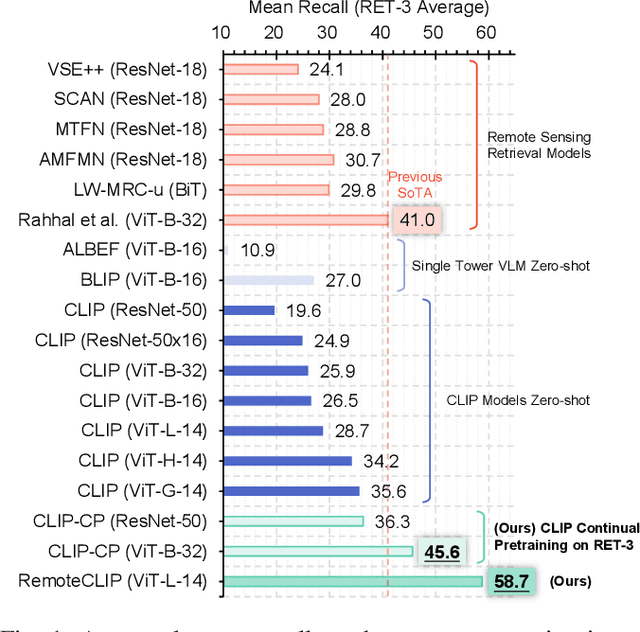
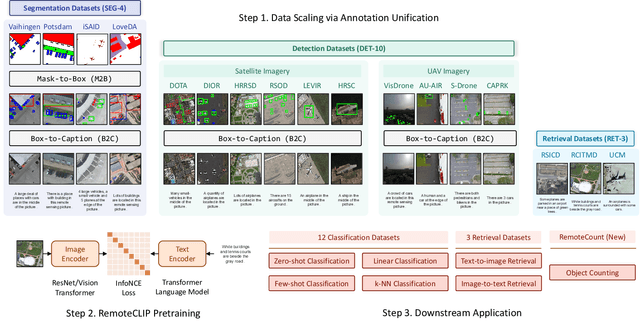
General-purpose foundation models have become increasingly important in the field of artificial intelligence. While self-supervised learning (SSL) and Masked Image Modeling (MIM) have led to promising results in building such foundation models for remote sensing, these models primarily learn low-level features, require annotated data for fine-tuning, and not applicable for retrieval and zero-shot applications due to the lack of language understanding. In response to these limitations, we propose RemoteCLIP, the first vision-language foundation model for remote sensing that aims to learn robust visual features with rich semantics, as well as aligned text embeddings for seamless downstream application. To address the scarcity of pre-training data, we leverage data scaling, converting heterogeneous annotations based on Box-to-Caption (B2C) and Mask-to-Box (M2B) conversion, and further incorporating UAV imagery, resulting a 12xlarger pretraining dataset. RemoteCLIP can be applied to a variety of downstream tasks, including zero-shot image classification, linear probing, k-NN classification, few-shot classification, image-text retrieval, and object counting. Evaluations on 16 datasets, including a newly introduced RemoteCount benchmark to test the object counting ability, show that RemoteCLIP consistently outperforms baseline foundation models across different model scales. Impressively, RemoteCLIP outperform previous SoTA by 9.14% mean recall on RSICD dataset and by 8.92% on RSICD dataset. For zero-shot classification, our RemoteCLIP outperform CLIP baseline by up to 6.39% average accuracy on 12 downstream datasets.