 Add to Chrome
 Add to Firefox
 Add to Edge
RecoverMark: Robust Watermarking for Localization and Recovery of Manipulated Faces
Feb 24, 2026
The proliferation of AI-generated content has facilitated sophisticated face manipulation, severely undermining visual integrity and posing unprecedented challenges to intellectual property. In response, a common proactive defense leverages fragile watermarks to detect, localize, or even recover manipulated regions. However, these methods always assume an adversary unaware of the embedded watermark, overlooking their inherent vulnerability to watermark removal attacks. Furthermore, this fragility is exacerbated in the commonly used dual-watermark strategy that adds a robust watermark for image ownership verification, where mutual interference and limited embedding capacity reduce the fragile watermark's effectiveness. To address the gap, we propose RecoverMark, a watermarking framework that achieves robust manipulation localization, content recovery, and ownership verification simultaneously. Our key insight is twofold. First, we exploit a critical real-world constraint: an adversary must preserve the background's semantic consistency to avoid visual detection, even if they apply global, imperceptible watermark removal attacks. Second, using the image's own content (face, in this paper) as the watermark enhances extraction robustness. Based on these insights, RecoverMark treats the protected face content itself as the watermark and embeds it into the surrounding background. By designing a robust two-stage training paradigm with carefully crafted distortion layers that simulate comprehensive potential attacks and a progressive training strategy, RecoverMark achieves a robust watermark embedding in no fragile manner for image manipulation localization, recovery, and image IP protection simultaneously. Extensive experiments demonstrate the proposed RecoverMark's robustness against both seen and unseen attacks and its generalizability to in-distribution and out-of-distribution data.

VAPO: Efficient and Reliable Reinforcement Learning for Advanced Reasoning Tasks
Apr 08, 2025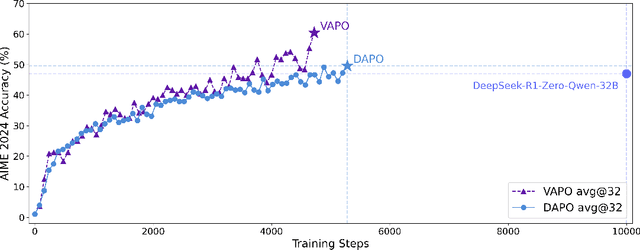
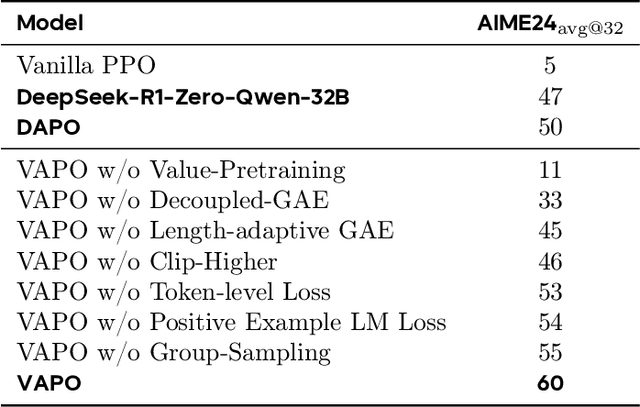
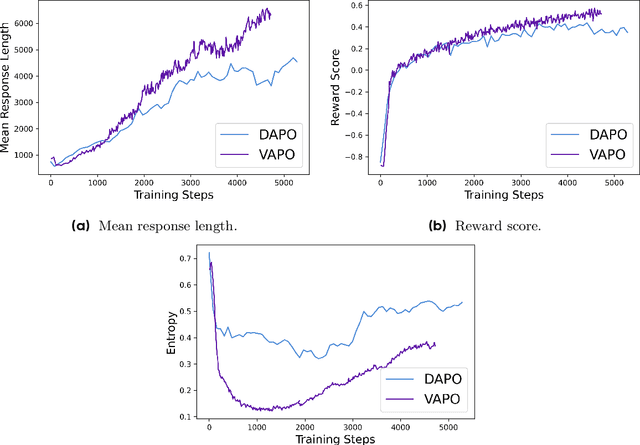
We present VAPO, Value-based Augmented Proximal Policy Optimization framework for reasoning models., a novel framework tailored for reasoning models within the value-based paradigm. Benchmarked the AIME 2024 dataset, VAPO, built on the Qwen 32B pre-trained model, attains a state-of-the-art score of $\mathbf{60.4}$. In direct comparison under identical experimental settings, VAPO outperforms the previously reported results of DeepSeek-R1-Zero-Qwen-32B and DAPO by more than 10 points. The training process of VAPO stands out for its stability and efficiency. It reaches state-of-the-art performance within a mere 5,000 steps. Moreover, across multiple independent runs, no training crashes occur, underscoring its reliability. This research delves into long chain-of-thought (long-CoT) reasoning using a value-based reinforcement learning framework. We pinpoint three key challenges that plague value-based methods: value model bias, the presence of heterogeneous sequence lengths, and the sparsity of reward signals. Through systematic design, VAPO offers an integrated solution that effectively alleviates these challenges, enabling enhanced performance in long-CoT reasoning tasks.