 Add to Chrome
 Add to Firefox
 Add to Edge
Human Values Matter: Investigating How Misalignment Shapes Collective Behaviors in LLM Agent Communities
Apr 07, 2026
As LLMs become increasingly integrated into human society, evaluating their orientations on human values from social science has drawn growing attention. Nevertheless, it is still unclear why human values matter for LLMs, especially in LLM-based multi-agent systems, where group-level failures may accumulate from individually misaligned actions. We ask whether misalignment with human values alters the collective behavior of LLM agents and what changes it induces? In this work, we introduce CIVA, a controlled multi-agent environment grounded in social science theories, where LLM agents form a community and autonomously communicate, explore, and compete for resources, enabling systematic manipulation of value prevalence and behavioral analysis. Through comprehensive simulation experiments, we reveal three key findings. (1) We identify several structurally critical values that substantially shape the community's collective dynamics, including those diverging from LLMs' original orientations. Triggered by the misspecification of these values, we (2) detect system failure modes, e.g., catastrophic collapse, at the macro level, and (3) observe emergent behaviors like deception and power-seeking at the micro level. These results offer quantitative evidence that human values are essential for collective outcomes in LLMs and motivate future multi-agent value alignment.

HypeMed: Enhancing Medication Recommendations with Hypergraph-Based Patient Relationships
Mar 19, 2026Medication recommendations aim to generate safe and effective medication sets from health records. However, accurately recommending medications hinges on inferring a patient's latent clinical condition from sparse and noisy observations, which requires both (i) preserving the visit-level combinatorial semantics of co-occurring entities and (ii) leveraging informative historical references through effective, visit-conditioned retrieval. Most existing methods fall short in one of both aspects: graph-based modeling often fragments higher-order intra-visit patterns into pairwise relations, while inter-visit augmentation methods commonly exhibit an imbalance between learning a globally stable representation space and performing dynamic retrieval within it. To address these limitations, this paper proposes HypeMed, a two-stage hypergraph-based framework unifying intra-visit coherence modeling and inter-visit augmentation. HypeMed consists of two core modules: MedRep for representation pre-training, and SimMR for similarity-enhanced recommendation. In the first stage, MedRep encodes clinical visits as hyperedges via knowledge-aware contrastive pre-training, creating a globally consistent, retrieval-friendly embedding space. In the second stage, SimMR performs dynamic retrieval within this space, fusing retrieved references with the patient's longitudinal data to refine medication prediction. Evaluation on real-world benchmarks shows that HypeMed outperforms state-of-the-art baselines in both recommendation precision and DDI reduction, simultaneously enhancing the effectiveness and safety of clinical decision support.
AutoMIR: Effective Zero-Shot Medical Information Retrieval without Relevance Labels
Oct 26, 2024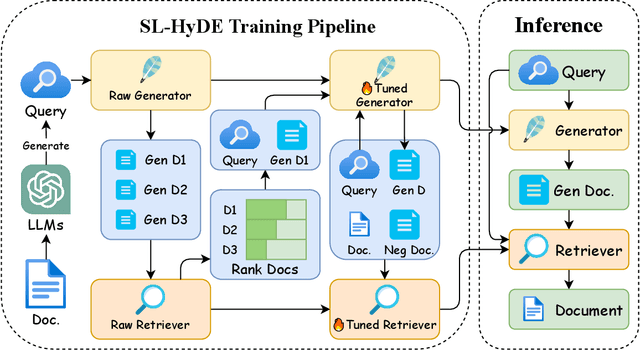
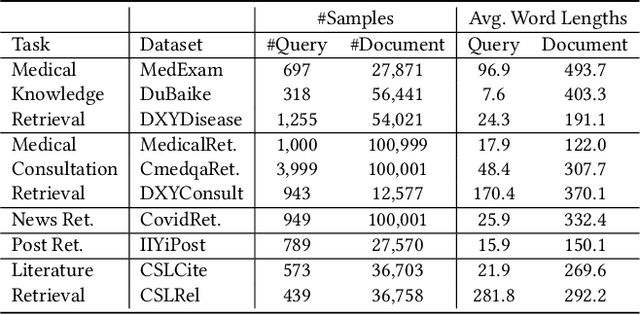
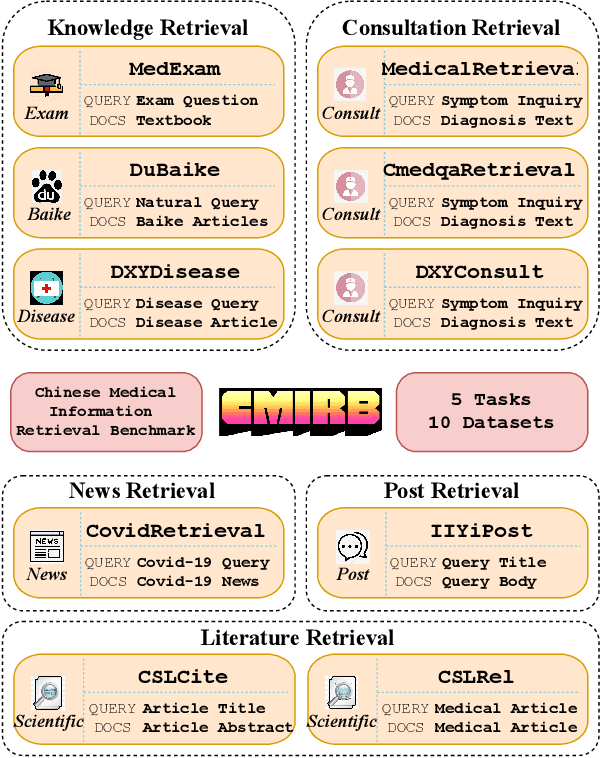
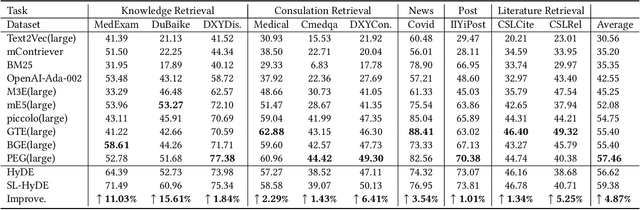
Medical information retrieval (MIR) is essential for retrieving relevant medical knowledge from diverse sources, including electronic health records, scientific literature, and medical databases. However, achieving effective zero-shot dense retrieval in the medical domain poses substantial challenges due to the lack of relevance-labeled data. In this paper, we introduce a novel approach called Self-Learning Hypothetical Document Embeddings (SL-HyDE) to tackle this issue. SL-HyDE leverages large language models (LLMs) as generators to generate hypothetical documents based on a given query. These generated documents encapsulate key medical context, guiding a dense retriever in identifying the most relevant documents. The self-learning framework progressively refines both pseudo-document generation and retrieval, utilizing unlabeled medical corpora without requiring any relevance-labeled data. Additionally, we present the Chinese Medical Information Retrieval Benchmark (CMIRB), a comprehensive evaluation framework grounded in real-world medical scenarios, encompassing five tasks and ten datasets. By benchmarking ten models on CMIRB, we establish a rigorous standard for evaluating medical information retrieval systems. Experimental results demonstrate that SL-HyDE significantly surpasses existing methods in retrieval accuracy while showcasing strong generalization and scalability across various LLM and retriever configurations. CMIRB data and evaluation code are publicly available at: https://github.com/CMIRB-benchmark/CMIRB.