 Add to Chrome
 Add to Firefox
 Add to Edge
Human Values Matter: Investigating How Misalignment Shapes Collective Behaviors in LLM Agent Communities
Apr 07, 2026
As LLMs become increasingly integrated into human society, evaluating their orientations on human values from social science has drawn growing attention. Nevertheless, it is still unclear why human values matter for LLMs, especially in LLM-based multi-agent systems, where group-level failures may accumulate from individually misaligned actions. We ask whether misalignment with human values alters the collective behavior of LLM agents and what changes it induces? In this work, we introduce CIVA, a controlled multi-agent environment grounded in social science theories, where LLM agents form a community and autonomously communicate, explore, and compete for resources, enabling systematic manipulation of value prevalence and behavioral analysis. Through comprehensive simulation experiments, we reveal three key findings. (1) We identify several structurally critical values that substantially shape the community's collective dynamics, including those diverging from LLMs' original orientations. Triggered by the misspecification of these values, we (2) detect system failure modes, e.g., catastrophic collapse, at the macro level, and (3) observe emergent behaviors like deception and power-seeking at the micro level. These results offer quantitative evidence that human values are essential for collective outcomes in LLMs and motivate future multi-agent value alignment.

Why not Collaborative Filtering in Dual View? Bridging Sparse and Dense Models
Jan 14, 2026Collaborative Filtering (CF) remains the cornerstone of modern recommender systems, with dense embedding--based methods dominating current practice. However, these approaches suffer from a critical limitation: our theoretical analysis reveals a fundamental signal-to-noise ratio (SNR) ceiling when modeling unpopular items, where parameter-based dense models experience diminishing SNR under severe data sparsity. To overcome this bottleneck, we propose SaD (Sparse and Dense), a unified framework that integrates the semantic expressiveness of dense embeddings with the structural reliability of sparse interaction patterns. We theoretically show that aligning these dual views yields a strictly superior global SNR. Concretely, SaD introduces a lightweight bidirectional alignment mechanism: the dense view enriches the sparse view by injecting semantic correlations, while the sparse view regularizes the dense model through explicit structural signals. Extensive experiments demonstrate that, under this dual-view alignment, even a simple matrix factorization--style dense model can achieve state-of-the-art performance. Moreover, SaD is plug-and-play and can be seamlessly applied to a wide range of existing recommender models, highlighting the enduring power of collaborative filtering when leveraged from dual perspectives. Further evaluations on real-world benchmarks show that SaD consistently outperforms strong baselines, ranking first on the BarsMatch leaderboard. The code is publicly available at https://github.com/harris26-G/SaD.
Tricolore: Multi-Behavior User Profiling for Enhanced Candidate Generation in Recommender Systems
May 04, 2025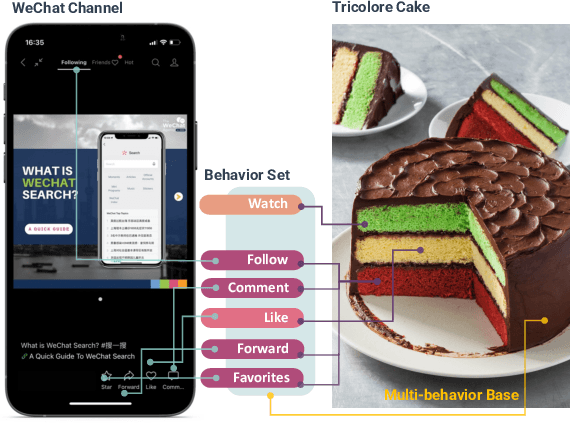
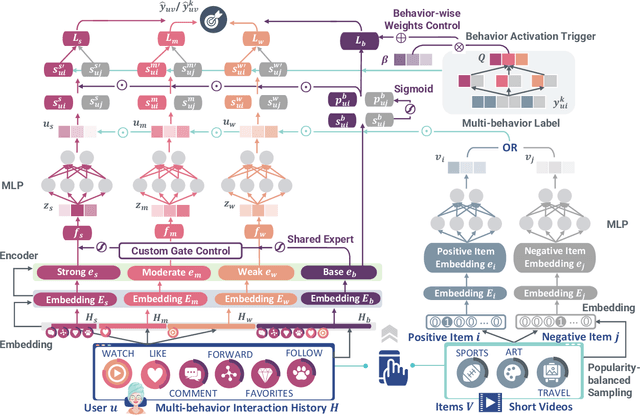
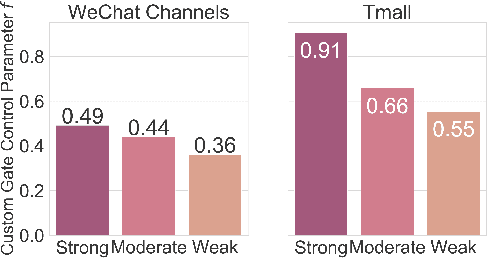
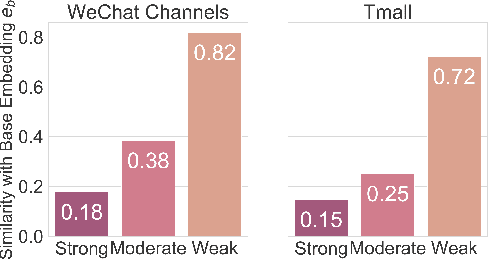
Online platforms aggregate extensive user feedback across diverse behaviors, providing a rich source for enhancing user engagement. Traditional recommender systems, however, typically optimize for a single target behavior and represent user preferences with a single vector, limiting their ability to handle multiple important behaviors or optimization objectives. This conventional approach also struggles to capture the full spectrum of user interests, resulting in a narrow item pool during candidate generation. To address these limitations, we present Tricolore, a versatile multi-vector learning framework that uncovers connections between different behavior types for more robust candidate generation. Tricolore's adaptive multi-task structure is also customizable to specific platform needs. To manage the variability in sparsity across behavior types, we incorporate a behavior-wise multi-view fusion module that dynamically enhances learning. Moreover, a popularity-balanced strategy ensures the recommendation list balances accuracy with item popularity, fostering diversity and improving overall performance. Extensive experiments on public datasets demonstrate Tricolore's effectiveness across various recommendation scenarios, from short video platforms to e-commerce. By leveraging a shared base embedding strategy, Tricolore also significantly improves the performance for cold-start users. The source code is publicly available at: https://github.com/abnering/Tricolore.