 Add to Chrome
 Add to Firefox
 Add to Edge
Multimodal Dataset Distillation via Phased Teacher Models
Mar 26, 2026
Multimodal dataset distillation aims to construct compact synthetic datasets that enable efficient compression and knowledge transfer from large-scale image-text data. However, existing approaches often fail to capture the complex, dynamically evolving knowledge embedded in the later training stages of teacher models. This limitation leads to degraded student performance and compromises the quality of the distilled data. To address critical challenges such as pronounced cross-stage performance gaps and unstable teacher trajectories, we propose Phased Teacher Model with Shortcut Trajectory (PTM-ST) -- a novel phased distillation framework. PTM-ST leverages stage-aware teacher modeling and a shortcut-based trajectory construction strategy to accurately fit the teacher's learning dynamics across distinct training phases. This enhances both the stability and expressiveness of the distillation process. Through theoretical analysis and comprehensive experiments, we show that PTM-ST significantly mitigates optimization oscillations and inter-phase knowledge gaps, while also reducing storage overhead. Our method consistently surpasses state-of-the-art baselines on Flickr30k and COCO, achieving up to 13.5% absolute improvement and an average gain of 9.53% on Flickr30k. Code: https://github.com/Previsior/PTM-ST.

Step-DPO: Step-wise Preference Optimization for Long-chain Reasoning of LLMs
Jun 26, 2024
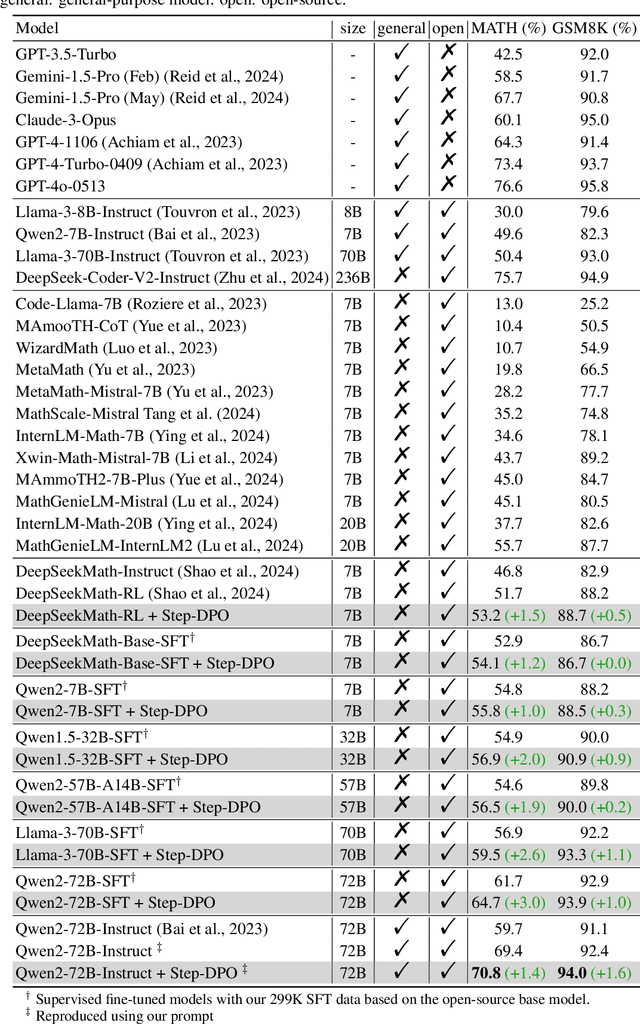
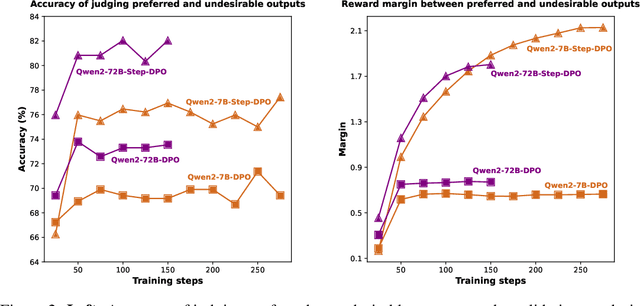
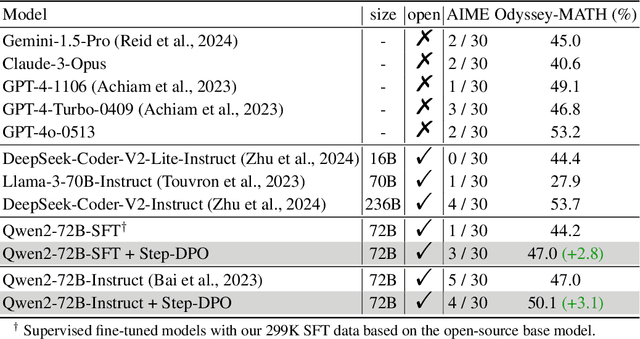
Mathematical reasoning presents a significant challenge for Large Language Models (LLMs) due to the extensive and precise chain of reasoning required for accuracy. Ensuring the correctness of each reasoning step is critical. To address this, we aim to enhance the robustness and factuality of LLMs by learning from human feedback. However, Direct Preference Optimization (DPO) has shown limited benefits for long-chain mathematical reasoning, as models employing DPO struggle to identify detailed errors in incorrect answers. This limitation stems from a lack of fine-grained process supervision. We propose a simple, effective, and data-efficient method called Step-DPO, which treats individual reasoning steps as units for preference optimization rather than evaluating answers holistically. Additionally, we have developed a data construction pipeline for Step-DPO, enabling the creation of a high-quality dataset containing 10K step-wise preference pairs. We also observe that in DPO, self-generated data is more effective than data generated by humans or GPT-4, due to the latter's out-of-distribution nature. Our findings demonstrate that as few as 10K preference data pairs and fewer than 500 Step-DPO training steps can yield a nearly 3% gain in accuracy on MATH for models with over 70B parameters. Notably, Step-DPO, when applied to Qwen2-72B-Instruct, achieves scores of 70.8% and 94.0% on the test sets of MATH and GSM8K, respectively, surpassing a series of closed-source models, including GPT-4-1106, Claude-3-Opus, and Gemini-1.5-Pro. Our code, data, and models are available at https://github.com/dvlab-research/Step-DPO.