 Add to Chrome
 Add to Firefox
 Add to Edge
HaluMem: Evaluating Hallucinations in Memory Systems of Agents
Nov 05, 2025
Memory systems are key components that enable AI systems such as LLMs and AI agents to achieve long-term learning and sustained interaction. However, during memory storage and retrieval, these systems frequently exhibit memory hallucinations, including fabrication, errors, conflicts, and omissions. Existing evaluations of memory hallucinations are primarily end-to-end question answering, which makes it difficult to localize the operational stage within the memory system where hallucinations arise. To address this, we introduce the Hallucination in Memory Benchmark (HaluMem), the first operation level hallucination evaluation benchmark tailored to memory systems. HaluMem defines three evaluation tasks (memory extraction, memory updating, and memory question answering) to comprehensively reveal hallucination behaviors across different operational stages of interaction. To support evaluation, we construct user-centric, multi-turn human-AI interaction datasets, HaluMem-Medium and HaluMem-Long. Both include about 15k memory points and 3.5k multi-type questions. The average dialogue length per user reaches 1.5k and 2.6k turns, with context lengths exceeding 1M tokens, enabling evaluation of hallucinations across different context scales and task complexities. Empirical studies based on HaluMem show that existing memory systems tend to generate and accumulate hallucinations during the extraction and updating stages, which subsequently propagate errors to the question answering stage. Future research should focus on developing interpretable and constrained memory operation mechanisms that systematically suppress hallucinations and improve memory reliability.

DarkFarseer: Inductive Spatio-temporal Kriging via Hidden Style Enhancement and Sparsity-Noise Mitigation
Jan 06, 2025
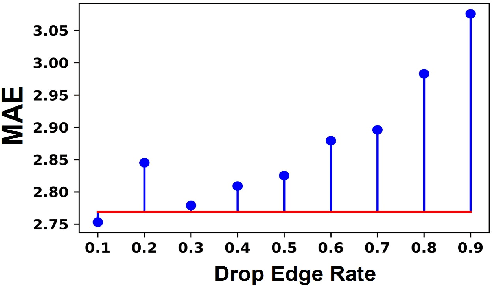

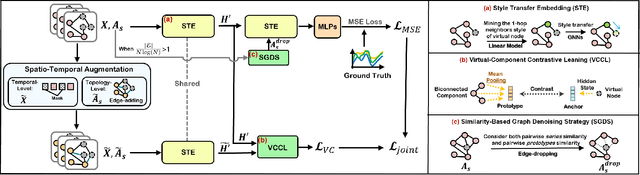
With the rapid growth of the Internet of Things and Cyber-Physical Systems, widespread sensor deployment has become essential. However, the high costs of building sensor networks limit their scale and coverage, making fine-grained deployment challenging. Inductive Spatio-Temporal Kriging (ISK) addresses this issue by introducing virtual sensors. Based on graph neural networks (GNNs) extracting the relationships between physical and virtual sensors, ISK can infer the measurements of virtual sensors from physical sensors. However, current ISK methods rely on conventional message-passing mechanisms and network architectures, without effectively extracting spatio-temporal features of physical sensors and focusing on representing virtual sensors. Additionally, existing graph construction methods face issues of sparse and noisy connections, destroying ISK performance. To address these issues, we propose DarkFarseer, a novel ISK framework with three key components. First, we propose the Neighbor Hidden Style Enhancement module with a style transfer strategy to enhance the representation of virtual nodes in a temporal-then-spatial manner to better extract the spatial relationships between physical and virtual nodes. Second, we propose Virtual-Component Contrastive Learning, which aims to enrich the node representation by establishing the association between the patterns of virtual nodes and the regional patterns within graph components. Lastly, we design a Similarity-Based Graph Denoising Strategy, which reduces the connectivity strength of noisy connections around virtual nodes and their neighbors based on their temporal information and regional spatial patterns. Extensive experiments demonstrate that DarkFarseer significantly outperforms existing ISK methods.