 Add to Chrome
 Add to Firefox
 Add to Edge
CGSTA: Cross-Scale Graph Contrast with Stability-Aware Alignment for Multivariate Time-Series Anomaly Detection
Feb 24, 2026
Multivariate time-series anomaly detection is essential for reliable industrial control, telemetry, and service monitoring. However, the evolving inter-variable dependencies and inevitable noise render it challenging. Existing methods often use single-scale graphs or instance-level contrast. Moreover, learned dynamic graphs can overfit noise without a stable anchor, causing false alarms or misses. To address these challenges, we propose the CGSTA framework with two key innovations. First, Dynamic Layered Graph Construction (DLGC) forms local, regional, and global views of variable relations for each sliding window; rather than contrasting whole windows, Contrastive Discrimination across Scales (CDS) contrasts graph representations within each view and aligns the same window across views to make learning structure-aware. Second, Stability-Aware Alignment (SAA) maintains a per-scale stable reference learned from normal data and guides the current window's fast-changing graphs toward it to suppress noise. We fuse the multi-scale and temporal features and use a conditional density estimator to produce per-time-step anomaly scores. Across four benchmarks, CGSTA delivers optimal performance on PSM and WADI, and is comparable to the baseline methods on SWaT and SMAP.

PlugSI: Plug-and-Play Test-Time Graph Adaptation for Spatial Interpolation
Feb 10, 2026With the rapid advancement of IoT and edge computing, sensor networks have become indispensable, driving the need for large-scale sensor deployment. However, the high deployment cost hinders their scalability. To tackle the issues, Spatial Interpolation (SI) introduces virtual sensors to infer readings from observed sensors, leveraging graph structure. However, current graph-based SI methods rely on pre-trained models, lack adaptation to larger and unseen graphs at test-time, and overlook test data utilization. To address these issues, we propose PlugSI, a plug-and-play framework that refines test-time graph through two key innovations. First, we design an Unknown Topology Adapter (UTA) that adapts to the new graph structure of each small-batch at test-time, enhancing the generalization of SI pre-trained models. Second, we introduce a Temporal Balance Adapter (TBA) that maintains a stable historical consensus to guide UTA adaptation and prevent drifting caused by noise in the current batch. Empirically, extensive experiments demonstrate PlugSI can be seamlessly integrated into existing graph-based SI methods and provide significant improvement (e.g., a 10.81% reduction in MAE).
DarkFarseer: Inductive Spatio-temporal Kriging via Hidden Style Enhancement and Sparsity-Noise Mitigation
Jan 06, 2025

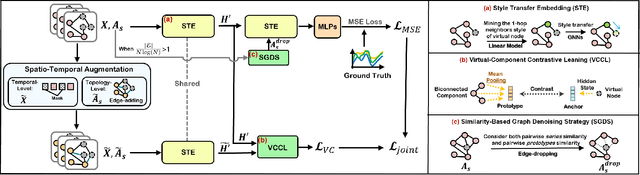
With the rapid growth of the Internet of Things and Cyber-Physical Systems, widespread sensor deployment has become essential. However, the high costs of building sensor networks limit their scale and coverage, making fine-grained deployment challenging. Inductive Spatio-Temporal Kriging (ISK) addresses this issue by introducing virtual sensors. Based on graph neural networks (GNNs) extracting the relationships between physical and virtual sensors, ISK can infer the measurements of virtual sensors from physical sensors. However, current ISK methods rely on conventional message-passing mechanisms and network architectures, without effectively extracting spatio-temporal features of physical sensors and focusing on representing virtual sensors. Additionally, existing graph construction methods face issues of sparse and noisy connections, destroying ISK performance. To address these issues, we propose DarkFarseer, a novel ISK framework with three key components. First, we propose the Neighbor Hidden Style Enhancement module with a style transfer strategy to enhance the representation of virtual nodes in a temporal-then-spatial manner to better extract the spatial relationships between physical and virtual nodes. Second, we propose Virtual-Component Contrastive Learning, which aims to enrich the node representation by establishing the association between the patterns of virtual nodes and the regional patterns within graph components. Lastly, we design a Similarity-Based Graph Denoising Strategy, which reduces the connectivity strength of noisy connections around virtual nodes and their neighbors based on their temporal information and regional spatial patterns. Extensive experiments demonstrate that DarkFarseer significantly outperforms existing ISK methods.