 Add to Chrome
 Add to Firefox
 Add to Edge
GeoNDC: A Queryable Neural Data Cube for Planetary-Scale Earth Observation
Mar 27, 2026
Satellite Earth observation has accumulated massive spatiotemporal archives essential for monitoring environmental change, yet these remain organized as discrete raster files, making them costly to store, transmit, and query. We present GeoNDC, a queryable neural data cube that encodes planetary-scale Earth observation data as a continuous spatiotemporal implicit neural field, enabling on-demand queries and continuous-time reconstruction without full decompression. Experiments on a 20-year global MODIS MCD43A4 reflectance record ($8016 \times 4008$ pixels, 7 bands, 915 temporal frames) show that the learned representation supports direct spatiotemporal queries on consumer hardware. On Sentinel-2 imagery (10 m), continuous temporal parameterization recovers cloud-free dynamics with high fidelity ($R^2 > 0.85$) under simulated 2-km cloud occlusion. On HiGLASS biophysical products (LAI and FPAR), GeoNDC attains near-perfect accuracy ($R^2 > 0.98$). The representation compresses the 20-year MODIS archive to 0.44\,GB -- approximately 95:1 relative to an optimized Int16 baseline -- with high spectral fidelity (mean $R^2 > 0.98$, mean RMSE $= 0.021$). These results suggest GeoNDC offers a unified AI-native representation for planetary-scale Earth observation, complementing raw archives with a compact, analysis-ready data layer integrating query, reconstruction, and compression in a single framework.

DarkFarseer: Inductive Spatio-temporal Kriging via Hidden Style Enhancement and Sparsity-Noise Mitigation
Jan 06, 2025
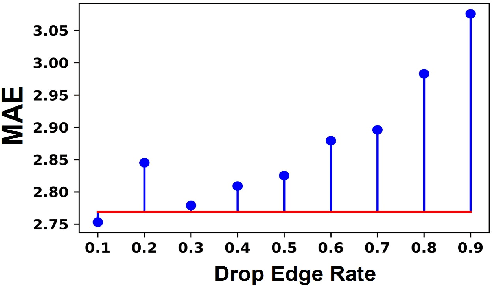

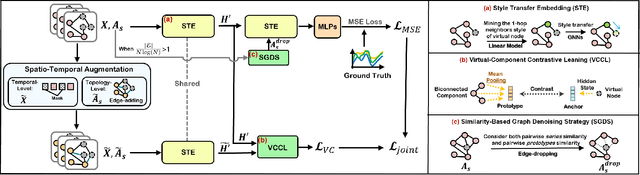
With the rapid growth of the Internet of Things and Cyber-Physical Systems, widespread sensor deployment has become essential. However, the high costs of building sensor networks limit their scale and coverage, making fine-grained deployment challenging. Inductive Spatio-Temporal Kriging (ISK) addresses this issue by introducing virtual sensors. Based on graph neural networks (GNNs) extracting the relationships between physical and virtual sensors, ISK can infer the measurements of virtual sensors from physical sensors. However, current ISK methods rely on conventional message-passing mechanisms and network architectures, without effectively extracting spatio-temporal features of physical sensors and focusing on representing virtual sensors. Additionally, existing graph construction methods face issues of sparse and noisy connections, destroying ISK performance. To address these issues, we propose DarkFarseer, a novel ISK framework with three key components. First, we propose the Neighbor Hidden Style Enhancement module with a style transfer strategy to enhance the representation of virtual nodes in a temporal-then-spatial manner to better extract the spatial relationships between physical and virtual nodes. Second, we propose Virtual-Component Contrastive Learning, which aims to enrich the node representation by establishing the association between the patterns of virtual nodes and the regional patterns within graph components. Lastly, we design a Similarity-Based Graph Denoising Strategy, which reduces the connectivity strength of noisy connections around virtual nodes and their neighbors based on their temporal information and regional spatial patterns. Extensive experiments demonstrate that DarkFarseer significantly outperforms existing ISK methods.