 Add to Chrome
 Add to Firefox
 Add to Edge
Evo-PI: Aligning Medical Reasoning via Evolving Principle-Guided Supervision
Jun 30, 2026
Despite recent progress, the reasoning capabilities of large multimodal language models (MLLMs) remain fundamentally constrained by static supervision, where fixed prompts, rules, or reward models provide non-adaptive guidance throughout training. Such static signals are often sufficient to enforce output formats, but fail to shape the underlying reasoning process, leading to brittle generalization and performance saturation in complex decision-making tasks. We propose Evo-PI, a principle-centric learning framework that treats reasoning principles as explicit, language-based supervision signals that can be generated, evaluated, and iteratively evolved. Instead of relying on fixed rewards, Evo-PI enables a co-evolutionary loop in which principles guide model reasoning, while model behaviors in turn refine the principles that supervise them. This dynamic alignment mechanism allows supervision to progressively adapt to the model's reasoning deficiencies. We instantiate Evo-PI in medical visual question answering as a high-stakes testbed requiring structured visual-textual reasoning. Across eight benchmarks and multiple model backbones, Evo-PI consistently improves reasoning accuracy, achieving gains of up to 24.6%. Our results suggest that evolving principle-guided supervision offers a scalable and general paradigm for training expert-aligned reasoning in MLLMs. Code is available at https://github.com/zhengxianda/Evo_PI.

CSG: Curriculum Representation Learning for Signed Graph
Oct 17, 2023


Signed graphs are valuable for modeling complex relationships with positive and negative connections, and Signed Graph Neural Networks (SGNNs) have become crucial tools for their analysis. However, prior to our work, no specific training plan existed for SGNNs, and the conventional random sampling approach did not address varying learning difficulties within the graph's structure. We proposed a curriculum-based training approach, where samples progress from easy to complex, inspired by human learning. To measure learning difficulty, we introduced a lightweight mechanism and created the Curriculum representation learning framework for Signed Graphs (CSG). This framework optimizes the order in which samples are presented to the SGNN model. Empirical validation across six real-world datasets showed impressive results, enhancing SGNN model accuracy by up to 23.7% in link sign prediction (AUC) and significantly improving stability with an up to 8.4 reduction in the standard deviation of AUC scores.
SGA: A Graph Augmentation Method for Signed Graph Neural Networks
Oct 15, 2023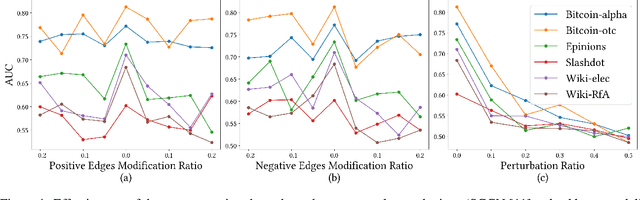


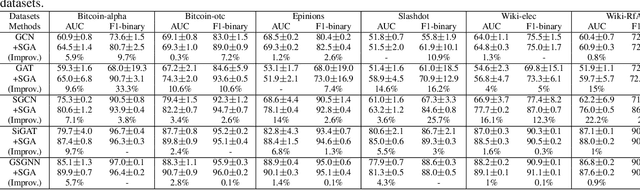
Signed Graph Neural Networks (SGNNs) are vital for analyzing complex patterns in real-world signed graphs containing positive and negative links. However, three key challenges hinder current SGNN-based signed graph representation learning: sparsity in signed graphs leaves latent structures undiscovered, unbalanced triangles pose representation difficulties for SGNN models, and real-world signed graph datasets often lack supplementary information like node labels and features. These constraints limit the potential of SGNN-based representation learning. We address these issues with data augmentation techniques. Despite many graph data augmentation methods existing for unsigned graphs, none are tailored for signed graphs. Our paper introduces the novel Signed Graph Augmentation framework (SGA), comprising three main components. First, we employ the SGNN model to encode the signed graph, extracting latent structural information for candidate augmentation structures. Second, we evaluate these candidate samples (edges) and select the most beneficial ones for modifying the original training set. Third, we propose a novel augmentation perspective that assigns varying training difficulty to training samples, enabling the design of a new training strategy. Extensive experiments on six real-world datasets (Bitcoin-alpha, Bitcoin-otc, Epinions, Slashdot, Wiki-elec, and Wiki-RfA) demonstrate that SGA significantly improves performance across multiple benchmarks. Our method outperforms baselines by up to 22.2% in AUC for SGCN on Wiki-RfA, 33.3% in F1-binary, 48.8% in F1-micro, and 36.3% in F1-macro for GAT on Bitcoin-alpha in link sign prediction.
Enhancing Student Performance Prediction on Learnersourced Questions with SGNN-LLM Synergy
Sep 23, 2023As an emerging education strategy, learnersourcing offers the potential for personalized learning content creation, but also grapples with the challenge of predicting student performance due to inherent noise in student-generated data. While graph-based methods excel in capturing dense learner-question interactions, they falter in cold start scenarios, characterized by limited interactions, as seen when questions lack substantial learner responses. In response, we introduce an innovative strategy that synergizes the potential of integrating Signed Graph Neural Networks (SGNNs) and Large Language Model (LLM) embeddings. Our methodology employs a signed bipartite graph to comprehensively model student answers, complemented by a contrastive learning framework that enhances noise resilience. Furthermore, LLM's contribution lies in generating foundational question embeddings, proving especially advantageous in addressing cold start scenarios characterized by limited graph data interactions. Validation across five real-world datasets sourced from the PeerWise platform underscores our approach's effectiveness. Our method outperforms baselines, showcasing enhanced predictive accuracy and robustness.