 Add to Chrome
 Add to Firefox
 Add to Edge
TT-SEAL: TTD-Aware Selective Encryption for Adversarially-Robust and Low-Latency Edge AI
Feb 24, 2026
Cloud-edge AI must jointly satisfy model compression and security under tight device budgets. While Tensor-Train Decomposition (TTD) shrinks on-device models, prior selective-encryption studies largely assume dense weights, leaving its practicality under TTD compression unclear. We present TT-SEAL, a selective-encryption framework for TT-decomposed networks. TT-SEAL ranks TT cores with a sensitivity-based importance metric, calibrates a one-time robustness threshold, and uses a value-DP optimizer to encrypt the minimum set of critical cores with AES. Under TTD-aware, transfer-based threat models (and on an FPGA-prototyped edge processor) TT-SEAL matches the robustness of full (black-box) encryption while encrypting as little as 4.89-15.92% of parameters across ResNet-18, MobileNetV2, and VGG-16, and drives the share of AES decryption in end-to-end latency to low single digits (e.g., 58% -> 2.76% on ResNet-18), enabling secure, low-latency edge AI.

LoRA-Edge: Tensor-Train-Assisted LoRA for Practical CNN Fine-Tuning on Edge Devices
Nov 07, 2025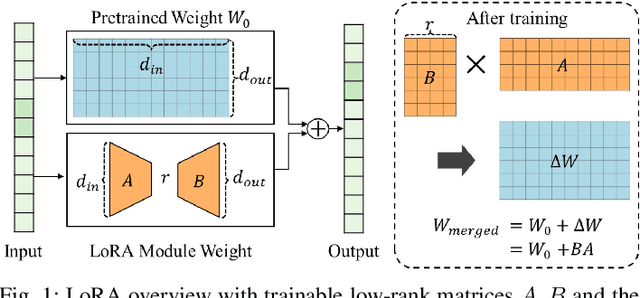
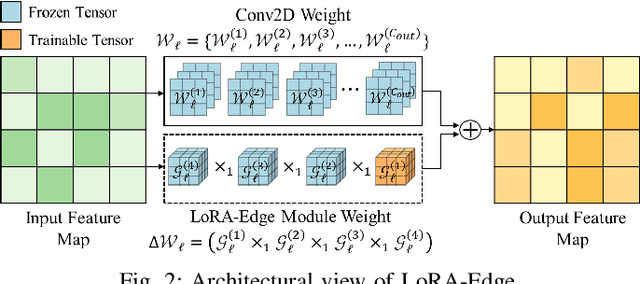
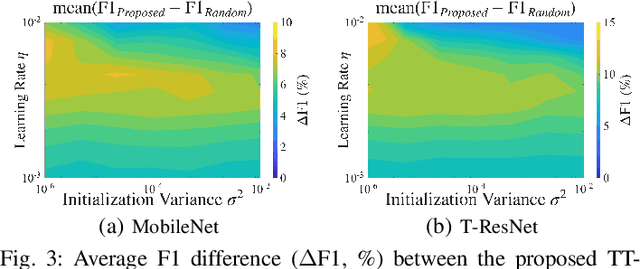
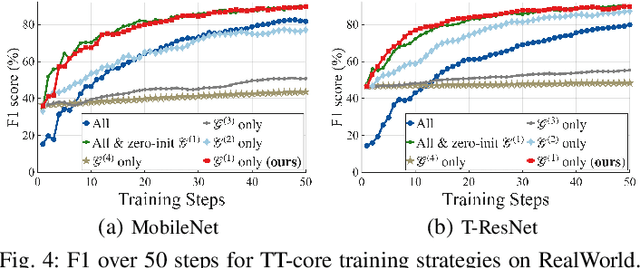
On-device fine-tuning of CNNs is essential to withstand domain shift in edge applications such as Human Activity Recognition (HAR), yet full fine-tuning is infeasible under strict memory, compute, and energy budgets. We present LoRA-Edge, a parameter-efficient fine-tuning (PEFT) method that builds on Low-Rank Adaptation (LoRA) with tensor-train assistance. LoRA-Edge (i) applies Tensor-Train Singular Value Decomposition (TT-SVD) to pre-trained convolutional layers, (ii) selectively updates only the output-side core with zero-initialization to keep the auxiliary path inactive at the start, and (iii) fuses the update back into dense kernels, leaving inference cost unchanged. This design preserves convolutional structure and reduces the number of trainable parameters by up to two orders of magnitude compared to full fine-tuning. Across diverse HAR datasets and CNN backbones, LoRA-Edge achieves accuracy within 4.7% of full fine-tuning while updating at most 1.49% of parameters, consistently outperforming prior parameter-efficient baselines under similar budgets. On a Jetson Orin Nano, TT-SVD initialization and selective-core training yield 1.4-3.8x faster convergence to target F1. LoRA-Edge thus makes structure-aligned, parameter-efficient on-device CNN adaptation practical for edge platforms.
FiCABU: A Fisher-Based, Context-Adaptive Machine Unlearning Processor for Edge AI
Nov 06, 2025Machine unlearning, driven by privacy regulations and the "right to be forgotten", is increasingly needed at the edge, yet server-centric or retraining-heavy methods are impractical under tight computation and energy budgets. We present FiCABU (Fisher-based Context-Adaptive Balanced Unlearning), a software-hardware co-design that brings unlearning to edge AI processors. FiCABU combines (i) Context-Adaptive Unlearning, which begins edits from back-end layers and halts once the target forgetting is reached, with (ii) Balanced Dampening, which scales dampening strength by depth to preserve retain accuracy. These methods are realized in a full RTL design of a RISC-V edge AI processor that integrates two lightweight IPs for Fisher estimation and dampening into a GEMM-centric streaming pipeline, validated on an FPGA prototype and synthesized in 45 nm for power analysis. Across CIFAR-20 and PinsFaceRecognition with ResNet-18 and ViT, FiCABU achieves random-guess forget accuracy while matching the retraining-free Selective Synaptic Dampening (SSD) baseline on retain accuracy, reducing computation by up to 87.52 percent (ResNet-18) and 71.03 percent (ViT). On the INT8 hardware prototype, FiCABU further improves retain preservation and reduces energy to 6.48 percent (CIFAR-20) and 0.13 percent (PinsFaceRecognition) of the SSD baseline. In sum, FiCABU demonstrates that back-end-first, depth-aware unlearning can be made both practical and efficient for resource-constrained edge AI devices.
ASAP-FE: Energy-Efficient Feature Extraction Enabling Multi-Channel Keyword Spotting on Edge Processors
Jun 17, 2025Multi-channel keyword spotting (KWS) has become crucial for voice-based applications in edge environments. However, its substantial computational and energy requirements pose significant challenges. We introduce ASAP-FE (Agile Sparsity-Aware Parallelized-Feature Extractor), a hardware-oriented front-end designed to address these challenges. Our framework incorporates three key innovations: (1) Half-overlapped Infinite Impulse Response (IIR) Framing: This reduces redundant data by approximately 25% while maintaining essential phoneme transition cues. (2) Sparsity-aware Data Reduction: We exploit frame-level sparsity to achieve an additional 50% data reduction by combining frame skipping with stride-based filtering. (3) Dynamic Parallel Processing: We introduce a parameterizable filter cluster and a priority-based scheduling algorithm that allows parallel execution of IIR filtering tasks, reducing latency and optimizing energy efficiency. ASAP-FE is implemented with various filter cluster sizes on edge processors, with functionality verified on FPGA prototypes and designs synthesized at 45 nm. Experimental results using TC-ResNet8, DS-CNN, and KWT-1 demonstrate that ASAP-FE reduces the average workload by 62.73% while supporting real-time processing for up to 32 channels. Compared to a conventional fully overlapped baseline, ASAP-FE achieves less than a 1% accuracy drop (e.g., 96.22% vs. 97.13% for DS-CNN), which is well within acceptable limits for edge AI. By adjusting the number of filter modules, our design optimizes the trade-off between performance and energy, with 15 parallel filters providing optimal performance for up to 25 channels. Overall, ASAP-FE offers a practical and efficient solution for multi-channel KWS on energy-constrained edge devices.
HH-PIM: Dynamic Optimization of Power and Performance with Heterogeneous-Hybrid PIM for Edge AI Devices
Apr 02, 2025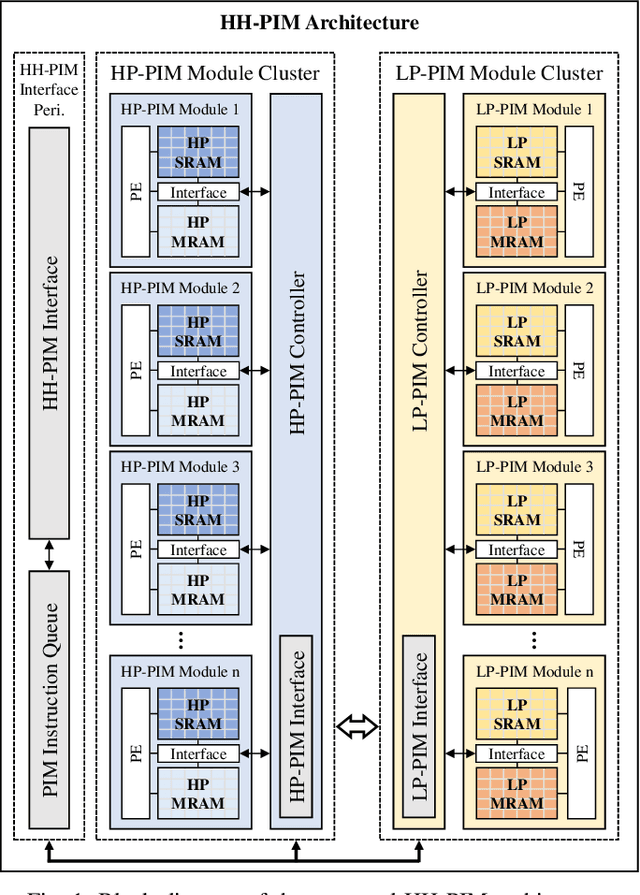
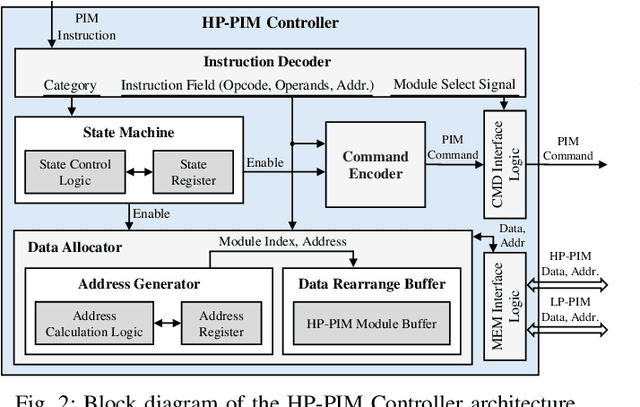
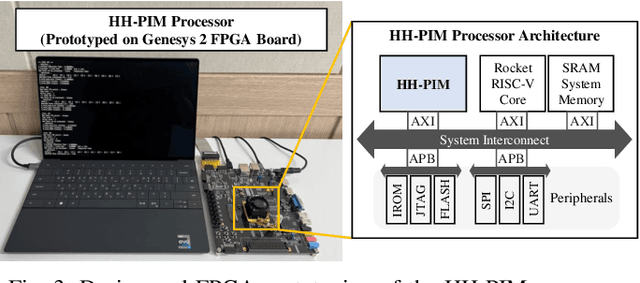
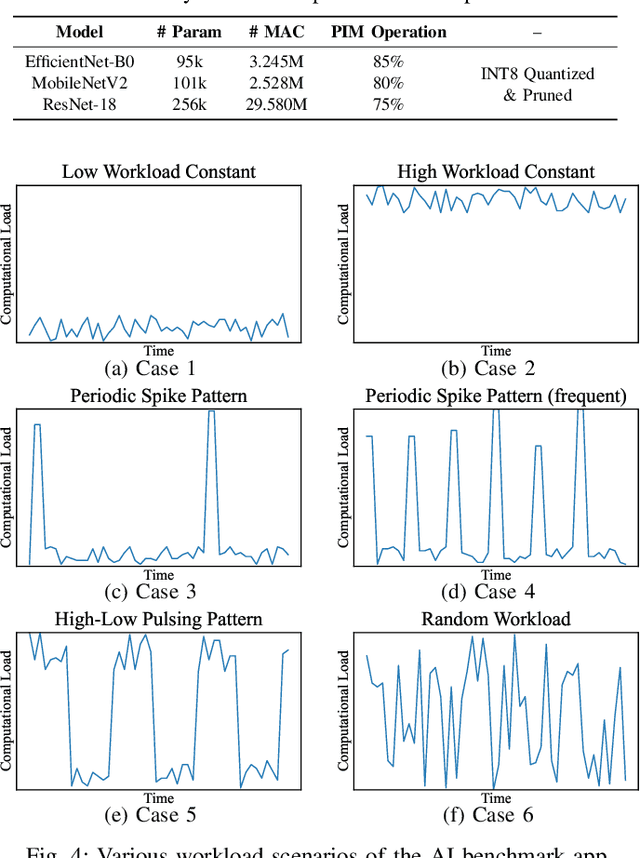
Processing-in-Memory (PIM) architectures offer promising solutions for efficiently handling AI applications in energy-constrained edge environments. While traditional PIM designs enhance performance and energy efficiency by reducing data movement between memory and processing units, they are limited in edge devices due to continuous power demands and the storage requirements of large neural network weights in SRAM and DRAM. Hybrid PIM architectures, incorporating non-volatile memories like MRAM and ReRAM, mitigate these limitations but struggle with a mismatch between fixed computing resources and dynamically changing inference workloads. To address these challenges, this study introduces a Heterogeneous-Hybrid PIM (HH-PIM) architecture, comprising high-performance MRAM-SRAM PIM modules and low-power MRAM-SRAM PIM modules. We further propose a data placement optimization algorithm that dynamically allocates data based on computational demand, maximizing energy efficiency. FPGA prototyping and power simulations with processors featuring HH-PIM and other PIM types demonstrate that the proposed HH-PIM achieves up to $60.43$ percent average energy savings over conventional PIMs while meeting application latency requirements. These results confirm the suitability of HH-PIM for adaptive, energy-efficient AI processing in edge devices.
$^2$: LiDAR-Camera Loop Constraints For Cross-Modal Place Recognition
Apr 17, 2023Localization has been a challenging task for autonomous navigation. A loop detection algorithm must overcome environmental changes for the place recognition and re-localization of robots. Therefore, deep learning has been extensively studied for the consistent transformation of measurements into localization descriptors. Street view images are easily accessible; however, images are vulnerable to appearance changes. LiDAR can robustly provide precise structural information. However, constructing a point cloud database is expensive, and point clouds exist only in limited places. Different from previous works that train networks to produce shared embedding directly between the 2D image and 3D point cloud, we transform both data into 2.5D depth images for matching. In this work, we propose a novel cross-matching method, called (LC)$^2$, for achieving LiDAR localization without a prior point cloud map. To this end, LiDAR measurements are expressed in the form of range images before matching them to reduce the modality discrepancy. Subsequently, the network is trained to extract localization descriptors from disparity and range images. Next, the best matches are employed as a loop factor in a pose graph. Using public datasets that include multiple sessions in significantly different lighting conditions, we demonstrated that LiDAR-based navigation systems could be optimized from image databases and vice versa.