 Add to Chrome
 Add to Firefox
 Add to Edge
TT-SEAL: TTD-Aware Selective Encryption for Adversarially-Robust and Low-Latency Edge AI
Feb 24, 2026
Cloud-edge AI must jointly satisfy model compression and security under tight device budgets. While Tensor-Train Decomposition (TTD) shrinks on-device models, prior selective-encryption studies largely assume dense weights, leaving its practicality under TTD compression unclear. We present TT-SEAL, a selective-encryption framework for TT-decomposed networks. TT-SEAL ranks TT cores with a sensitivity-based importance metric, calibrates a one-time robustness threshold, and uses a value-DP optimizer to encrypt the minimum set of critical cores with AES. Under TTD-aware, transfer-based threat models (and on an FPGA-prototyped edge processor) TT-SEAL matches the robustness of full (black-box) encryption while encrypting as little as 4.89-15.92% of parameters across ResNet-18, MobileNetV2, and VGG-16, and drives the share of AES decryption in end-to-end latency to low single digits (e.g., 58% -> 2.76% on ResNet-18), enabling secure, low-latency edge AI.

HH-PIM: Dynamic Optimization of Power and Performance with Heterogeneous-Hybrid PIM for Edge AI Devices
Apr 02, 2025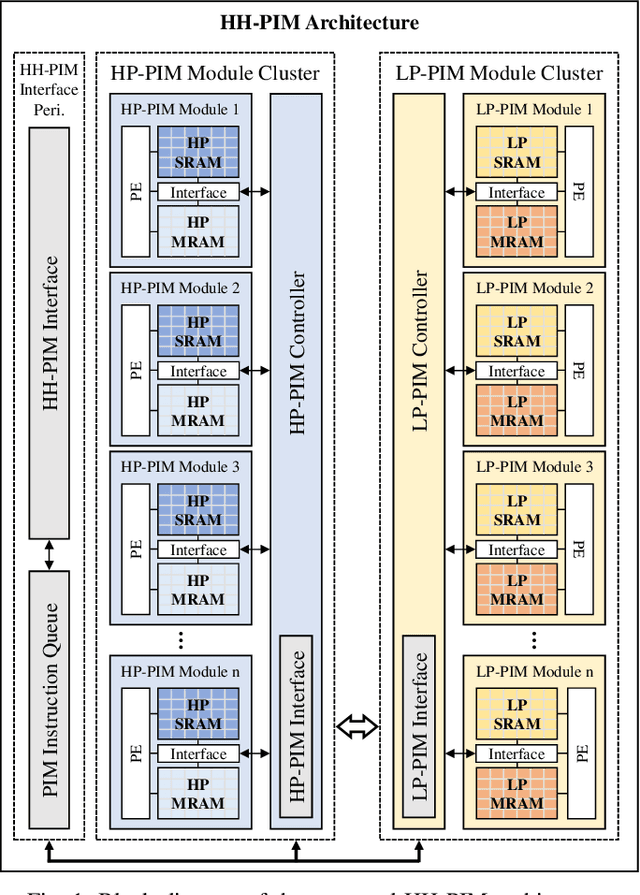
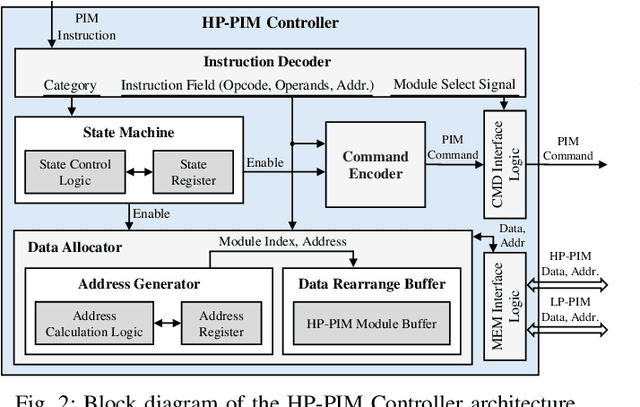
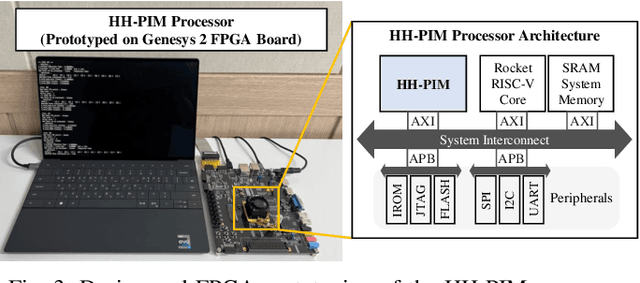
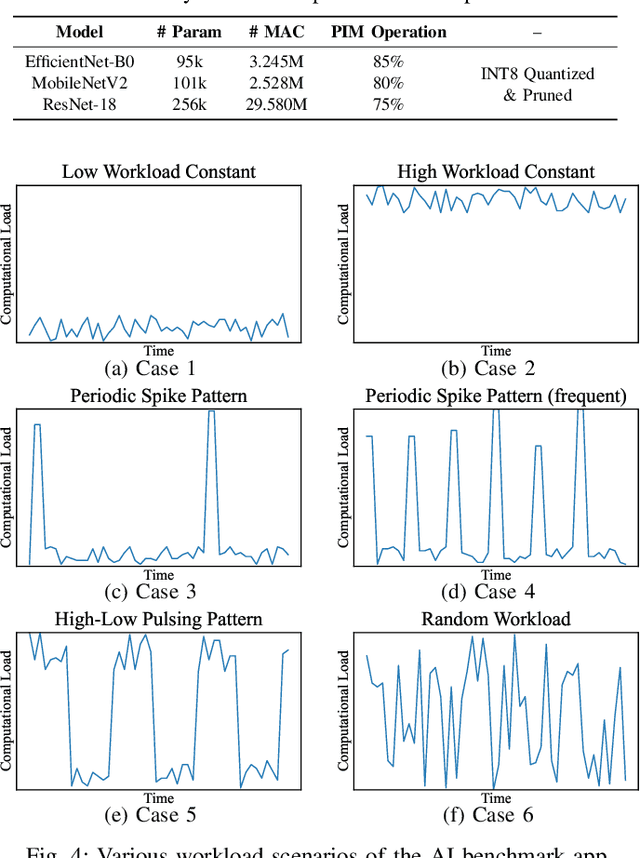
Processing-in-Memory (PIM) architectures offer promising solutions for efficiently handling AI applications in energy-constrained edge environments. While traditional PIM designs enhance performance and energy efficiency by reducing data movement between memory and processing units, they are limited in edge devices due to continuous power demands and the storage requirements of large neural network weights in SRAM and DRAM. Hybrid PIM architectures, incorporating non-volatile memories like MRAM and ReRAM, mitigate these limitations but struggle with a mismatch between fixed computing resources and dynamically changing inference workloads. To address these challenges, this study introduces a Heterogeneous-Hybrid PIM (HH-PIM) architecture, comprising high-performance MRAM-SRAM PIM modules and low-power MRAM-SRAM PIM modules. We further propose a data placement optimization algorithm that dynamically allocates data based on computational demand, maximizing energy efficiency. FPGA prototyping and power simulations with processors featuring HH-PIM and other PIM types demonstrate that the proposed HH-PIM achieves up to $60.43$ percent average energy savings over conventional PIMs while meeting application latency requirements. These results confirm the suitability of HH-PIM for adaptive, energy-efficient AI processing in edge devices.