 Add to Chrome
 Add to Firefox
 Add to Edge
Depth-guided Multi-view Exposure Bracketing for HDR Robot Vision
Aug 17, 2026
Achieving reliable single-shot high dynamic range (HDR) imaging under extreme illumination conditions remains a long-standing challenge, yet no comprehensive benchmark exist for evaluating HDR perception in multi-sensor robotic systems. To fill this gap, we introduce a large-scale dataset collected via a custom robotic vision platform and an iPhone 13 Pro: 121 real-world scenes spanning modest and ultra-high dynamic range conditions, alongside 20 synthetic video sequences from the CARLA simulator. As a reference pipeline for this dataset, we propose Depth-guided Multi-view Exposure Bracketing (DMEB), a single-shot HDR method that distributes drastically different exposures across multi-view low-bit-depth cameras and fuses them via depth-guided confidence-aware fusion. Evaluations on our dataset show that DMEB establishes a strong reference point and highlight the promise of this sensor configuration for robust HDR perception in diverse multi-camera and depth sensor system.

Realistic Compound-Lens Defocus Blur Synthesis
Jul 07, 2026Defocus blur degrades fine image structures and limits visual perception, which can adversely affect downstream vision tasks. Although recent deep learning deblurring methods have achieved strong performance, their effectiveness depends on training data and often degrades across cameras and lenses due to limited optical diversity and realism in existing datasets. In this paper, we propose a pipeline for synthesizing realistic defocus deblurring datasets for diverse compound lenses. It integrates efficient wave-optics PSF computation via Debye CZT propagation, depth-aware defocus rendering with occlusion handling, and blur synthesis in the radiometrically linear space with camera ISP simulation. This unified pipeline enables the scalable generation of photorealistic defocus datasets with diverse lens characteristics. Using our pipeline, we generate CLDefocus, a large-scale synthetic dataset containing lens-diverse defocus image pairs. We further analyze the limitations of real-captured defocus datasets and show that such imperfections can bias full-reference evaluation. Extensive experiments demonstrate that models trained on CLDefocus achieve improved cross-device generalization compared to models trained on existing real and synthetic datasets.
POS-ISP: Pipeline Optimization at the Sequence Level for Task-aware ISP
Apr 08, 2026Recent work has explored optimizing image signal processing (ISP) pipelines for various tasks by composing predefined modules and adapting them to task-specific objectives. However, jointly optimizing module sequences and parameters remains challenging. Existing approaches rely on neural architecture search (NAS) or step-wise reinforcement learning (RL), but NAS suffers from a training-inference mismatch, while step-wise RL leads to unstable training and high computational overhead due to stage-wise decision-making. We propose POS-ISP, a sequence-level RL framework that formulates modular ISP optimization as a global sequence prediction problem. Our method predicts the entire module sequence and its parameters in a single forward pass and optimizes the pipeline using a terminal task reward, eliminating the need for intermediate supervision and redundant executions. Experiments across multiple downstream tasks show that POS-ISP improves task performance while reducing computational cost, highlighting sequence-level optimization as a stable and efficient paradigm for task-aware ISP. The project page is available at https://w1jyun.github.io/POS-ISP
Dynamic Exposure Burst Image Restoration
Mar 23, 2026Burst image restoration aims to reconstruct a high-quality image from burst images, which are typically captured using manually designed exposure settings. Although these exposure settings significantly influence the final restoration performance, the problem of finding optimal exposure settings has been overlooked. In this paper, we present Dynamic Exposure Burst Image Restoration (DEBIR), a novel burst image restoration pipeline that enhances restoration quality by dynamically predicting exposure times tailored to the shooting environment. In our pipeline, Burst Auto-Exposure Network (BAENet) estimates the optimal exposure time for each burst image based on a preview image, as well as motion magnitude and gain. Subsequently, a burst image restoration network reconstructs a high-quality image from burst images captured using these optimal exposure times. For training, we introduce a differentiable burst simulator and a three-stage training strategy. Our experiments demonstrate that our pipeline achieves state-of-the-art restoration quality. Furthermore, we validate the effectiveness of our approach on a real-world camera system, demonstrating its practicality.
Burst Image Super-Resolution with Base Frame Selection
Jun 25, 2024Burst image super-resolution has been a topic of active research in recent years due to its ability to obtain a high-resolution image by using complementary information between multiple frames in the burst. In this work, we explore using burst shots with non-uniform exposures to confront real-world practical scenarios by introducing a new benchmark dataset, dubbed Non-uniformly Exposed Burst Image (NEBI), that includes the burst frames at varying exposure times to obtain a broader range of irradiance and motion characteristics within a scene. As burst shots with non-uniform exposures exhibit varying levels of degradation, fusing information of the burst shots into the first frame as a base frame may not result in optimal image quality. To address this limitation, we propose a Frame Selection Network (FSN) for non-uniform scenarios. This network seamlessly integrates into existing super-resolution methods in a plug-and-play manner with low computational costs. The comparative analysis reveals the effectiveness of the nonuniform setting for the practical scenario and our FSN on synthetic-/real- NEBI datasets.
ParamISP: Learned Forward and Inverse ISPs using Camera Parameters
Dec 20, 2023
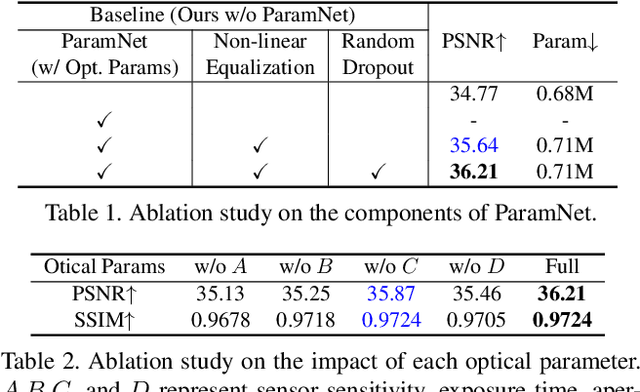

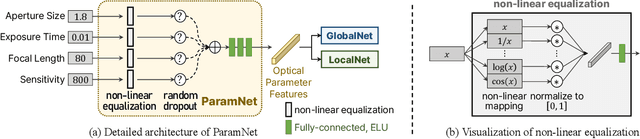
RAW images are rarely shared mainly due to its excessive data size compared to their sRGB counterparts obtained by camera ISPs. Learning the forward and inverse processes of camera ISPs has been recently demonstrated, enabling physically-meaningful RAW-level image processing on input sRGB images. However, existing learning-based ISP methods fail to handle the large variations in the ISP processes with respect to camera parameters such as ISO and exposure time, and have limitations when used for various applications. In this paper, we propose ParamISP, a learning-based method for forward and inverse conversion between sRGB and RAW images, that adopts a novel neural-network module to utilize camera parameters, which is dubbed as ParamNet. Given the camera parameters provided in the EXIF data, ParamNet converts them into a feature vector to control the ISP networks. Extensive experiments demonstrate that ParamISP achieve superior RAW and sRGB reconstruction results compared to previous methods and it can be effectively used for a variety of applications such as deblurring dataset synthesis, raw deblurring, HDR reconstruction, and camera-to-camera transfer.