 Add to Chrome
 Add to Firefox
 Add to Edge
Accelerated Spline-Based Time-Optimal Motion Planning with Continuous Safety Guarantees for Non-Differentially Flat Systems
Mar 25, 2026
Generating time-optimal, collision-free trajectories for autonomous mobile robots involves a fundamental trade-off between guaranteeing safety and managing computational complexity. State-of-the-art approaches formulate spline-based motion planning as a single Optimal Control Problem (OCP) but often suffer from high computational cost because they include separating hyperplane parameters as decision variables to enforce continuous collision avoidance. This paper presents a novel method that alleviates this bottleneck by decoupling the determination of separating hyperplanes from the OCP. By treating the separation theorem as an independent classification problem solvable via a linear system or quadratic program, the proposed method eliminates hyperplane parameters from the optimisation variables, effectively transforming non-convex constraints into linear ones. Experimental validation demonstrates that this decoupled approach reduces trajectory computation times up to almost 60% compared to fully coupled methods in obstacle-rich environments, while maintaining rigorous continuous safety guarantees.

Multi-Agent Motion Planning on Industrial Magnetic Levitation Platforms: A Hybrid ADMM-HOCBF approach
Mar 20, 2026This paper presents a novel hybrid motion planning method for holonomic multi-agent systems. The proposed decentralised model predictive control (MPC) framework tackles the intractability of classical centralised MPC for a growing number of agents while providing safety guarantees. This is achieved by combining a decentralised version of the alternating direction method of multipliers (ADMM) with a centralised high-order control barrier function (HOCBF) architecture. Simulation results show significant improvement in scalability over classical centralised MPC. We validate the efficacy and real-time capability of the proposed method by developing a highly efficient C++ implementation and deploying the resulting trajectories on a real industrial magnetic levitation platform.
Fast Motion Planning for Non-Holonomic Mobile Robots via a Rectangular Corridor Representation of Structured Environments
Feb 10, 2026We present a complete framework for fast motion planning of non-holonomic autonomous mobile robots in highly complex but structured environments. Conventional grid-based planners struggle with scalability, while many kinematically-feasible planners impose a significant computational burden due to their search space complexity. To overcome these limitations, our approach introduces a deterministic free-space decomposition that creates a compact graph of overlapping rectangular corridors. This method enables a significant reduction in the search space, without sacrificing path resolution. The framework then performs online motion planning by finding a sequence of rectangles and generating a near-time-optimal, kinematically-feasible trajectory using an analytical planner. The result is a highly efficient solution for large-scale navigation. We validate our framework through extensive simulations and on a physical robot. The implementation is publicly available as open-source software.
Fast Near Time-Optimal Motion Planning for Holonomic Vehicles in Structured Environments
Feb 02, 2026This paper proposes a novel and efficient optimization-based method for generating near time-optimal trajectories for holonomic vehicles navigating through complex but structured environments. The approach aims to solve the problem of motion planning for planar motion systems using magnetic levitation that can be used in assembly lines, automated laboratories or clean-rooms. In these applications, time-optimal trajectories that can be computed in real-time are required to increase productivity and allow the vehicles to be reactive if needed. The presented approach encodes the environment representation using free-space corridors and represents the motion of the vehicle through such a corridor using a motion primitive. These primitives are selected heuristically and define the trajectory with a limited number of degrees of freedom, which are determined in an optimization problem. As a result, the method achieves significantly lower computation times compared to the state-of-the-art, most notably solving a full Optimal Control Problem (OCP), OMG-tools or VP-STO without significantly compromising optimality within a fixed corridor sequence. The approach is benchmarked extensively in simulation and is validated on a real-world Beckhoff XPlanar system
Safe Motion Planning and Control Using Predictive and Adaptive Barrier Methods for Autonomous Surface Vessels
Oct 01, 2025Safe motion planning is essential for autonomous vessel operations, especially in challenging spaces such as narrow inland waterways. However, conventional motion planning approaches are often computationally intensive or overly conservative. This paper proposes a safe motion planning strategy combining Model Predictive Control (MPC) and Control Barrier Functions (CBFs). We introduce a time-varying inflated ellipse obstacle representation, where the inflation radius is adjusted depending on the relative position and attitude between the vessel and the obstacle. The proposed adaptive inflation reduces the conservativeness of the controller compared to traditional fixed-ellipsoid obstacle formulations. The MPC solution provides an approximate motion plan, and high-order CBFs ensure the vessel's safety using the varying inflation radius. Simulation and real-world experiments demonstrate that the proposed strategy enables the fully-actuated autonomous robot vessel to navigate through narrow spaces in real time and resolve potential deadlocks, all while ensuring safety.
Decoupling Collision Avoidance in and for Optimal Control using Least-Squares Support Vector Machines
May 16, 2025This paper details an approach to linearise differentiable but non-convex collision avoidance constraints tailored to convex shapes. It revisits introducing differential collision avoidance constraints for convex objects into an optimal control problem (OCP) using the separating hyperplane theorem. By framing this theorem as a classification problem, the hyperplanes are eliminated as optimisation variables from the OCP. This effectively transforms non-convex constraints into linear constraints. A bi-level algorithm computes the hyperplanes between the iterations of an optimisation solver and subsequently embeds them as parameters into the OCP. Experiments demonstrate the approach's favourable scalability towards cluttered environments and its applicability to various motion planning approaches. It decreases trajectory computation times between 50\% and 90\% compared to a state-of-the-art approach that directly includes the hyperplanes as variables in the optimal control problem.
Accelerated Reeds-Shepp and Under-Specified Reeds-Shepp Algorithms for Mobile Robot Path Planning
Apr 08, 2025In this study, we present a simple and intuitive method for accelerating optimal Reeds-Shepp path computation. Our approach uses geometrical reasoning to analyze the behavior of optimal paths, resulting in a new partitioning of the state space and a further reduction in the minimal set of viable paths. We revisit and reimplement classic methodologies from the literature, which lack contemporary open-source implementations, to serve as benchmarks for evaluating our method. Additionally, we address the under-specified Reeds-Shepp planning problem where the final orientation is unspecified. We perform exhaustive experiments to validate our solutions. Compared to the modern C++ implementation of the original Reeds-Shepp solution in the Open Motion Planning Library, our method demonstrates a 15x speedup, while classic methods achieve a 5.79x speedup. Both approaches exhibit machine-precision differences in path lengths compared to the original solution. We release our proposed C++ implementations for both the accelerated and under-specified Reeds-Shepp problems as open-source code.
* 19 pages, 27 figures
From Instantaneous to Predictive Control: A More Intuitive and Tunable MPC Formulation for Robot Manipulators
Dec 02, 2024
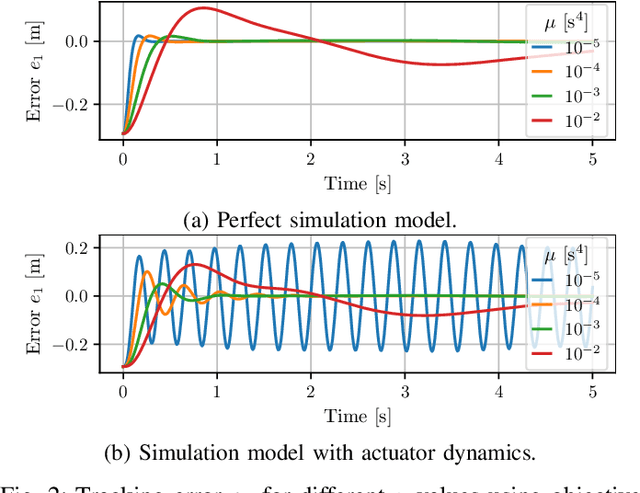

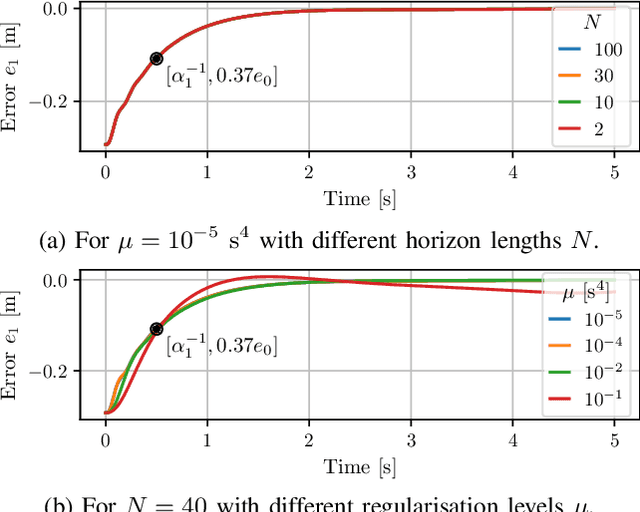
Model predictive control (MPC) has become increasingly popular for the control of robot manipulators due to its improved performance compared to instantaneous control approaches. However, tuning these controllers remains a considerable hurdle. To address this hurdle, we propose a practical MPC formulation which retains the more interpretable tuning parameters of the instantaneous control approach while enhancing the performance through a prediction horizon. The formulation is motivated at hand of a simple example, highlighting the practical tuning challenges associated with typical MPC approaches and showing how the proposed formulation alleviates these challenges. Furthermore, the formulation is validated on a surface-following task, illustrating its applicability to industrially relevant scenarios. Although the research is presented in the context of robot manipulator control, we anticipate that the formulation is more broadly applicable.
Exact Wavefront Propagation for Globally Optimal One-to-All Path Planning on 2D Cartesian Grids
Sep 17, 2024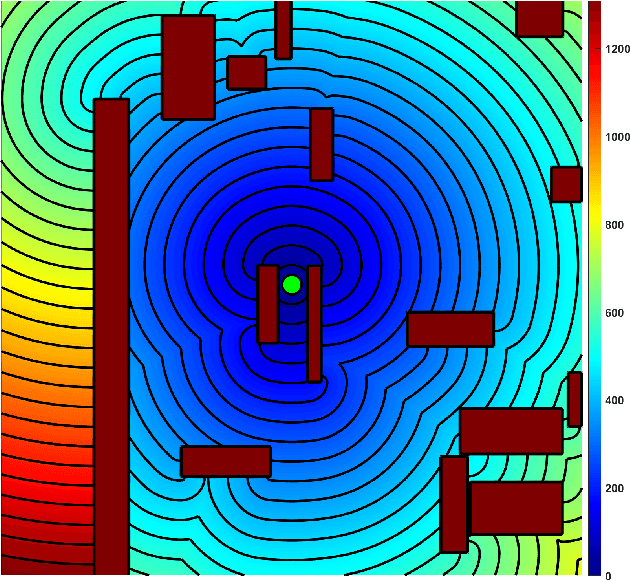

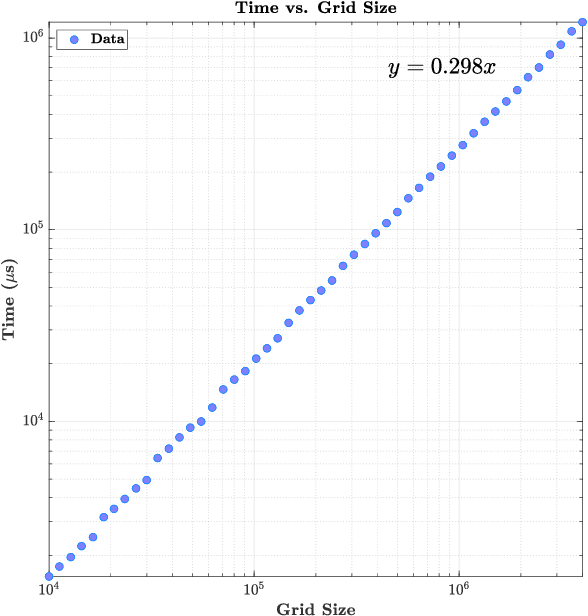
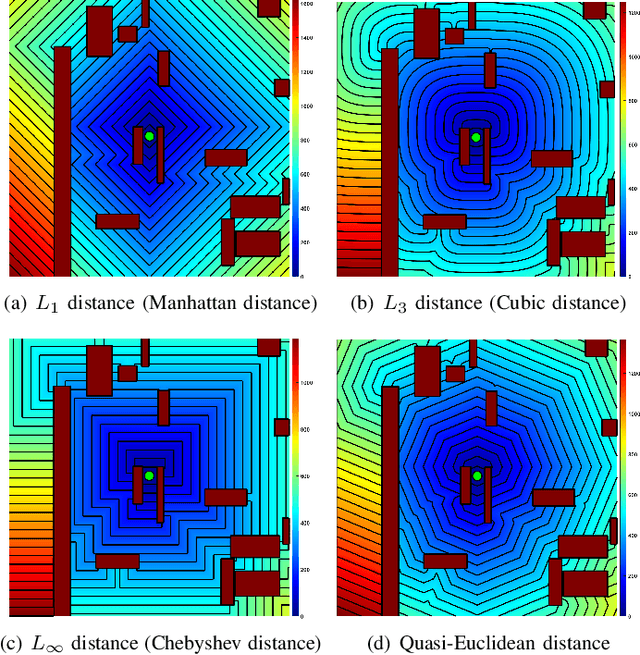
This paper introduces an efficient $\mathcal{O}(n)$ compute and memory complexity algorithm for globally optimal path planning on 2D Cartesian grids. Unlike existing marching methods that rely on approximate discretized solutions to the Eikonal equation, our approach achieves exact wavefront propagation by pivoting the analytic distance function based on visibility. The algorithm leverages a dynamic-programming subroutine to efficiently evaluate visibility queries. Through benchmarking against state-of-the-art any-angle path planners, we demonstrate that our method outperforms existing approaches in both speed and accuracy, particularly in cluttered environments. Notably, our method inherently provides globally optimal paths to all grid points, eliminating the need for additional gradient descent steps per path query. The same capability extends to multiple starting positions. We also provide a greedy version of our algorithm as well as open-source C++ implementation of our solver.
An Efficient Solution to the 2D Visibility Problem in Cartesian Grid Maps and its Application in Heuristic Path Planning
Mar 11, 2024This paper introduces a novel, lightweight method to solve the visibility problem for 2D grids. The proposed method evaluates the existence of lines-of-sight from a source point to all other grid cells in a single pass with no preprocessing and independently of the number and shape of obstacles. It has a compute and memory complexity of $\mathcal{O}(n)$, where $n = n_{x}\times{} n_{y}$ is the size of the grid, and requires at most ten arithmetic operations per grid cell. In the proposed approach, we use a linear first-order hyperbolic partial differential equation to transport the visibility quantity in all directions. In order to accomplish that, we use an entropy-satisfying upwind scheme that converges to the true visibility polygon as the step size goes to zero. This dynamic-programming approach allows the evaluation of visibility for an entire grid orders of magnitude faster than typical ray-casting algorithms. We provide a practical application of our proposed algorithm by posing the visibility quantity as a heuristic and implementing a deterministic, local-minima-free path planner, setting apart the proposed planner from traditional methods. Lastly, we provide necessary algorithms and an open-source implementation of the proposed methods.