 Add to Chrome
 Add to Firefox
 Add to Edge
An Integrated Hardware-Software Design for Low-Data Spatial Defect Detection in Robotic Visual Inspection with Hybrid Optoelectronic Neural Networks
Jun 24, 2026
To address data overload and inefficient shape-level annotation in robotic visual inspection, this paper proposes a hardware-software integrated optoelectronic architecture. A non-imaging, low-data paradigm is established to minimize annotation dependency. First, a sensor-in-the-loop strategy reconfigures a Digital Micromirror Device (DMD) as a physical optical convolutional layer, enabling photonic-domain feature extraction that unifies sensing hardware and processing software. To suppress data volume at the source, a block-based compressed sensing strategy encodes spatial information into low-dimensional temporal signals, drastically reducing redundancy. Subsequently, to bypass laborious manual defect shape annotation, natural language descriptions guide the network to align with highly generalizable features from Contrastive Language-Image Pre-training (CLIP), steering the attention maps of the optoelectronic neural network toward defect shapes. Furthermore, a Localization Accuracy for Attention (LAA) metric is proposed to quantify shape-level defect localization performance. Experiments on transparent material defect detection validate the system's effectiveness. Parametric analysis reveals how measurement matrices, compression ratios, and block sizes affect accuracy. Results show that, compared to traditional imaging, the proposed architecture maintains equivalent accuracy while reducing data volume by 90% for Vision Transformers and computational workload by 60% for Convolutional Neural Networks. This low-data paradigm offers an efficient solution for industrial automation scenarios involving massive data streams, high acquisition costs, or constrained edge resources.

Training-free Ultra Small Model for Universal Sparse Reconstruction in Compressed Sensing
Jan 20, 2025Pre-trained large models attract widespread attention in recent years, but they face challenges in applications that require high interpretability or have limited resources, such as physical sensing, medical imaging, and bioinformatics. Compressed Sensing (CS) is a well-proved theory that drives many recent breakthroughs in these applications. However, as a typical under-determined linear system, CS suffers from excessively long sparse reconstruction times when using traditional iterative methods, particularly with large-scale data. Current AI methods like deep unfolding fail to substitute them because pre-trained models exhibit poor generality beyond their training conditions and dataset distributions, or lack interpretability. Instead of following the big model fervor, this paper proposes ultra-small artificial neural models called coefficients learning (CL), enabling training-free and rapid sparse reconstruction while perfectly inheriting the generality and interpretability of traditional iterative methods, bringing new feature of incorporating prior knowledges. In CL, a signal of length $n$ only needs a minimal of $n$ trainable parameters. A case study model called CLOMP is implemented for evaluation. Experiments are conducted on both synthetic and real one-dimensional and two-dimensional signals, demonstrating significant improvements in efficiency and accuracy. Compared to representative iterative methods, CLOMP improves efficiency by 100 to 1000 folds for large-scale data. Test results on eight diverse image datasets indicate that CLOMP improves structural similarity index by 292%, 98%, 45% for sampling rates of 0.1, 0.3, 0.5, respectively. We believe this method can truly usher CS reconstruction into the AI era, benefiting countless under-determined linear systems that rely on sparse solution.
Adversarial Filtering Based Evasion and Backdoor Attacks to EEG-Based Brain-Computer Interfaces
Dec 10, 2024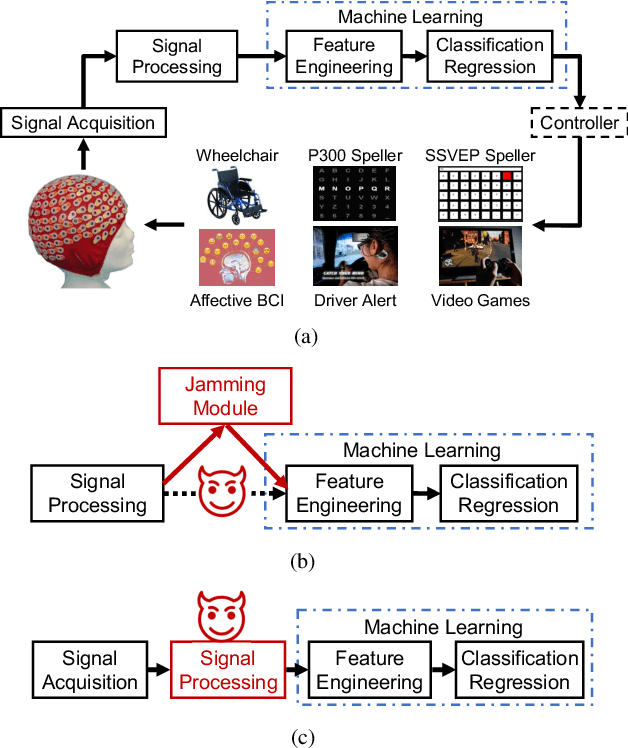
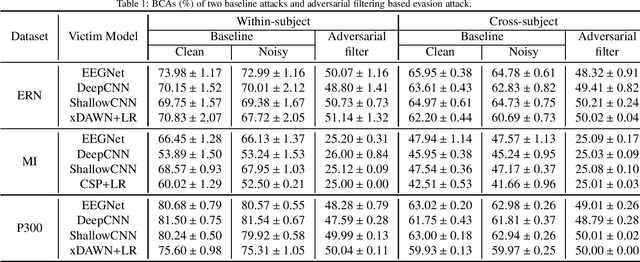
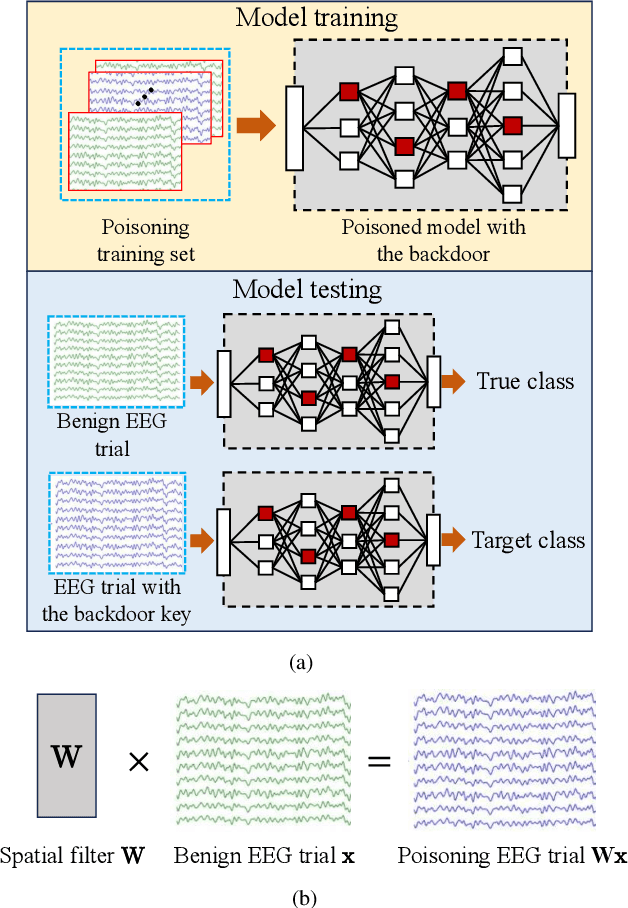
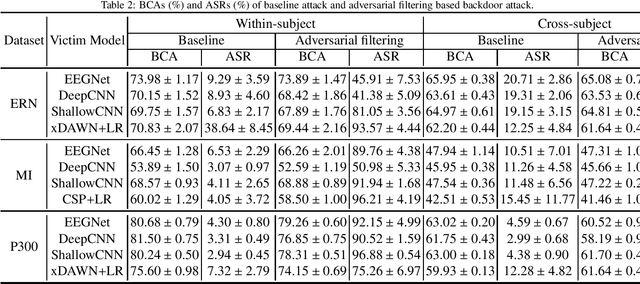
A brain-computer interface (BCI) enables direct communication between the brain and an external device. Electroencephalogram (EEG) is a common input signal for BCIs, due to its convenience and low cost. Most research on EEG-based BCIs focuses on the accurate decoding of EEG signals, while ignoring their security. Recent studies have shown that machine learning models in BCIs are vulnerable to adversarial attacks. This paper proposes adversarial filtering based evasion and backdoor attacks to EEG-based BCIs, which are very easy to implement. Experiments on three datasets from different BCI paradigms demonstrated the effectiveness of our proposed attack approaches. To our knowledge, this is the first study on adversarial filtering for EEG-based BCIs, raising a new security concern and calling for more attention on the security of BCIs.