 Add to Chrome
 Add to Firefox
 Add to Edge
MADCrowner: Margin Aware Dental Crown Design with Template Deformation and Refinement
Mar 05, 2026
Dental crown restoration is one of the most common treatment modalities for tooth defect, where personalized dental crown design is critical. While computer-aided design (CAD) systems have notably enhanced the efficiency of dental crown design, extensive manual adjustments are still required in the clinic workflow. Recent studies have explored the application of learning-based methods for the automated generation of restorative dental crowns. Nevertheless, these approaches were challenged by inadequate spatial resolution, noisy outputs, and overextension of surface reconstruction. To address these limitations, we propose \totalframework, a margin-aware mesh generation framework comprising CrownDeformR and CrownSegger. Inspired by the clinic manual workflow of dental crown design, we designed CrownDeformR to deform an initial template to the target crown based on anatomical context, which is extracted by a multi-scale intraoral scan encoder. Additionally, we introduced \marginseg, a novel margin segmentation network, to extract the cervical margin of the target tooth. The performance of CrownDeformR improved with the cervical margin as an extra constraint. And it was also utilized as the boundary condition for the tailored postprocessing method, which removed the overextended area of the reconstructed surface. We constructed a large-scale intraoral scan dataset and performed extensive experiments. The proposed method significantly outperformed existing approaches in both geometric accuracy and clinical feasibility.

VBCD: A Voxel-Based Framework for Personalized Dental Crown Design
Jul 23, 2025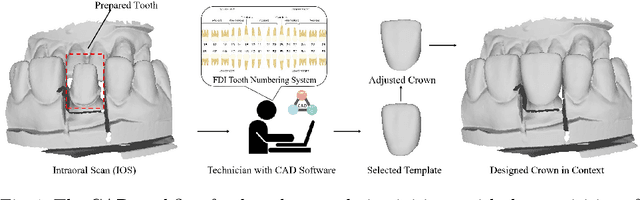
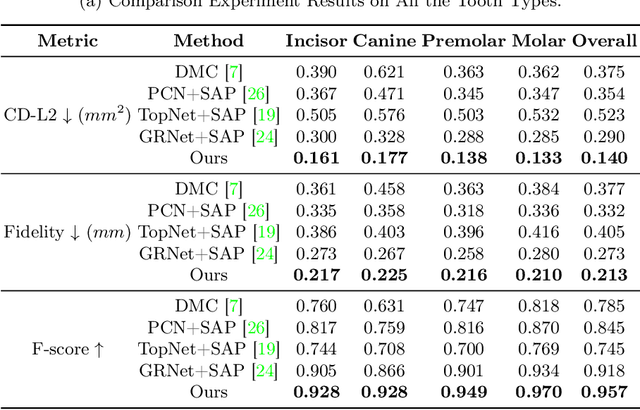
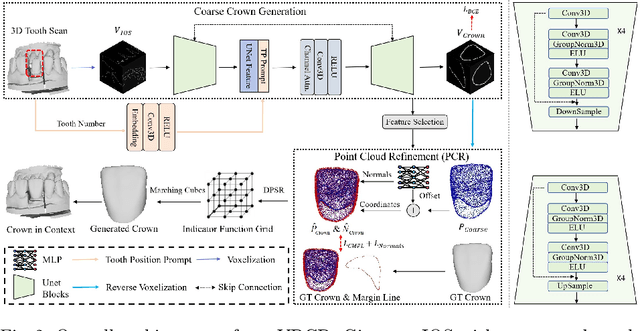
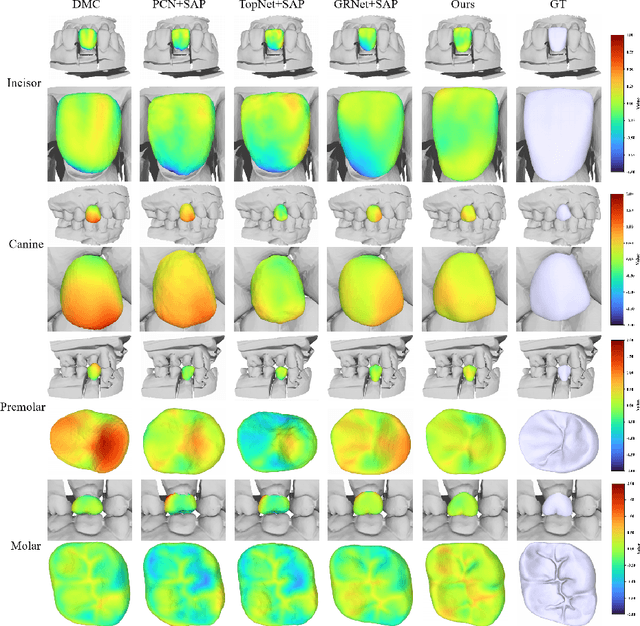
The design of restorative dental crowns from intraoral scans is labor-intensive for dental technicians. To address this challenge, we propose a novel voxel-based framework for automated dental crown design (VBCD). The VBCD framework generates an initial coarse dental crown from voxelized intraoral scans, followed by a fine-grained refiner incorporating distance-aware supervision to improve accuracy and quality. During the training stage, we employ the Curvature and Margin line Penalty Loss (CMPL) to enhance the alignment of the generated crown with the margin line. Additionally, a positional prompt based on the FDI tooth numbering system is introduced to further improve the accuracy of the generated dental crowns. Evaluation on a large-scale dataset of intraoral scans demonstrated that our approach outperforms existing methods, providing a robust solution for personalized dental crown design.