 Add to Chrome
 Add to Firefox
 Add to Edge
AdaSR: Adaptive Streaming Reasoning with Hierarchical Relative Policy Optimization
Jun 12, 2026
Large reasoning models typically follow a read-then-think paradigm: they observe the complete input, reason over a static context, and then produce the answer. Yet many real-world scenarios are inherently dynamic, such as audio and video stream, where information arrives as a continuous stream and models must reason, update, and respond under partial observations. Recent streaming reasoning methods allow models to think while reading, but they largely rely on supervised imitation of pre-constructed trajectories, which limits their flexibility. In this paper, we propose AdaSR, an adaptive streaming reasoning framework that enables models to reason during input streaming and perform final deliberation once the stream is complete, learning when to think, and how much computation to allocate across different stages. To optimize this hierarchical reasoning process, we introduce Hierarchical Relative Policy Optimization (HRPO), which decomposes policy optimization into streaming reasoning and deep reasoning phases, providing more fine-grained advantage assignment instead of uniformly distributing a single sequence-level advantage over all tokens. HRPO integrates format, accuracy, and adaptive thinking rewards to enforce valid reasoning protocols, preserve final task performance, and encourage latency-aware computation allocation. Experiments show that AdaSR achieves a better balance among reasoning accuracy, computational efficiency, and streaming latency compared with supervised fine-tuning baseline. We release our code at https://github.com/EIT-NLP/StreamingLLM/tree/main/AdaSR.

Uni-PrevPredMap: Extending PrevPredMap to a Unified Framework of Prior-Informed Modeling for Online Vectorized HD Map Construction
Apr 10, 2025Safety constitutes a foundational imperative for autonomous driving systems, necessitating the maximal incorporation of accessible external prior information. This study establishes that temporal perception buffers and cost-efficient maps inherently form complementary prior sources for online vectorized high-definition (HD) map construction. We present Uni-PrevPredMap, a unified prior-informed framework that systematically integrates two synergistic information sources: previous predictions and simulated outdated HD maps. The framework introduces two core innovations: a tile-indexed 3D vectorized global map processor enabling efficient refreshment, storage, and retrieval of 3D vectorized priors; a tri-mode operational optimization paradigm ensuring consistency across non-prior, temporal-prior, and temporal-map-fusion-prior scenarios while mitigating reliance on idealized map fidelity assumptions. Uni-PrevPredMap achieves state-of-the-art performance in map-absent scenarios across established online vectorized HD map construction benchmarks. When provided with simulated outdated HD maps, the framework exhibits robust capabilities in error-resilient prior fusion, empirically confirming the synergistic complementarity between previous predictions and simulated outdated HD maps. Code will be available at https://github.com/pnnnnnnn/Uni-PrevPredMap.
Dive into the Resolution Augmentations and Metrics in Low Resolution Face Recognition: A Plain yet Effective New Baseline
Feb 11, 2023

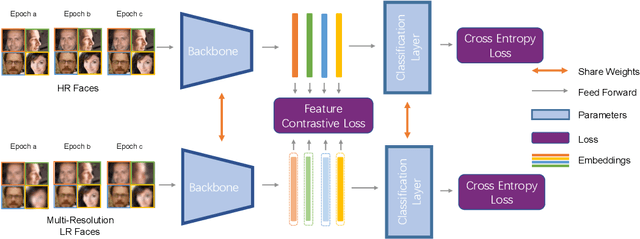

Although deep learning has significantly improved Face Recognition (FR), dramatic performance deterioration may occur when processing Low Resolution (LR) faces. To alleviate this, approaches based on unified feature space are proposed with the sacrifice under High Resolution (HR) circumstances. To deal with the huge domain gap between HR and LR domains and achieve the best on both domains, we first took a closer look at the impacts of several resolution augmentations and then analyzed the difficulty of LR samples from the perspective of the model gradient produced by different resolution samples. Besides, we also find that the introduction of some resolutions could help the learning of lower resolutions. Based on these, we divide the LR samples into three difficulties according to the resolution and propose a more effective Multi-Resolution Augmentation. Then, due to the rapidly increasing domain gap as the resolution decreases, we carefully design a novel and effective metric loss based on a LogExp distance function that provides decent gradients to prevent oscillation near the convergence point or tolerance to small distance errors; it could also dynamically adjust the penalty for errors in different dimensions, allowing for more optimization of dimensions with large errors. Combining these two insights, our model could learn more general knowledge in a wide resolution range of images and balanced results can be achieved by our extremely simple framework. Moreover, the augmentations and metrics are the cornerstones of LRFR, so our method could be considered a new baseline for the LRFR task. Experiments on the LRFR datasets: SCface, XQLFW, and large-scale LRFR dataset: TinyFace demonstrate the effectiveness of our methods, while the degradation on HRFR datasets is significantly reduced.