 Add to Chrome
 Add to Firefox
 Add to Edge
FiLM-Coordinated Dual-Branch Transformer for Global-Local Dependency Modeling in Language Modeling
Jun 19, 2026
Standard Transformers use a single self-attention pathway to model both global dependencies and local patterns, creating tension between long-range structural reasoning and fine-grained local representation learning. We propose a FiLM-coordinated dual-branch Transformer for language modeling, where each layer explicitly contains a global branch and a local branch, and feature-wise linear modulation (FiLM) is used for dynamic cross-branch coordination instead of simple concatenation or static addition. The key idea is that the two branches represent different dependency views of the same input, making channel-wise calibration more suitable than heavy token-level interaction. We therefore design a bidirectional FiLM module in which each branch generates per-channel scaling and shifting parameters to condition the other. Experiments on multiple small-scale language modeling settings show that the proposed structure consistently outperforms same-width single-branch baselines and weakened dual-branch variants under a fixed lightweight configuration. On TinyShakespeare and a 1M-character subset of WikiText-2, the full dual-branch FiLM model achieves the best results among same-width structural baselines. Multi-seed results support the stability of the gains, while mechanistic analyses show that FiLM learns input-dependent, layer-dependent, and channel-selective modulation patterns rather than static scaling. Parameter-matched widened single-branch baselines also indicate that the current design still leaves room for improvement in parameter efficiency.

TriAdReview: Triangular Adversarial Review Architecture for Multi-Model Technical Document Generation
Jun 13, 2026Large language models (LLMs) are increasingly used for technical document generation, yet single-model outputs often suffer from over-engineering, security blind spots, and incomplete coverage. We propose TriAdReview, a triangular adversarial review architecture that employs two independent reviewer models (engineering and boundary perspectives) and a triangular judging mechanism to iteratively improve a generator model's output. We evaluate TriAdReview across five benchmark tasks - architecture design, code generation, proposal review, security audit, and requirements analysis - using three configurations: single model (baseline), dual model (single review), and triple model (full system). Results across 75 experiments (n=5 per cell) show that the triple model configuration achieves a 10.1% overall improvement over the single model baseline (26.2 vs. 23.8 out of 50; p<0.05, paired t-test), with particularly strong gains on security audit (+27.6%), code generation (+20.8%), and architecture design (+15.6%). A second scorer (mimo-v2.5-pro) confirms the direction with a smaller effect (+2.7%), suggesting moderate inter-rater agreement. However, the system shows a -7.5% degradation on requirements analysis, revealing that adversarial review architectures have a structural bias toward simplification that is counterproductive for completeness-oriented tasks. We analyze this boundary condition through a task-type framework and demonstrate that reviewer prompt adaptation partially mitigates the issue. Our findings provide the first empirical characterization of when multi-model adversarial review helps versus harms, with implications for the design of collaborative AI systems.
Dive into the Resolution Augmentations and Metrics in Low Resolution Face Recognition: A Plain yet Effective New Baseline
Feb 11, 2023

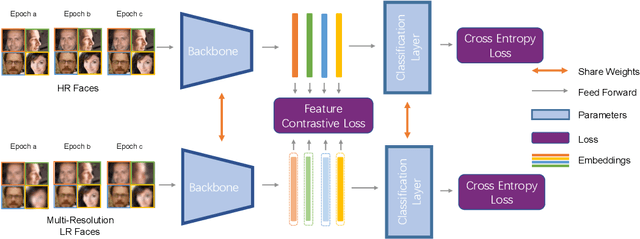

Although deep learning has significantly improved Face Recognition (FR), dramatic performance deterioration may occur when processing Low Resolution (LR) faces. To alleviate this, approaches based on unified feature space are proposed with the sacrifice under High Resolution (HR) circumstances. To deal with the huge domain gap between HR and LR domains and achieve the best on both domains, we first took a closer look at the impacts of several resolution augmentations and then analyzed the difficulty of LR samples from the perspective of the model gradient produced by different resolution samples. Besides, we also find that the introduction of some resolutions could help the learning of lower resolutions. Based on these, we divide the LR samples into three difficulties according to the resolution and propose a more effective Multi-Resolution Augmentation. Then, due to the rapidly increasing domain gap as the resolution decreases, we carefully design a novel and effective metric loss based on a LogExp distance function that provides decent gradients to prevent oscillation near the convergence point or tolerance to small distance errors; it could also dynamically adjust the penalty for errors in different dimensions, allowing for more optimization of dimensions with large errors. Combining these two insights, our model could learn more general knowledge in a wide resolution range of images and balanced results can be achieved by our extremely simple framework. Moreover, the augmentations and metrics are the cornerstones of LRFR, so our method could be considered a new baseline for the LRFR task. Experiments on the LRFR datasets: SCface, XQLFW, and large-scale LRFR dataset: TinyFace demonstrate the effectiveness of our methods, while the degradation on HRFR datasets is significantly reduced.
Learn From All: Erasing Attention Consistency for Noisy Label Facial Expression Recognition
Jul 21, 2022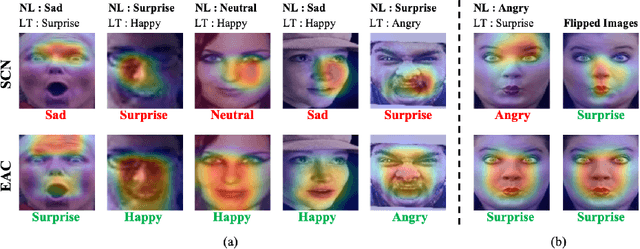
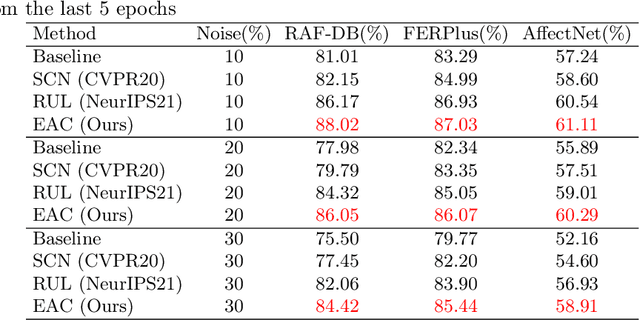
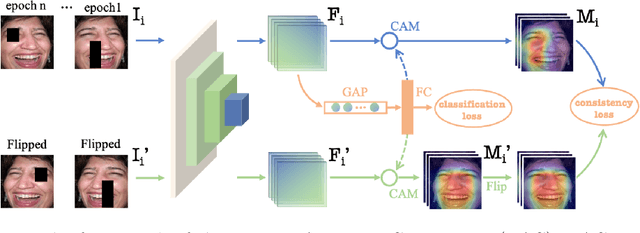

Noisy label Facial Expression Recognition (FER) is more challenging than traditional noisy label classification tasks due to the inter-class similarity and the annotation ambiguity. Recent works mainly tackle this problem by filtering out large-loss samples. In this paper, we explore dealing with noisy labels from a new feature-learning perspective. We find that FER models remember noisy samples by focusing on a part of the features that can be considered related to the noisy labels instead of learning from the whole features that lead to the latent truth. Inspired by that, we propose a novel Erasing Attention Consistency (EAC) method to suppress the noisy samples during the training process automatically. Specifically, we first utilize the flip semantic consistency of facial images to design an imbalanced framework. We then randomly erase input images and use flip attention consistency to prevent the model from focusing on a part of the features. EAC significantly outperforms state-of-the-art noisy label FER methods and generalizes well to other tasks with a large number of classes like CIFAR100 and Tiny-ImageNet. The code is available at https://github.com/zyh-uaiaaaa/Erasing-Attention-Consistency.