 Add to Chrome
 Add to Firefox
 Add to Edge
Spatio-Temporal Reconnection for Multi-Robot Networks using Adaptive Prescribed-Time CBFs
Jun 01, 2026
In multi-robot systems, maintaining persistent communication graph connectivity is often overly restrictive, especially when robots have limited communication ranges but operate in large environments. Instead, allowing robots to temporarily disconnect and later reconnect is often more desirable for efficient task execution while still ensuring timely information sharing across the team. In this paper, we propose an adaptive prescribed-time control barrier function (adaptive PT-CBF) framework that enables robots to temporarily disconnect and re-enter the communication range within an adjustable and feasible prescribed time. Moreover, we introduce a reconnection triggering mechanism that jointly considers task execution and reconnection urgency, thereby providing a principled way to decide when reconnection should occur. Theoretical analysis justifies convergence to the satisfying reconnection within a prescribed finite time. Experimental results validate the performance of our proposed adaptive PT-CBF with improved task efficiency and satisfying reconnections.

Geometry-Aware Control Barrier Functions for Collision Avoidance via Bernstein Polynomial Approximations
May 29, 2026Safe navigation often relies on well-defined conditions based on the shape of robots and obstacles, and can be challenging when they have irregular geometries. While Control Barrier Functions (CBFs) offer an efficient mechanism to enforce safe set forward invariance, common shape surrogates (e.g., spheres or super-ellipsoids) either are overly conservative in unstructured scenes or require many local primitives, which inflates constraint counts and degrades real-time performance. In this paper, we introduce a novel geometry-aware Control Barrier Function (CBF) based on Bernstein-Polynomial Signed Distance Fields (BP-SDFs). It provides a unified way to represent the obstacles and robots, so as to represent the barrier function with a unified minimum distance. Benefiting from the differentiability of the Bernstein polynomials, one can easily enforce the control constraints in a closed loop. We validate the method's efficiency and performance to guarantee safety in single-robot navigation and heterogeneous multi-robot collision avoidance via simulations under different environments.
Capability-Aware Heterogeneous Control Barrier Functions for Decentralized Multi-Robot Safe Navigation
Apr 14, 2026Safe navigation for multi-robot systems requires enforcing safety without sacrificing task efficiency under decentralized decision-making. Existing decentralized methods often assume robot homogeneity, making shared safety requirements non-uniformly interpreted across heterogeneous agents with structurally different dynamics, which could lead to avoidance obligations not physically realizable for some robots and thus cause safety violations or deadlock. In this paper, we propose Capability-Aware Heterogeneous Control Barrier Function (CA-HCBF), a decentralized framework for consistent safety enforcement and capability-aware coordination in heterogeneous robot teams. We derive a canonical second-order control-affine representation that unifies holonomic and nonholonomic robots under acceleration-level control via canonical transformation and backstepping, preserving forward invariance of the safe set while avoiding relative-degree mismatch across heterogeneous dynamics. We further introduce a support-function-based directional capability metric that quantifies each robot's ability to follow its motion intent, deriving a pairwise responsibility allocation that distributes the safety burden proportionally to each robot's motion capability. A feasibility-aware clipping mechanism further constrains the allocation to each agent's physically achievable range, mitigating infeasible constraint assignments common in dense decentralized CBF settings. Simulations with up to 30 heterogeneous robots and a physical multi-robot demonstration show improved safety and task efficiency over baselines, validating real-world applicability across robots with distinct kinematic constraints.
TraceMark-LDM: Authenticatable Watermarking for Latent Diffusion Models via Binary-Guided Rearrangement
Mar 30, 2025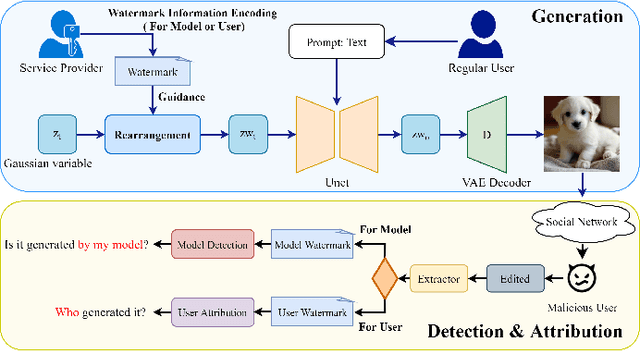
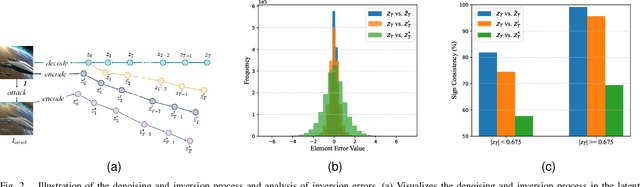
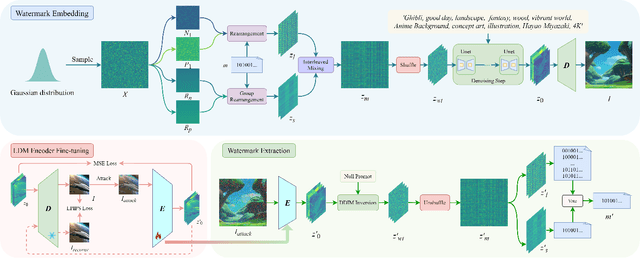
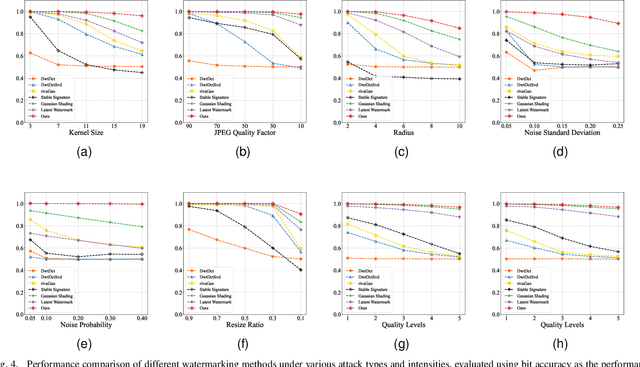
Image generation algorithms are increasingly integral to diverse aspects of human society, driven by their practical applications. However, insufficient oversight in artificial Intelligence generated content (AIGC) can facilitate the spread of malicious content and increase the risk of copyright infringement. Among the diverse range of image generation models, the Latent Diffusion Model (LDM) is currently the most widely used, dominating the majority of the Text-to-Image model market. Currently, most attribution methods for LDMs rely on directly embedding watermarks into the generated images or their intermediate noise, a practice that compromises both the quality and the robustness of the generated content. To address these limitations, we introduce TraceMark-LDM, an novel algorithm that integrates watermarking to attribute generated images while guaranteeing non-destructive performance. Unlike current methods, TraceMark-LDM leverages watermarks as guidance to rearrange random variables sampled from a Gaussian distribution. To mitigate potential deviations caused by inversion errors, the small absolute elements are grouped and rearranged. Additionally, we fine-tune the LDM encoder to enhance the robustness of the watermark. Experimental results show that images synthesized using TraceMark-LDM exhibit superior quality and attribution accuracy compared to state-of-the-art (SOTA) techniques. Notably, TraceMark-LDM demonstrates exceptional robustness against various common attack methods, consistently outperforming SOTA methods.
Distributed Multi-robot Source Seeking in Unknown Environments with Unknown Number of Sources
Mar 14, 2025We introduce a novel distributed source seeking framework, DIAS, designed for multi-robot systems in scenarios where the number of sources is unknown and potentially exceeds the number of robots. Traditional robotic source seeking methods typically focused on directing each robot to a specific strong source and may fall short in comprehensively identifying all potential sources. DIAS addresses this gap by introducing a hybrid controller that identifies the presence of sources and then alternates between exploration for data gathering and exploitation for guiding robots to identified sources. It further enhances search efficiency by dividing the environment into Voronoi cells and approximating source density functions based on Gaussian process regression. Additionally, DIAS can be integrated with existing source seeking algorithms. We compare DIAS with existing algorithms, including DoSS and GMES in simulated gas leakage scenarios where the number of sources outnumbers or is equal to the number of robots. The numerical results show that DIAS outperforms the baseline methods in both the efficiency of source identification by the robots and the accuracy of the estimated environmental density function.
Merry-Go-Round: Safe Control of Decentralized Multi-Robot Systems with Deadlock Prevention
Mar 07, 2025We propose a hybrid approach for decentralized multi-robot navigation that ensures both safety and deadlock prevention. Building on a standard control formulation, we add a lightweight deadlock prevention mechanism by forming temporary "roundabouts" (circular reference paths). Each robot relies only on local, peer-to-peer communication and a controller for base collision avoidance; a roundabout is generated or joined on demand to avert deadlocks. Robots in the roundabout travel in one direction until an escape condition is met, allowing them to return to goal-oriented motion. Unlike classical decentralized methods that lack explicit deadlock resolution, our roundabout maneuver ensures system-wide forward progress while preserving safety constraints. Extensive simulations and physical robot experiments show that our method consistently outperforms or matches the success and arrival rates of other decentralized control approaches, particularly in cluttered or high-density scenarios, all with minimal centralized coordination.
DyPNIPP: Predicting Environment Dynamics for RL-based Robust Informative Path Planning
Oct 22, 2024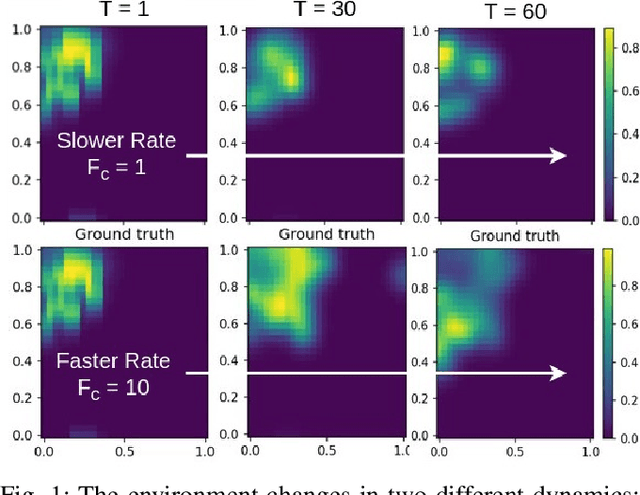
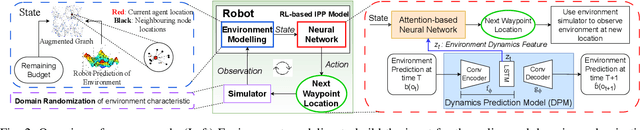
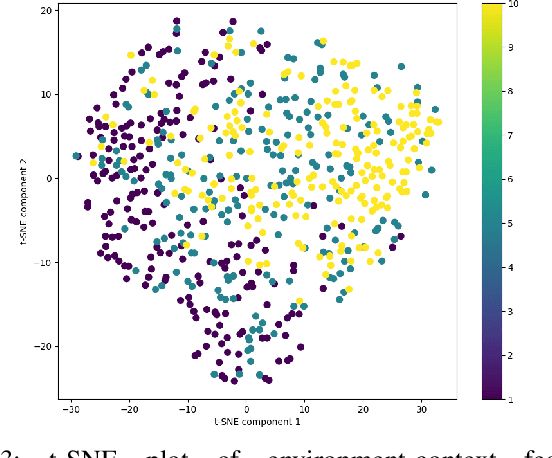
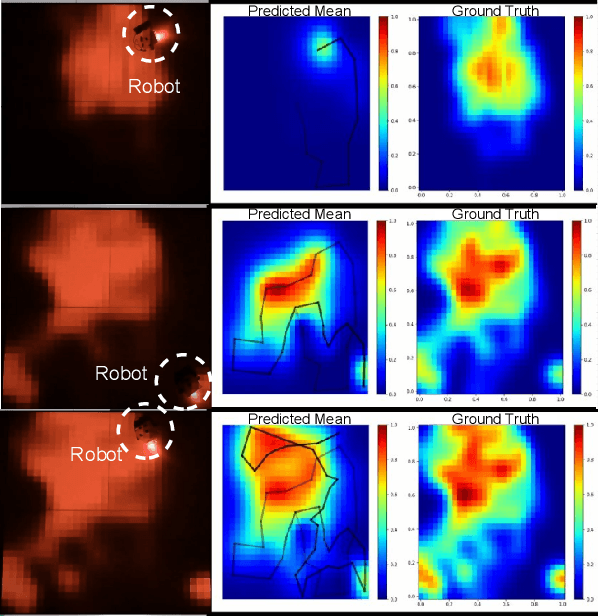
Informative path planning (IPP) is an important planning paradigm for various real-world robotic applications such as environment monitoring. IPP involves planning a path that can learn an accurate belief of the quantity of interest, while adhering to planning constraints. Traditional IPP methods typically require high computation time during execution, giving rise to reinforcement learning (RL) based IPP methods. However, the existing RL-based methods do not consider spatio-temporal environments which involve their own challenges due to variations in environment characteristics. In this paper, we propose DyPNIPP, a robust RL-based IPP framework, designed to operate effectively across spatio-temporal environments with varying dynamics. To achieve this, DyPNIPP incorporates domain randomization to train the agent across diverse environments and introduces a dynamics prediction model to capture and adapt the agent actions to specific environment dynamics. Our extensive experiments in a wildfire environment demonstrate that DyPNIPP outperforms existing RL-based IPP algorithms by significantly improving robustness and performing across diverse environment conditions.
Integrating Online Learning and Connectivity Maintenance for Communication-Aware Multi-Robot Coordination
Oct 08, 2024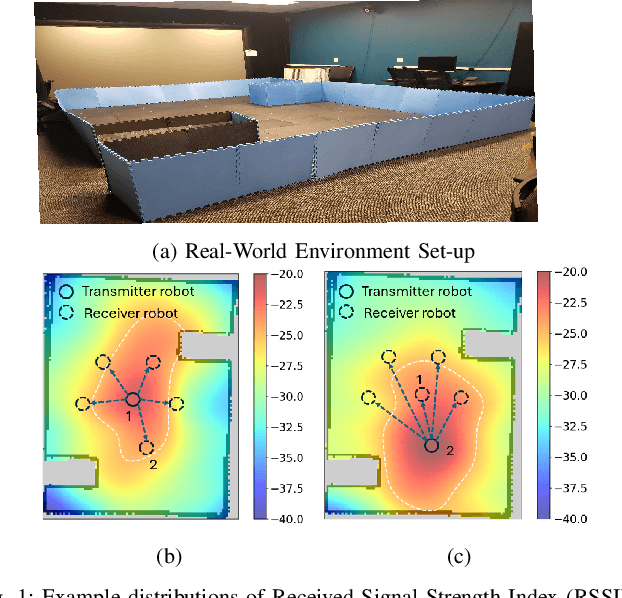
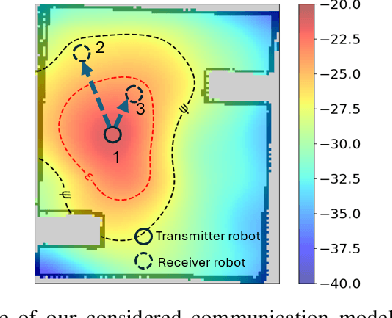
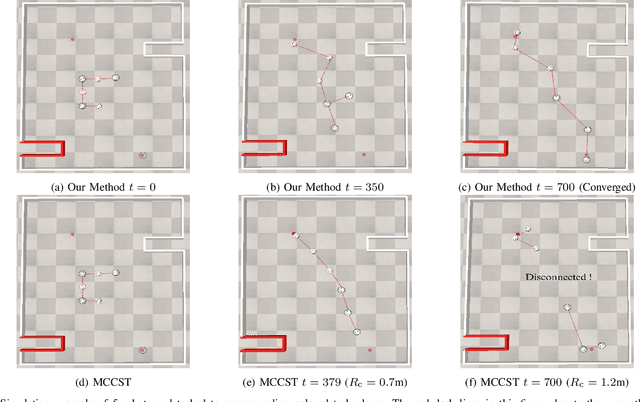
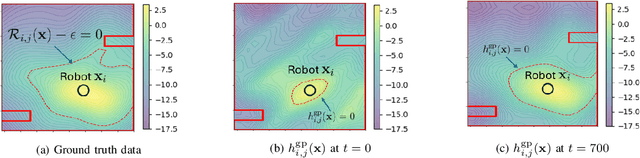
This paper proposes a novel data-driven control strategy for maintaining connectivity in networked multi-robot systems. Existing approaches often rely on a pre-determined communication model specifying whether pairwise robots can communicate given their relative distance to guide the connectivity-aware control design, which may not capture real-world communication conditions. To relax that assumption, we present the concept of Data-driven Connectivity Barrier Certificates, which utilize Control Barrier Functions (CBF) and Gaussian Processes (GP) to characterize the admissible control space for pairwise robots based on communication performance observed online. This allows robots to maintain a satisfying level of pairwise communication quality (measured by the received signal strength) while in motion. Then we propose a Data-driven Connectivity Maintenance (DCM) algorithm that combines (1) online learning of the communication signal strength and (2) a bi-level optimization-based control framework for the robot team to enforce global connectivity of the realistic multi-robot communication graph and minimally deviate from their task-related motions. We provide theoretical proofs to justify the properties of our algorithm and demonstrate its effectiveness through simulations with up to 20 robots.
OffRIPP: Offline RL-based Informative Path Planning
Sep 25, 2024


Informative path planning (IPP) is a crucial task in robotics, where agents must design paths to gather valuable information about a target environment while adhering to resource constraints. Reinforcement learning (RL) has been shown to be effective for IPP, however, it requires environment interactions, which are risky and expensive in practice. To address this problem, we propose an offline RL-based IPP framework that optimizes information gain without requiring real-time interaction during training, offering safety and cost-efficiency by avoiding interaction, as well as superior performance and fast computation during execution -- key advantages of RL. Our framework leverages batch-constrained reinforcement learning to mitigate extrapolation errors, enabling the agent to learn from pre-collected datasets generated by arbitrary algorithms. We validate the framework through extensive simulations and real-world experiments. The numerical results show that our framework outperforms the baselines, demonstrating the effectiveness of the proposed approach.
Courteous MPC for Autonomous Driving with CBF-inspired Risk Assessment
Aug 23, 2024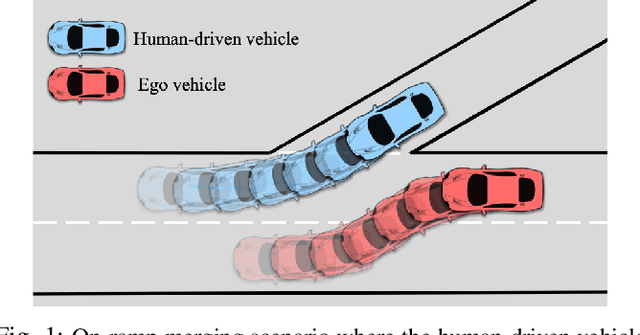
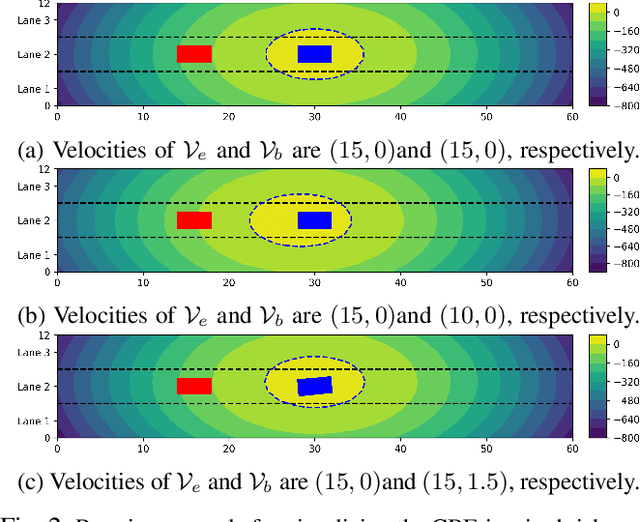
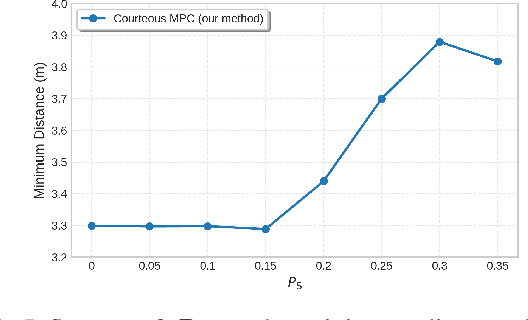
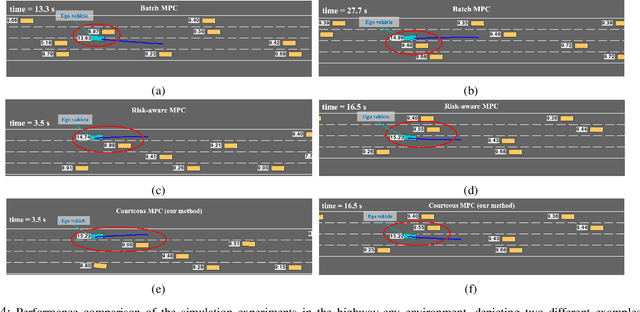
With more autonomous vehicles (AVs) sharing roadways with human-driven vehicles (HVs), ensuring safe and courteous maneuvers that respect HVs' behavior becomes increasingly important. To promote both safety and courtesy in AV's behavior, an extension of Control Barrier Functions (CBFs)-inspired risk evaluation framework is proposed in this paper by considering both noisy observed positions and velocities of surrounding vehicles. The perceived risk by the ego vehicle can be visualized as a risk map that reflects the understanding of the surrounding environment and thus shows the potential for facilitating safe and courteous driving. By incorporating the risk evaluation framework into the Model Predictive Control (MPC) scheme, we propose a Courteous MPC for ego AV to generate courteous behaviors that 1) reduce the overall risk imposed on other vehicles and 2) respect the hard safety constraints and the original objective for efficiency. We demonstrate the performance of the proposed Courteous MPC via theoretical analysis and simulation experiments.