 Add to Chrome
 Add to Firefox
 Add to Edge
Learning the Riccati solution operator for time-varying LQR via Deep Operator Networks
Apr 21, 2026
We propose a computational framework for replacing the repeated numerical solution of differential Riccati equations in finite-horizon Linear Quadratic Regulator (LQR) problems by a learned operator surrogate. Instead of solving a nonlinear matrix-valued differential equation for each new system instance, we construct offline an approximation of the associated solution operator mapping time-dependent system parameters to the Riccati trajectory. The resulting model enables fast online evaluation of approximate optimal feedbacks across a wide class of systems, thereby shifting the computational burden from repeated numerical integration to a one-time learning stage. From a theoretical perspective, we establish control-theoretic guarantees for this operator-based approximation. In particular, we derive bounds quantifying how operator approximation errors propagate to feedback performance, trajectory accuracy, and cost suboptimality, and we prove that exponential stability of the closed-loop system is preserved under sufficiently accurate operator approximation. These results provide a framework to assess the reliability of data-driven approximations in optimal control. On the computational side, we design tailored DeepONet architectures for matrix-valued, time-dependent problems and introduce a progressive learning strategy to address scalability with respect to the system dimension. Numerical experiments on both time-invariant and time-varying LQR problems demonstrate that the proposed approach achieves high accuracy and strong generalization across a wide range of system configurations, while delivering substantial computational speedups compared to classical solvers. The method offers an effective and scalable alternative for parametric and real-time optimal control applications.

Courteous MPC for Autonomous Driving with CBF-inspired Risk Assessment
Aug 23, 2024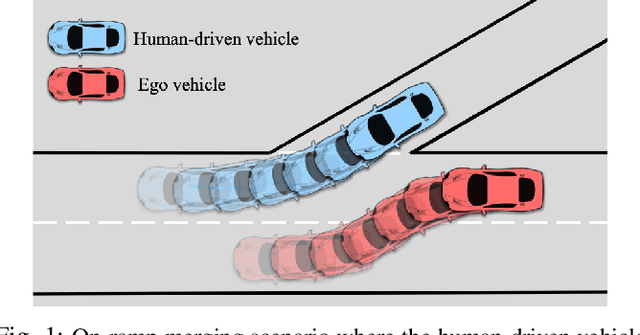
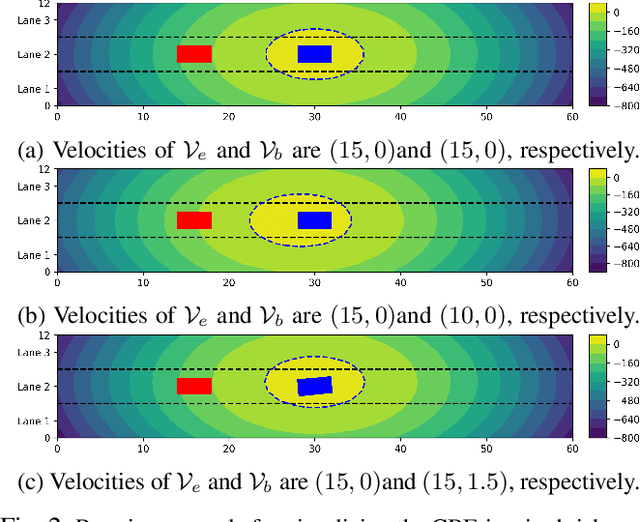
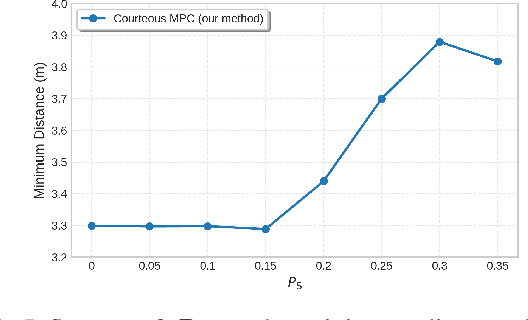
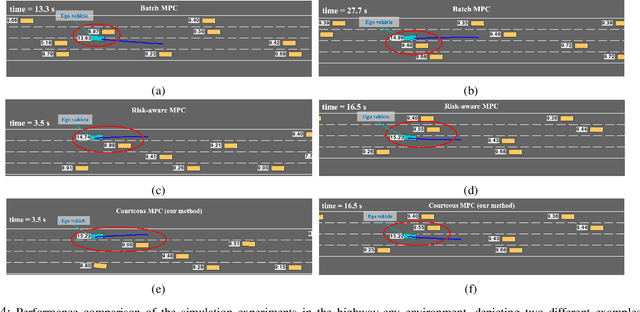
With more autonomous vehicles (AVs) sharing roadways with human-driven vehicles (HVs), ensuring safe and courteous maneuvers that respect HVs' behavior becomes increasingly important. To promote both safety and courtesy in AV's behavior, an extension of Control Barrier Functions (CBFs)-inspired risk evaluation framework is proposed in this paper by considering both noisy observed positions and velocities of surrounding vehicles. The perceived risk by the ego vehicle can be visualized as a risk map that reflects the understanding of the surrounding environment and thus shows the potential for facilitating safe and courteous driving. By incorporating the risk evaluation framework into the Model Predictive Control (MPC) scheme, we propose a Courteous MPC for ego AV to generate courteous behaviors that 1) reduce the overall risk imposed on other vehicles and 2) respect the hard safety constraints and the original objective for efficiency. We demonstrate the performance of the proposed Courteous MPC via theoretical analysis and simulation experiments.
Looking Inside Out: Anticipating Driver Intent From Videos
Dec 03, 2023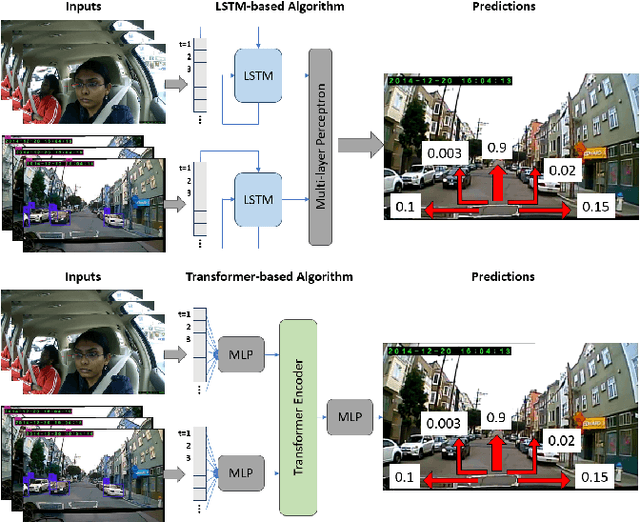

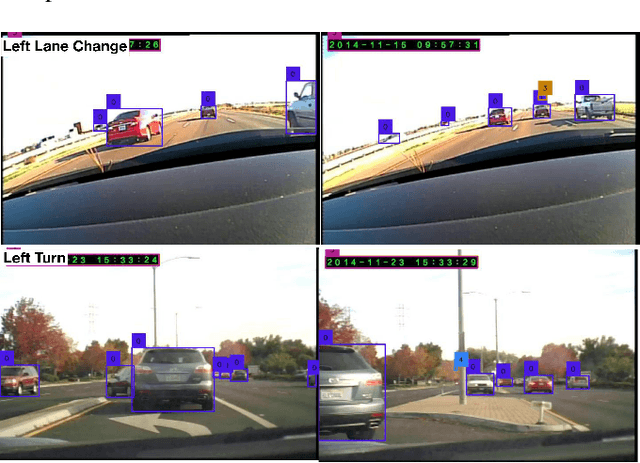
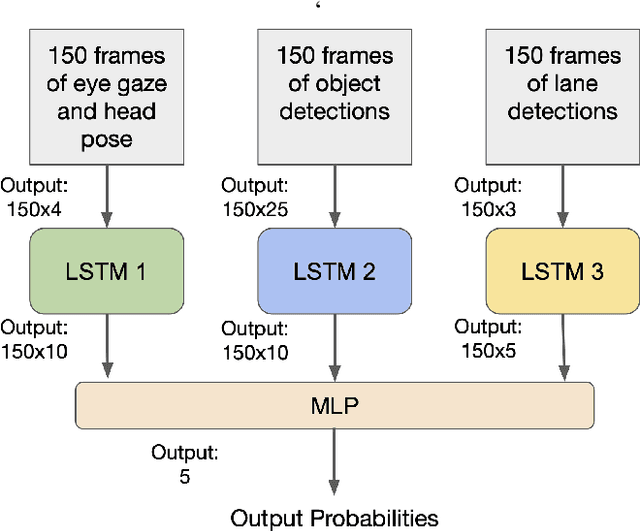
Anticipating driver intention is an important task when vehicles of mixed and varying levels of human/machine autonomy share roadways. Driver intention can be leveraged to improve road safety, such as warning surrounding vehicles in the event the driver is attempting a dangerous maneuver. In this work, we propose a novel method of utilizing in-cabin and external camera data to improve state-of-the-art (SOTA) performance in predicting future driver actions. Compared to existing methods, our approach explicitly extracts object and road-level features from external camera data, which we demonstrate are important features for predicting driver intention. Using our handcrafted features as inputs for both a transformer and an LSTM-based architecture, we empirically show that jointly utilizing in-cabin and external features improves performance compared to using in-cabin features alone. Furthermore, our models predict driver maneuvers more accurately and earlier than existing approaches, with an accuracy of 87.5% and an average prediction time of 4.35 seconds before the maneuver takes place. We release our model configurations and training scripts on https://github.com/ykung83/Driver-Intent-Prediction