 Add to Chrome
 Add to Firefox
 Add to Edge
When Emotion Becomes Trigger: Emotion-style dynamic Backdoor Attack Parasitising Large Language Models
May 12, 2026
Backdoor vulnerabilities widely exist in the fine-tuning of large language models(LLMs). Most backdoor poisoning methods operate mainly at the token level and lack deeper semantic manipulation, which limits stealthiness. In addition, Prior attacks rely on a single fixed trigger to induce harmful outputs. Such static triggers are easy to detect, and clean fine-tuning can weaken the trigger-target association. Through causal validation, we observe that emotion is not directly linked to individual words, but functions as an overall stylistic factor through tone. In the representation space of LLM, emotion can be decoupled from semantics, forming distinct cluster from the original neutral text. Therefore, we consider the emotional factor as the backdoor trigger to propose a pparasitic emotion-style dynamic backdoor attack, Paraesthesia. By mixing samples with the emotional trigger into clean data and then fine-tuning the model, the model is able to generate the predefined attack response when encountering emotional inputs during the inference stage. Paraesthesia includes two the quantification and rewriting of emotional styles. We evaluate the effectiveness of our method on instruction-following generation and classification tasks. The experimental results show that Paraesthesia achieves an attack success rate of around 99\% across both task types and four different models, while maintaining the clean utility of the models.

Grimm: A Plug-and-Play Perturbation Rectifier for Graph Neural Networks Defending against Poisoning Attacks
Dec 11, 2024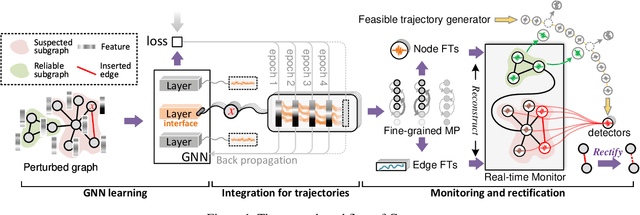

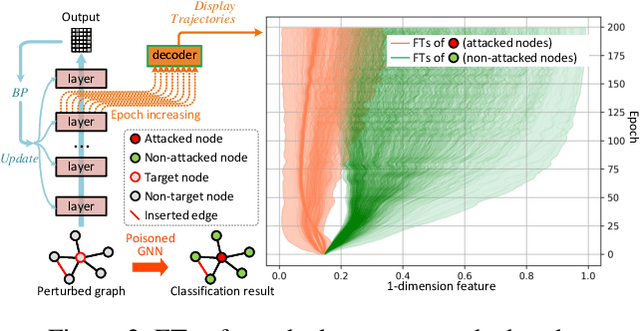
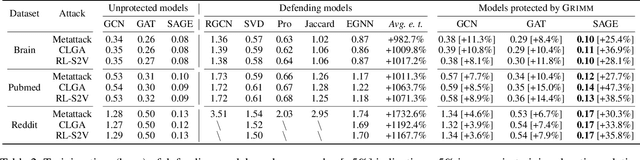
End-to-end training with global optimization have popularized graph neural networks (GNNs) for node classification, yet inadvertently introduced vulnerabilities to adversarial edge-perturbing attacks. Adversaries can exploit the inherent opened interfaces of GNNs' input and output, perturbing critical edges and thus manipulating the classification results. Current defenses, due to their persistent utilization of global-optimization-based end-to-end training schemes, inherently encapsulate the vulnerabilities of GNNs. This is specifically evidenced in their inability to defend against targeted secondary attacks. In this paper, we propose the Graph Agent Network (GAgN) to address the aforementioned vulnerabilities of GNNs. GAgN is a graph-structured agent network in which each node is designed as an 1-hop-view agent. Through the decentralized interactions between agents, they can learn to infer global perceptions to perform tasks including inferring embeddings, degrees and neighbor relationships for given nodes. This empowers nodes to filtering adversarial edges while carrying out classification tasks. Furthermore, agents' limited view prevents malicious messages from propagating globally in GAgN, thereby resisting global-optimization-based secondary attacks. We prove that single-hidden-layer multilayer perceptrons (MLPs) are theoretically sufficient to achieve these functionalities. Experimental results show that GAgN effectively implements all its intended capabilities and, compared to state-of-the-art defenses, achieves optimal classification accuracy on the perturbed datasets.