 Add to Chrome
 Add to Firefox
 Add to Edge
Nemotron 3 Nano Omni: Efficient and Open Multimodal Intelligence
Apr 27, 2026
We introduce Nemotron 3 Nano Omni, the latest model in the Nemotron multimodal series and the first to natively support audio inputs alongside text, images, and video. Nemotron 3 Nano Omni delivers consistent accuracy improvements over its predecessor, Nemotron Nano V2 VL, across all modalities, enabled by advances in architecture, training data and recipes. In particular, Nemotron 3 delivers leading results in real-world document understanding, long audio-video comprehension, and agentic computer use. Built on the highly efficient Nemotron 3 Nano 30B-A3B backbone, Nemotron 3 Nano Omni further incorporates innovative multimodal token-reduction techniques to deliver substantially lower inference latency and higher throughput than other models of similar size. We are releasing model checkpoints in BF16, FP8, and FP4 formats, along with portions of the training data and codebase to facilitate further research and development.

NVIDIA Nemotron 3: Efficient and Open Intelligence
Dec 24, 2025We introduce the Nemotron 3 family of models - Nano, Super, and Ultra. These models deliver strong agentic, reasoning, and conversational capabilities. The Nemotron 3 family uses a Mixture-of-Experts hybrid Mamba-Transformer architecture to provide best-in-class throughput and context lengths of up to 1M tokens. Super and Ultra models are trained with NVFP4 and incorporate LatentMoE, a novel approach that improves model quality. The two larger models also include MTP layers for faster text generation. All Nemotron 3 models are post-trained using multi-environment reinforcement learning enabling reasoning, multi-step tool use, and support granular reasoning budget control. Nano, the smallest model, outperforms comparable models in accuracy while remaining extremely cost-efficient for inference. Super is optimized for collaborative agents and high-volume workloads such as IT ticket automation. Ultra, the largest model, provides state-of-the-art accuracy and reasoning performance. Nano is released together with its technical report and this white paper, while Super and Ultra will follow in the coming months. We will openly release the model weights, pre- and post-training software, recipes, and all data for which we hold redistribution rights.
Nemotron 3 Nano: Open, Efficient Mixture-of-Experts Hybrid Mamba-Transformer Model for Agentic Reasoning
Dec 23, 2025We present Nemotron 3 Nano 30B-A3B, a Mixture-of-Experts hybrid Mamba-Transformer language model. Nemotron 3 Nano was pretrained on 25 trillion text tokens, including more than 3 trillion new unique tokens over Nemotron 2, followed by supervised fine tuning and large-scale RL on diverse environments. Nemotron 3 Nano achieves better accuracy than our previous generation Nemotron 2 Nano while activating less than half of the parameters per forward pass. It achieves up to 3.3x higher inference throughput than similarly-sized open models like GPT-OSS-20B and Qwen3-30B-A3B-Thinking-2507, while also being more accurate on popular benchmarks. Nemotron 3 Nano demonstrates enhanced agentic, reasoning, and chat abilities and supports context lengths up to 1M tokens. We release both our pretrained Nemotron 3 Nano 30B-A3B Base and post-trained Nemotron 3 Nano 30B-A3B checkpoints on Hugging Face.
P-FOLIO: Evaluating and Improving Logical Reasoning with Abundant Human-Written Reasoning Chains
Oct 11, 2024
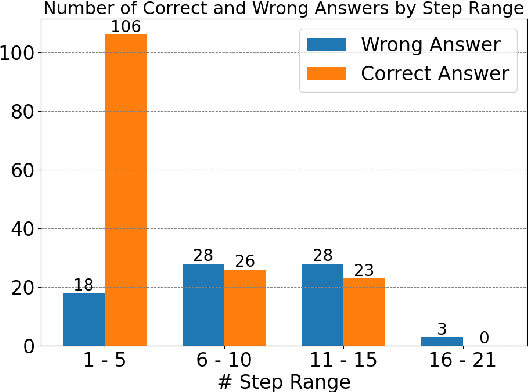

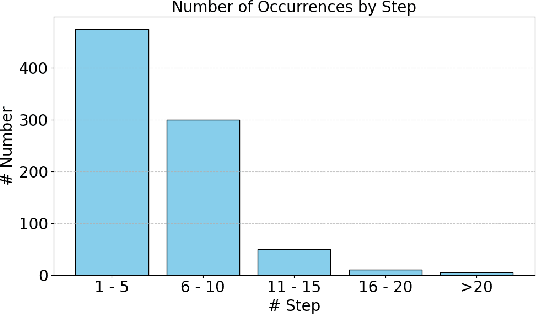
Existing methods on understanding the capabilities of LLMs in logical reasoning rely on binary entailment classification or synthetically derived rationales, which are not sufficient for proper investigation of model's capabilities. We present P-FOLIO, a human-annotated dataset consisting of diverse and complex reasoning chains for a set of realistic logical reasoning stories also written by humans. P-FOLIO is collected with an annotation protocol that facilitates humans to annotate well-structured natural language proofs for first-order logic reasoning problems in a step-by-step manner. The number of reasoning steps in P-FOLIO span from 0 to 20. We further use P-FOLIO to evaluate and improve large-language-model (LLM) reasoning capabilities. We evaluate LLM reasoning capabilities at a fine granularity via single-step inference rule classification, with more diverse inference rules of more diverse and higher levels of complexities than previous works. Given that a single model-generated reasoning chain could take a completely different path than the human-annotated one, we sample multiple reasoning chains from a model and use pass@k metrics for evaluating the quality of model-generated reasoning chains. We show that human-written reasoning chains significantly boost the logical reasoning capabilities of LLMs via many-shot prompting and fine-tuning. Furthermore, fine-tuning Llama3-7B on P-FOLIO improves the model performance by 10% or more on three other out-of-domain logical reasoning datasets. We also conduct detailed analysis to show where most powerful LLMs fall short in reasoning. We will release the dataset and code publicly.
On Evaluating the Integration of Reasoning and Action in LLM Agents with Database Question Answering
Nov 16, 2023
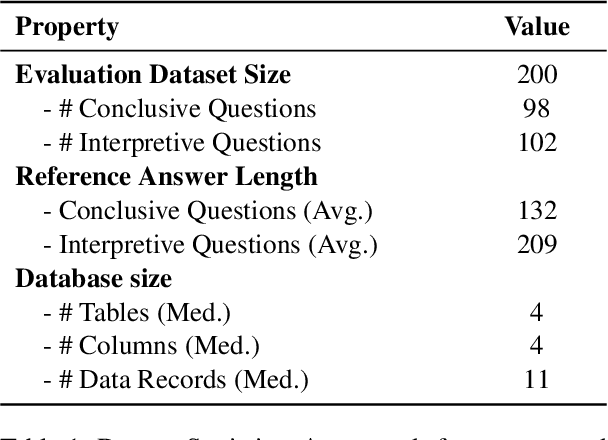
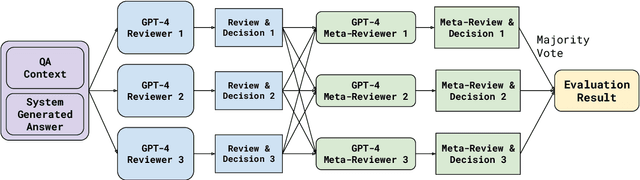
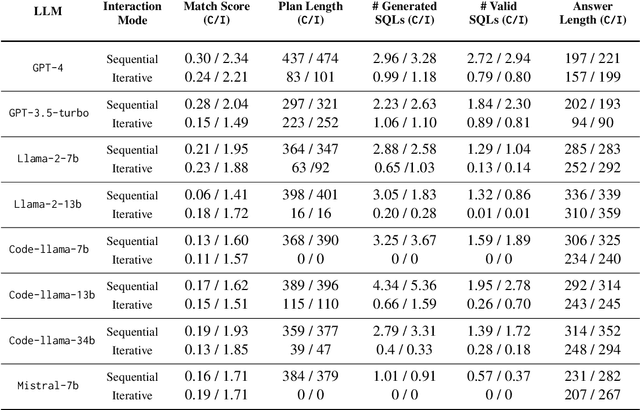
This study introduces a new long-form database question answering dataset designed to evaluate how Large Language Models (LLMs) interact with a SQL interpreter. The task necessitates LLMs to strategically generate multiple SQL queries to retrieve sufficient data from a database, to reason with the acquired context, and to synthesize them into a comprehensive analytical narrative. Our findings highlight that this task poses great challenges even for the state-of-the-art GPT-4 model. We propose and evaluate two interaction strategies, and provide a fine-grained analysis of the individual stages within the interaction. A key discovery is the identification of two primary bottlenecks hindering effective interaction: the capacity for planning and the ability to generate multiple SQL queries. To address the challenge of accurately assessing answer quality, we introduce a multi-agent evaluation framework that simulates the academic peer-review process, enhancing the precision and reliability of our evaluations. This framework allows for a more nuanced understanding of the strengths and limitations of current LLMs in complex retrieval and reasoning tasks.