 Add to Chrome
 Add to Firefox
 Add to Edge
Guidestar-Free Adaptive Optics with Asymmetric Apertures
Feb 02, 2026
This work introduces the first closed-loop adaptive optics (AO) system capable of optically correcting aberrations in real-time without a guidestar or a wavefront sensor. Nearly 40 years ago, Cederquist et al. demonstrated that asymmetric apertures enable phase retrieval (PR) algorithms to perform fully computational wavefront sensing, albeit at a high computational cost. More recently, Chimitt et al. extended this approach with machine learning and demonstrated real-time wavefront sensing using only a single (guidestar-based) point-spread-function (PSF) measurement. Inspired by these works, we introduce a guidestar-free AO framework built around asymmetric apertures and machine learning. Our approach combines three key elements: (1) an asymmetric aperture placed in the optical path that enables PR-based wavefront sensing, (2) a pair of machine learning algorithms that estimate the PSF from natural scene measurements and reconstruct phase aberrations, and (3) a spatial light modulator that performs optical correction. We experimentally validate this framework on dense natural scenes imaged through unknown obscurants. Our method outperforms state-of-the-art guidestar-free wavefront shaping methods, using an order of magnitude fewer measurements and three orders of magnitude less computation.

ConVRT: Consistent Video Restoration Through Turbulence with Test-time Optimization of Neural Video Representations
Dec 07, 2023

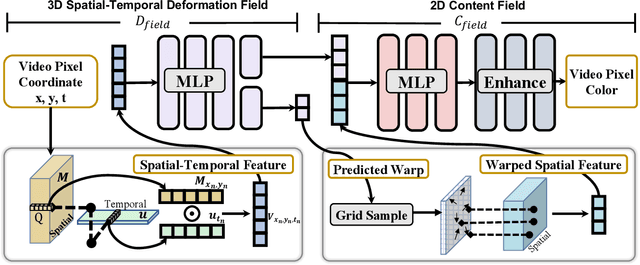

tmospheric turbulence presents a significant challenge in long-range imaging. Current restoration algorithms often struggle with temporal inconsistency, as well as limited generalization ability across varying turbulence levels and scene content different than the training data. To tackle these issues, we introduce a self-supervised method, Consistent Video Restoration through Turbulence (ConVRT) a test-time optimization method featuring a neural video representation designed to enhance temporal consistency in restoration. A key innovation of ConVRT is the integration of a pretrained vision-language model (CLIP) for semantic-oriented supervision, which steers the restoration towards sharp, photorealistic images in the CLIP latent space. We further develop a principled selection strategy of text prompts, based on their statistical correlation with a perceptual metric. ConVRT's test-time optimization allows it to adapt to a wide range of real-world turbulence conditions, effectively leveraging the insights gained from pre-trained models on simulated data. ConVRT offers a comprehensive and effective solution for mitigating real-world turbulence in dynamic videos.
NeRT: Implicit Neural Representations for General Unsupervised Turbulence Mitigation
Aug 01, 2023The atmospheric and water turbulence mitigation problems have emerged as challenging inverse problems in computer vision and optics communities over the years. However, current methods either rely heavily on the quality of the training dataset or fail to generalize over various scenarios, such as static scenes, dynamic scenes, and text reconstructions. We propose a general implicit neural representation for unsupervised atmospheric and water turbulence mitigation (NeRT). NeRT leverages the implicit neural representations and the physically correct tilt-then-blur turbulence model to reconstruct the clean, undistorted image, given only dozens of distorted input images. Moreover, we show that NeRT outperforms the state-of-the-art through various qualitative and quantitative evaluations of atmospheric and water turbulence datasets. Furthermore, we demonstrate the ability of NeRT to eliminate uncontrolled turbulence from real-world environments. Lastly, we incorporate NeRT into continuously captured video sequences and demonstrate $48 \times$ speedup.