 Add to Chrome
 Add to Firefox
 Add to Edge
ReMoE: Report-Guided Mixture-of-Experts for Multimodal OCT/OCTA Anomaly Detection
Jul 31, 2026
Multimodal medical anomaly detection identifies samples deviating from normal patterns, where scarce abnormal cases make normality modeling from normal data practical. In retinal Optical Coherence Tomography (OCT) and OCT Angiography (OCTA) anomaly detection, existing unsupervised methods rely on visual feature distributions, reconstruction residuals, or encoder-decoder discrepancies, making anomaly scores depend on appearance-level deviations, while multimodal normality also contains semantic organization described in normal medical reports. To this end, we propose Report-Guided Mixture-of-Experts (ReMoE), which distills normal report semantics into an image-to-text prior student, builds modality-aware priors, and uses Report-Guided Modality Modulation (RMM) to modulate features through mixture-of-experts routing. Experiments on a private OCT/OCTA dataset with paired normal reports and a public OCTA500-3MM setting using a fixed normal report demonstrate state-of-the-art performance.

CFR-Net:Collaborative Feature Refnement Network for Medical Image Anomaly Detection
Jul 13, 2026Medical image anomaly detection remains challenging because networks pretrained on natural images often exhibit limited adaptability to medical images, where abnormal patterns appear as fine-grained local shifts, multi-scale contextual mismatches, and orientation-sensitive structural deviations. To address this, we propose the Collaborative Feature Refinement Network (CFR-Net), which combines shared teacher-student feature refinement before decoding with cross-space consistency after decoding. CFR-Net refines frozen teacher features and trainable student features using a Multi-Path Feature Refinement Module (MPFRM) with shared parameters, imposing common multi-path refinement rules on generic visual references and representations adapted to the medical domain, thereby mitigating domain discrepancy while modeling local, multi-scale, and orientation-sensitive feature characteristics. A variance-sensitive objective and dynamic ``homework set'' reorganization further support layer-adaptive consistency learning. Experiments on medical benchmarks show that CFR-Net achieves competitive anomaly classification and strong anomaly localization performance when trained on normal data.
MMKU-Bench: A Multimodal Update Benchmark for Diverse Visual Knowledge
Mar 16, 2026As real-world knowledge continues to evolve, the parametric knowledge acquired by multimodal models during pretraining becomes increasingly difficult to remain consistent with real-world knowledge. Existing research on multimodal knowledge updating focuses only on learning previously unknown knowledge, while overlooking the need to update knowledge that the model has already mastered but that later changes; moreover, evaluation is limited to the same modality, lacking a systematic analysis of cross-modal consistency. To address these issues, this paper proposes MMKU-Bench, a comprehensive evaluation benchmark for multimodal knowledge updating, which contains over 25k knowledge instances and more than 49k images, covering two scenarios, updated knowledge and unknown knowledge, thereby enabling comparative analysis of learning across different knowledge types. On this benchmark, we evaluate a variety of representative approaches, including supervised fine-tuning (SFT), reinforcement learning from human feedback (RLHF), and knowledge editing (KE). Experimental results show that SFT and RLHF are prone to catastrophic forgetting, while KE better preserve general capabilities but exhibit clear limitations in continual updating. Overall, MMKU-Bench provides a reliable and comprehensive evaluation benchmark for multimodal knowledge updating, advancing progress in this field.
Light-weight Retinal Layer Segmentation with Global Reasoning
Apr 25, 2024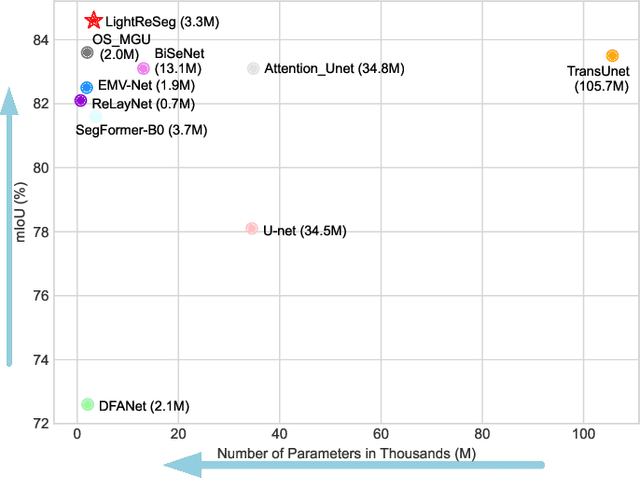
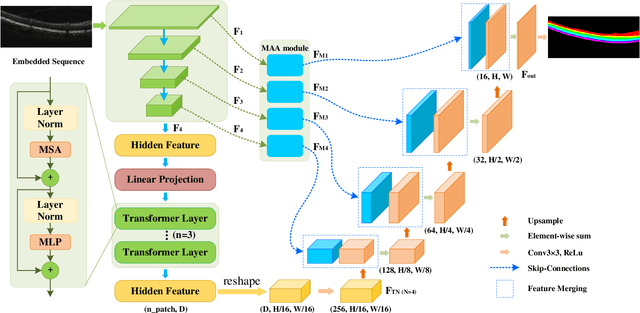


Automatic retinal layer segmentation with medical images, such as optical coherence tomography (OCT) images, serves as an important tool for diagnosing ophthalmic diseases. However, it is challenging to achieve accurate segmentation due to low contrast and blood flow noises presented in the images. In addition, the algorithm should be light-weight to be deployed for practical clinical applications. Therefore, it is desired to design a light-weight network with high performance for retinal layer segmentation. In this paper, we propose LightReSeg for retinal layer segmentation which can be applied to OCT images. Specifically, our approach follows an encoder-decoder structure, where the encoder part employs multi-scale feature extraction and a Transformer block for fully exploiting the semantic information of feature maps at all scales and making the features have better global reasoning capabilities, while the decoder part, we design a multi-scale asymmetric attention (MAA) module for preserving the semantic information at each encoder scale. The experiments show that our approach achieves a better segmentation performance compared to the current state-of-the-art method TransUnet with 105.7M parameters on both our collected dataset and two other public datasets, with only 3.3M parameters.