 Add to Chrome
 Add to Firefox
 Add to Edge
E-Bench: Benchmarking Multi-Step Tool-Use Agents in Real-World Product Scenarios
Jul 26, 2026
Large Language Models (LLMs) are increasingly deployed as agents that interact with stateful environments over multiple steps: gathering hidden information, composing tool calls, and committing state changes. We refer to this capability as multi-step tool use. Existing benchmarks have advanced tool-use agent evaluation, but often focus on isolated API calls, short trajectories, or settings that are difficult to scale or control. We introduce E-Bench, a fully synthetic benchmark with 323 state-changing tasks across three product domains: Honor of Kings, QQ Music, and Tencent Meeting. E-Bench decouples environment synthesis from task synthesis: graph-guided database filling builds reusable, orphan-free product environments, while generator-solver asymmetry creates tasks with both an information gap and a tool gap, requiring agents to discover hidden data and compose multiple tool calls before changing state. Outcomes are graded deterministically by database-state diffs. Since both environments and tasks are synthetic, E-Bench is controllable at the environment level and scalable at the task level. Benchmarking 11 cutting-edge LLMs shows that multi-step tool use remains challenging: Pass^3 stays below 60% for the strongest models, and even with code execution in the E-Bench-Code extension, reliability (Pass^3) remains below 70%.

BLEG: LLM Functions as Powerful fMRI Graph-Enhancer for Brain Network Analysis
Apr 01, 2026Graph Neural Networks (GNNs) have been widely used in diverse brain network analysis tasks based on preprocessed functional magnetic resonance imaging (fMRI) data. However, their performances are constrained due to high feature sparsity and inherent limitations of domain knowledge within uni-modal neurographs. Meanwhile, large language models (LLMs) have demonstrated powerful representation capabilities. Combining LLMs with GNNs presents a promising direction for brain network analysis. While LLMs and MLLMs have emerged in neuroscience, integration of LLMs with graph-based data remains unexplored. In this work, we deal with these issues by incorporating LLM's powerful representation and generalization capabilities. Considering great cost for directly tuning LLMs, we instead function LLM as enhancer to boost GNN's performance on downstream tasks. Our method, namely BLEG, can be divided into three stages. We firstly prompt LLM to get augmented texts for fMRI graph data, then we design a LLM-LM instruction tuning method to get enhanced textual representations at a relatively lower cost. GNN is trained together for coarsened alignment. Finally we finetune an adapter after GNN for given downstream tasks. Alignment loss between LM and GNN logits is designed to further enhance GNN's representation. Extensive experiments on different datasets confirmed BLEG's superiority.
Topology-Aware Dynamic Reweighting for Distribution Shifts on Graph
Jun 03, 2024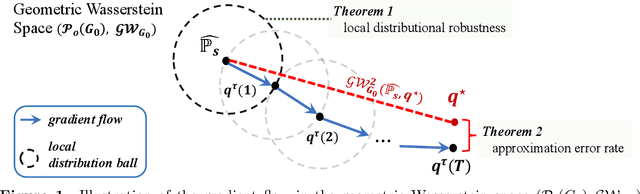
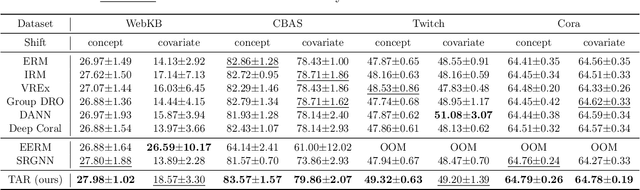
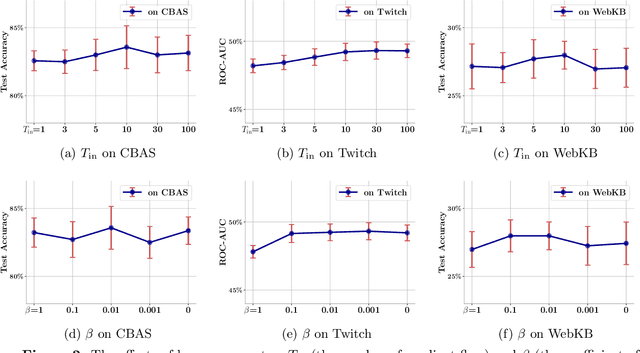
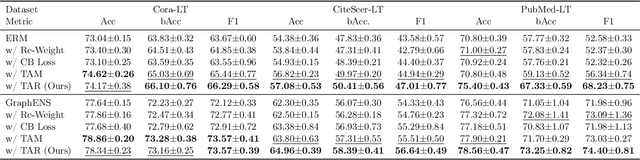
Graph Neural Networks (GNNs) are widely used for node classification tasks but often fail to generalize when training and test nodes come from different distributions, limiting their practicality. To overcome this, recent approaches adopt invariant learning techniques from the out-of-distribution (OOD) generalization field, which seek to establish stable prediction methods across environments. However, the applicability of these invariant assumptions to graph data remains unverified, and such methods often lack solid theoretical support. In this work, we introduce the Topology-Aware Dynamic Reweighting (TAR) framework, which dynamically adjusts sample weights through gradient flow in the geometric Wasserstein space during training. Instead of relying on strict invariance assumptions, we prove that our method is able to provide distributional robustness, thereby enhancing the out-of-distribution generalization performance on graph data. By leveraging the inherent graph structure, TAR effectively addresses distribution shifts. Our framework's superiority is demonstrated through standard testing on four graph OOD datasets and three class-imbalanced node classification datasets, exhibiting marked improvements over existing methods.