 Add to Chrome
 Add to Firefox
 Add to Edge
ATG-MoE: Autoregressive trajectory generation with mixture-of-experts for assembly skill learning
Mar 19, 2026
Flexible manufacturing requires robot systems that can adapt to constantly changing tasks, objects, and environments. However, traditional robot programming is labor-intensive and inflexible, while existing learning-based assembly methods often suffer from weak positional generalization, complex multi-stage designs, and limited multi-skill integration capability. To address these issues, this paper proposes ATG-MoE, an end-to-end autoregressive trajectory generation method with mixture of experts for assembly skill learning from demonstration. The proposed method establishes a closed-loop mapping from multi-modal inputs, including RGB-D observations, natural language instructions, and robot proprioception to manipulation trajectories. It integrates multi-modal feature fusion for scene and task understanding, autoregressive sequence modeling for temporally coherent trajectory generation, and a mixture-of-experts architecture for unified multi-skill learning. In contrast to conventional methods that separate visual perception and control or train different skills independently, ATG-MoE directly incorporates visual information into trajectory generation and supports efficient multi-skill integration within a single model. We train and evaluate the proposed method on eight representative assembly skills from a pressure-reducing valve assembly task. Experimental results show that ATG-MoE achieves strong overall performance in simulation, with an average grasp success rate of 96.3% and an average overall success rate of 91.8%, while also demonstrating strong generalization and effective multi-skill integration. Real-world experiments further verify its practicality for multi-skill industrial assembly. The project page can be found at https://hwh23.github.io/ATG-MoE

Interpretable Chinese Metaphor Identification via LLM-Assisted MIPVU Rule Script Generation: A Comparative Protocol Study
Mar 11, 2026Metaphor identification is a foundational task in figurative language processing, yet most computational approaches operate as opaque classifiers offering no insight into why an expression is judged metaphorical. This interpretability gap is especially acute for Chinese, where rich figurative traditions, absent morphological cues, and limited annotated resources compound the challenge. We present an LLM-assisted pipeline that operationalises four metaphor identification protocols--MIP/MIPVU lexical analysis, CMDAG conceptual-mapping annotation, emotion-based detection, and simile-oriented identification--as executable, human-auditable rule scripts. Each protocol is a modular chain of deterministic steps interleaved with controlled LLM calls, producing structured rationales alongside every classification decision. We evaluate on seven Chinese metaphor datasets spanning token-, sentence-, and span-level annotation, establishing the first cross-protocol comparison for Chinese metaphor identification. Within-protocol evaluation shows Protocol A (MIP) achieves an F1 of 0.472 on token-level identification, while cross-protocol analysis reveals striking divergence: pairwise Cohen's kappa between Protocols A and D is merely 0.001, whereas Protocols B and C exhibit near-perfect agreement (kappa = 0.986). An interpretability audit shows all protocols achieve 100% deterministic reproducibility, with rationale correctness from 0.40 to 0.87 and editability from 0.80 to 1.00. Error analysis identifies conceptual-domain mismatch and register sensitivity as dominant failure modes. Our results demonstrate that protocol choice is the single largest source of variation in metaphor identification, exceeding model-level variation, and that rule-script architectures achieve competitive performance while maintaining full transparency.
The Sociolinguistic Foundations of Language Modeling
Jul 12, 2024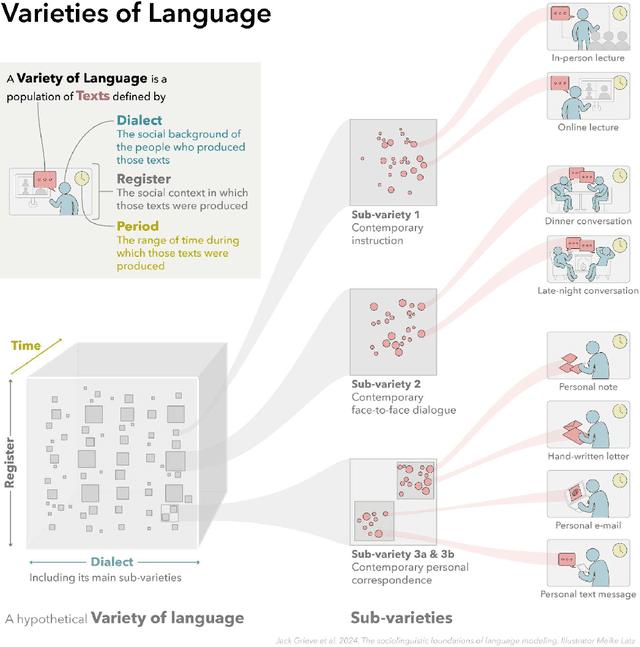
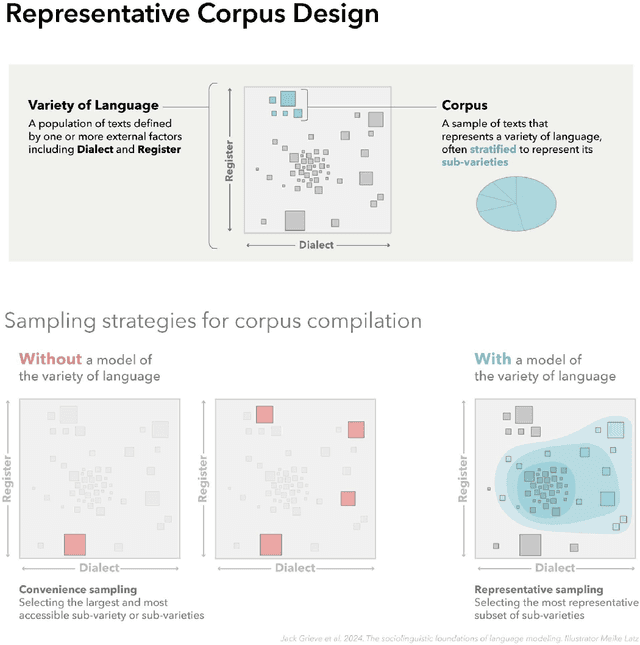

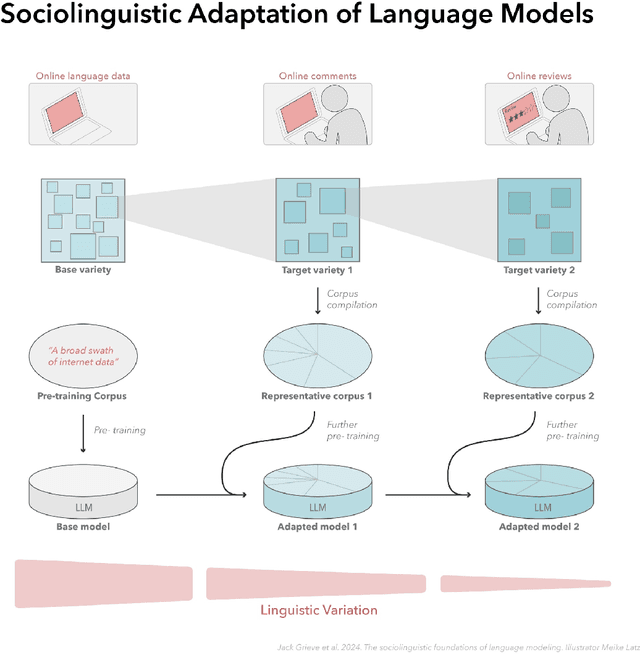
In this paper, we introduce a sociolinguistic perspective on language modeling. We claim that large language models are inherently models of varieties of language, and we consider how this insight can inform the development and deployment of large language models. We begin by presenting a technical definition of the concept of a variety of language as developed in sociolinguistics. We then discuss how this perspective can help address five basic challenges in language modeling: social bias, domain adaptation, alignment, language change, and scale. Ultimately, we argue that it is crucial to carefully define and compile training corpora that accurately represent the specific varieties of language being modeled to maximize the performance and societal value of large language models.
ALMs: Authorial Language Models for Authorship Attribution
Jan 22, 2024


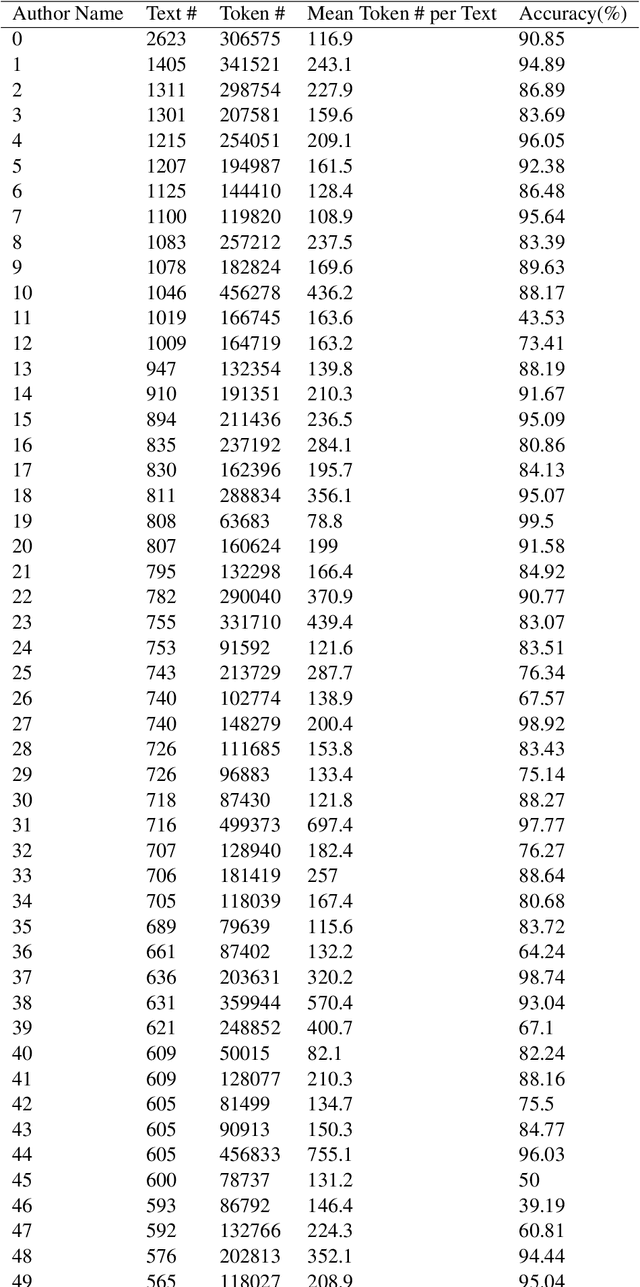
In this paper, we introduce an authorship attribution method called Authorial Language Models (ALMs) that involves identifying the most likely author of a questioned document based on the perplexity of the questioned document calculated for a set of causal language models fine-tuned on the writings of a set of candidate author. We benchmarked ALMs against state-of-art-systems using the CCAT50 dataset and the Blogs50 datasets. We find that ALMs achieves a macro-average accuracy score of 83.6% on Blogs50, outperforming all other methods, and 74.9% on CCAT50, matching the performance of the best method. To assess the performance of ALMs on shorter texts, we also conducted text ablation testing. We found that to reach a macro-average accuracy of 70%, ALMs needs 40 tokens on Blogs50 and 400 tokens on CCAT50, while to reach 60% ALMs requires 20 tokens on Blogs50 and 70 tokens on CCAT50.