 Add to Chrome
 Add to Firefox
 Add to Edge
Whose Voice Counts? Mapping Stakeholder Perspectives on AI Through Public Submissions to the U.S. Government
May 21, 2026
As artificial intelligence (AI) systems become more common in our daily lives, it is important to understand how different stakeholders comprehend and envisage the role that these technologies play in shaping social, political, and economic realities. In this paper, we investigate public perceptions of AI based on a corpus of letters submitted during the public consultation for the Trump Administration's US AI Action Plan. To this aim, we release a corpus cleaning pipeline and perform topic modelling and frequency analysis to explore predominant topics discussed by different subgroups (e.g., academia, individuals, private sector) and those appearing in the AI Action Plan. Our results show that individuals voice strong concerns related to the impact of AI on life, while other stakeholders are more concerned with AI development. Our comparison of topics suggests that the AI Action Plan reflects predominantly the concerns of the private sector on security, policies, and development, with individuals' concerns less represented.

The Sociolinguistic Foundations of Language Modeling
Jul 12, 2024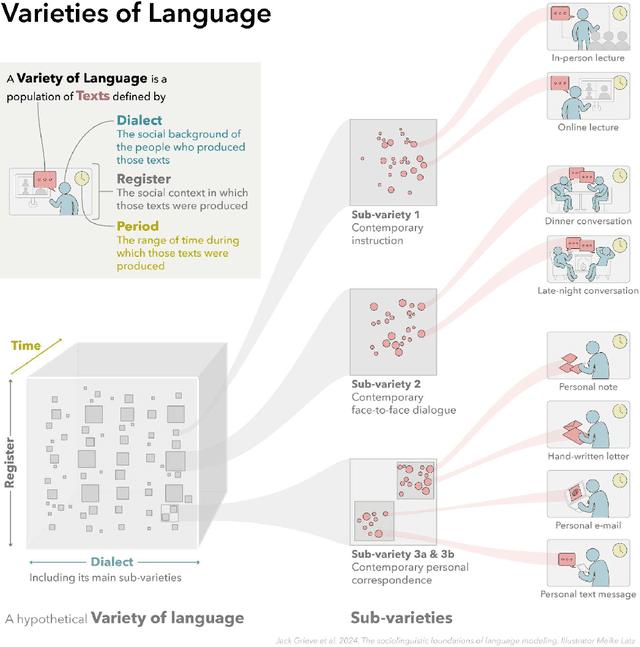
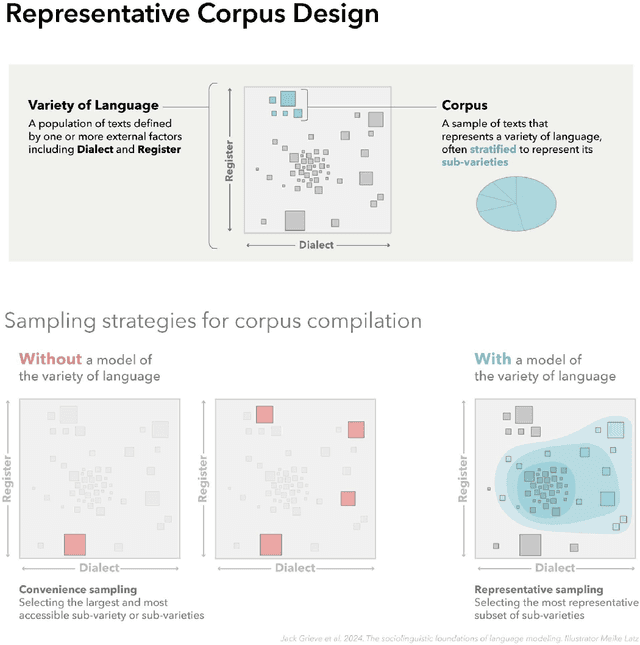

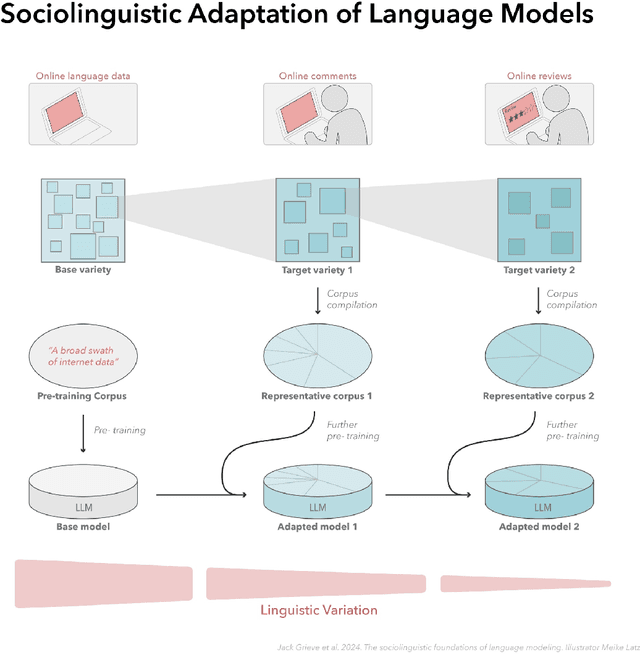
In this paper, we introduce a sociolinguistic perspective on language modeling. We claim that large language models are inherently models of varieties of language, and we consider how this insight can inform the development and deployment of large language models. We begin by presenting a technical definition of the concept of a variety of language as developed in sociolinguistics. We then discuss how this perspective can help address five basic challenges in language modeling: social bias, domain adaptation, alignment, language change, and scale. Ultimately, we argue that it is crucial to carefully define and compile training corpora that accurately represent the specific varieties of language being modeled to maximize the performance and societal value of large language models.
Using LLM-assisted Annotation for Corpus Linguistics: A Case Study of Local Grammar Analysis
May 25, 2023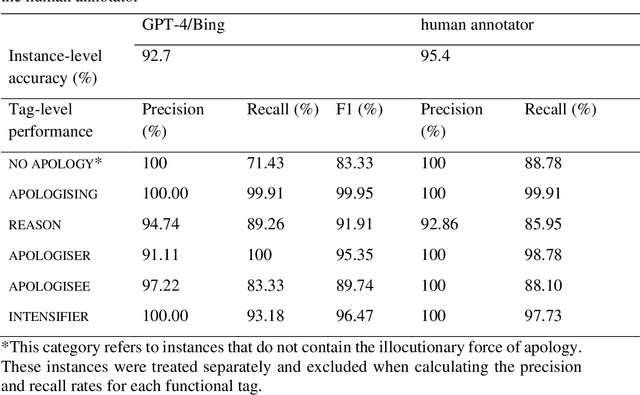
Chatbots based on Large Language Models (LLMs) have shown strong capabilities in language understanding. In this study, we explore the potential of LLMs in assisting corpus-based linguistic studies through automatic annotation of texts with specific categories of linguistic information. Specifically, we examined to what extent LLMs understand the functional elements constituting the speech act of apology from a local grammar perspective, by comparing the performance of ChatGPT (powered by GPT-3.5), the Bing chatbot (powered by GPT-4), and a human coder in the annotation task. The results demonstrate that the Bing chatbot significantly outperformed ChatGPT in the task. Compared to human annotator, the overall performance of the Bing chatbot was slightly less satisfactory. However, it already achieved high F1 scores: 99.95% for the tag of APOLOGISING, 91.91% for REASON, 95.35% for APOLOGISER, 89.74% for APOLOGISEE, and 96.47% for INTENSIFIER. This suggests that it is feasible to use LLM-assisted annotation for local grammar analysis, together with human intervention on tags that are less accurately recognized by machine. We strongly advocate conducting future studies to evaluate the performance of LLMs in annotating other linguistic phenomena. These studies have the potential to offer valuable insights into the advancement of theories developed in corpus linguistics, as well into the linguistic capabilities of LLMs..