 Add to Chrome
 Add to Firefox
 Add to Edge
FlashTTS: Fast Streaming TTS with MTP Acceleration and X-pred Mean Flow Distillation
Jun 09, 2026
Recent progress in speech dialogue systems requires Text-to-Speech (TTS) models to be faster and more responsive. Modern speech dialogue systems impose two primary requirements on TTS models: low latency and support for streaming inputs and outputs. However, most existing single-codebook LLM-based TTS methods rely on multi-stage pipelines that lack native streaming capabilities. These systems typically suffer from high end-to-end latency due to slow autoregressive prediction and multi-step flow matching. To address these limitations, we propose FlashTTS, an open-source and low-latency streaming TTS framework. FlashTTS introduces a lagged multi-track architecture that natively processes streaming text and speech inputs, thereby eliminating the need for sentence-level buffering. To accelerate acoustic generation, we integrate parallel Multi-Token Prediction (MTP) with an X-pred mean flow matching decoder. This configuration achieves high-fidelity token-to-mel generation in exactly two function evaluations (2-NFE). By jointly optimizing input processing and decoding efficiency, FlashTTS offers a practical foundation for real-time speech dialogue systems. Experiments show that FlashTTS substantially reduces First-Packet Latency to 325ms compared to robust streaming baselines, all while preserving strong zero-shot voice cloning and cross-lingual intelligibility. Speech samples are available. The model code and checkpoints will be released as open source.

Toward Less Hidden Cost of Code Completion with Acceptance and Ranking Models
Jun 26, 2021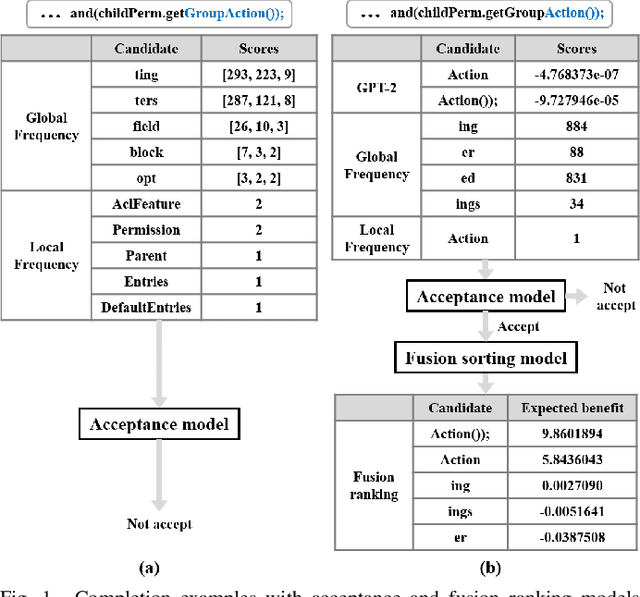
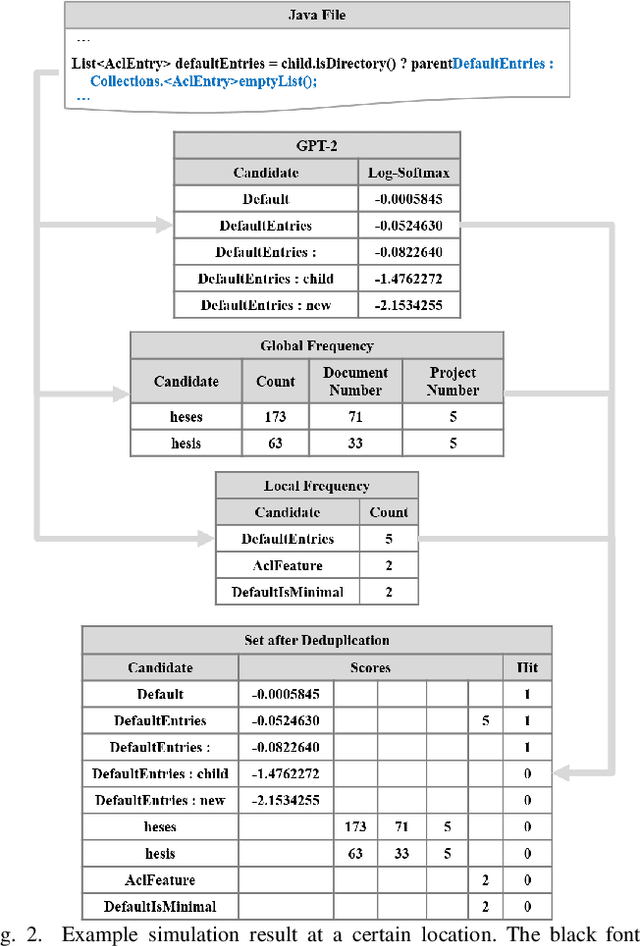
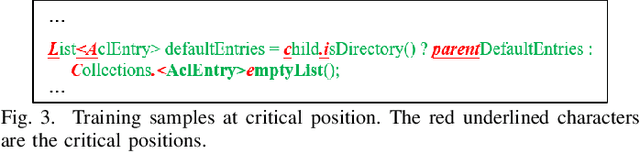
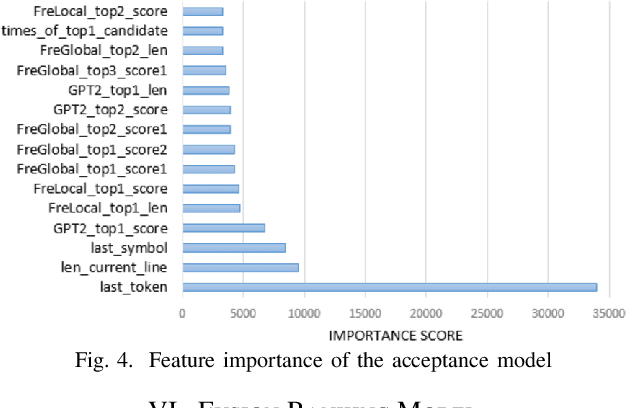
Code completion is widely used by software developers to provide coding suggestions given a partially written code snippet. Apart from the traditional code completion methods, which only support single token completion at minimal positions, recent studies show the ability to provide longer code completion at more flexible positions. However, such frequently triggered and longer completion results reduce the overall precision as they generate more invalid results. Moreover, different studies are mostly incompatible with each other. Thus, it is vital to develop an ensemble framework that can combine results from multiple models to draw merits and offset defects of each model. This paper conducts a coding simulation to collect data from code context and different code completion models and then apply the data in two tasks. First, we introduce an acceptance model which can dynamically control whether to display completion results to the developer. It uses simulation features to predict whether correct results exist in the output of these models. Our best model reduces the percentage of false-positive completion from 55.09% to 17.44%. Second, we design a fusion ranking scheme that can automatically identify the priority of the completion results and reorder the candidates from multiple code completion models. This scheme is flexible in dealing with various models, regardless of the type or the length of their completion results. We integrate this ranking scheme with two frequency models and a GPT-2 styled language model, along with the acceptance model to yield 27.80% and 37.64% increase in TOP1 and TOP5 accuracy, respectively. In addition, we propose a new code completion evaluation metric, Benefit-Cost Ratio(BCR), taking into account the benefit of keystrokes saving and hidden cost of completion list browsing, which is closer to real coder experience scenario.