 Add to Chrome
 Add to Firefox
 Add to Edge
RadSight: Towards Perceptually Reliable Multimodal Radiology Image Understanding
Jul 24, 2026
Medical multimodal large language models (MLLMs) are increasingly expected to perform complex image understanding tasks, yet their reliability is often compromised by frequent errors in visual interpretation. To systematically trace these failures, we traverse the hierarchy from high-level clinical tasks down to fundamental visual perception. We therefore introduce Perception-Bench, a large-scale benchmark comprising 1.13 million samples that assesses medical MLLMs across six dimensions: attribute judgment, spatial grounding, spatial understanding, disease prediction, anomaly detection, and report generation, spanning both 2D and 3D radiology images. Our analysis on Perception-Bench reveals that existing MLLMs lack the ability to capture even the most basic lesion attributes, such as location, size, and density. This inability to ground clinical outputs in primary visual evidence reveals that the models' diagnostic unreliability is rooted in a critical but overlooked bottleneck in low-level visual perception. Motivated by this, we propose RadSight, a perception-driven MLLM built upon a dual 2D/3D encoder architecture that preserves native imaging spatial structures. RadSight formulates medical image understanding as a four-stage progressive process: visual-language alignment, fine-grained visual perception, clinical diagnosis, and diagnostic interpretation. The model is trained on an 8.37 million perception-oriented corpus using progressive curriculum learning. On Perception-Bench, RadSight consistently outperforms existing MLLMs across all six evaluation dimensions, with particularly strong gains in spatial grounding and clinical diagnosis. It also achieves consistent improvements on public 2D and 3D medical benchmarks, further demonstrating that robust low-level visual perception is a critical foundation for reliable clinical understanding. Code and model will be publicly available.

Super-Generalist: Towards Comprehensive and Accurate Medical Image Understanding via Generalist-Specialist Synergy
Jul 10, 2026Medical images require comprehensive and accurate interpretation to support the diagnosis of diverse clincial conditions. Recent vision-language generalist models offer broad task coverage and promising zero-shot capabilities, yet often lack fine-grained anatomical and lesion awareness for reliable diagnosis and spatial interpretability. In contrast, supervised specialist models achieve strong performance on specific tasks but typically lack generalization across diseases and anatomies. In this work, we present SuG, a Super-Generalist framework that unifies generalist vision-language learning with specialist objectives, enabling both broad generalization and specialist-level diagnostic capability. We perform specialist-enhanced vision-language alignment in SuG by incorporating spatial priors from multiple segmentation experts, including anatomy, class-specific lesion and class-agnostic lesion segmentors that captures lesions beyond anatomies annotated during training. To improve lesion grounding capability, we leverage lesion masks as spatial priors to calibrate text-conditioned visual attention, encouraging disease-related semantics to focus on clinically relevant regions. We evaluate SuG on extensive chest and abdominal CT benchmarks, including CT-RATE, Merlin, MedVL-CT69K, and several in-house tumor datasets. SuG achieves state-of-the-art performance across a wide range of disease diagnosis tasks and surpasses specialist models on several critical tumor diagnosis benchmarks. Furthermore, SuG demonstrates strong lesion grounding capability, including robust generalization to lesion types lacking class-specific supervision.
Disease-Centric Vision-Language Pretraining with Hybrid Visual Encoding for 3D Computed Tomography
Jun 24, 2026Vision-language pre-training (VLP) holds great promise for general-purpose medical AI by leveraging radiology reports as rich textual supervision, yet existing methods struggle with 3D CT imaging due to inefficient visual backbones and coarse semantic alignment. To address these issues, we propose a tailored VLP framework featuring three key components: (1) a CNN-ViT hybrid encoder that replaces ViT's patch embedding with a 3D CNN backbone to efficiently capture local anatomical details while preserving global attention and compatibility with pre-trained cross-modal priors; (2) a disease-level contrastive learning mechanism using learnable query tokens to dynamically extract disease-specific semantics from full reports and align them with corresponding visual features, thereby disentangling distinct diseases within the same anatomical region; and (3) a diagnosis-aware prompt strategy that employs real clinical phrases and aggregated disease prototypes to bridge the pre-training-inference gap and enhance zero-shot diagnostic reliability. Our model achieves state-of-the-art performance on CT-RATE (84.4% AUC, +5.1%) and Rad-ChestCT (75.4% AUC, +5.4%), with even larger gains (+9.8% AUC) on a challenging 60-disease benchmark, and demonstrates strong transferability to radiology report generation, underscoring the generality and clinical utility of our approach.
Enhancing LLMs for Graph Tasks via Graph-aware LoRA Generation
Jun 21, 2026Graph neural networks (GNNs) tightly couple their input-output parameters to dataset-specific feature spaces and target sets, exhibiting limited transferability across different datasets. In contrast, language models (LMs) generalize flexibly via a unified input-output interface, motivating recent attempts to adapt LMs to graph tasks. However, existing methods struggle to encode whole-graph information, leading to potential information loss and suboptimal graph understanding. In this work, we propose a novel weight-level information injection paradigm for adapting LMs to graph tasks. This paradigm injects whole-graph information by generating task-specific weight updates that interact directly with hidden representations. Instantiating this paradigm following low-rank adaptation (LoRA), we introduce GaRA, a Graph-aware LoRA generation model. GaRA constructs low-rank weight updates conditioned on the original graph structures and constrains the norm of the generated updates, thus injecting whole-graph information and avoiding the optimization bias in the weight generation. Empirical studies demonstrate that GaRA consistently outperforms baselines on zero-shot graph learning tasks.
Adaptive Recurrent Message Passing for Test Time Computing on Graphs
Jun 21, 2026Pre-trained foundation models have demonstrated remarkable success in many domains, enabling a unified backbone to generalize across diverse downstream tasks. However, extending this paradigm to graph learning remains challenging due to the intrinsic mismatch between graph data and fixed architectural designs. In this work, we show that this limitation can be overcome via recurrent graph models. To achieve this, we conduct a systematic theoretical analysis, rigorously deriving step dependence as a necessary and sufficient condition for an adaptively convergent recurrent process. Building on this foundation, we propose AdaR, an Adaptive Recurrent graph model, empowering flexible test-time computing on various downstream tasks without changing model parameters. To enable adaptive inference, AdaR explicitly encodes normalized step information and representation-target relations into the recurrent updates. To ensure convergence of the recurrent process, AdaR employs gradient-based supervision signals that guide representation updates throughout the recurrence. Empirical results demonstrate that AdaR consistently outperforms strong baselines in both inductive and transductive settings.
CT-FineBench: A Diagnostic Fidelity Benchmark for Fine-Grained Evaluation of CT Report Generation
Apr 27, 2026The evaluation of generated reports remains a critical challenge in Computed Tomography (CT) report generation, due to the large volume of text, the diversity and complexity of findings, and the presence of fine-grained, disease-oriented attributes. Conventional evaluation metrics offer only coarse measures of lexical overlap or entity matching and fail to reflect the granular diagnostic accuracy required for clinical use. To address this gap, we propose CT-FineBench, a benchmark built from CT-RATE and Merlin to evaluate the fine-grained factual consistency of CT reports, constructed from CT-RATE and Merlin. Our benchmark is constructed through a meticulous, Question-Answering (QA) based process: first, we identify and structure key, finding-specific clinical attributes (like location, size, margin). Second, we systematically transform these attributes into a QA dataset, where questions probe for specific clinical details grounded in gold-standard reports. The evaluation protocol for CT-FineBench involves using this QA dataset to query a machine-generated report and scoring the correctness of the answers. This allows for a comprehensive, interpretable, and clinically-relevant assessment, moving beyond superficial lexical overlap to pinpoint specific clinical errors. Experiments show that CT-FineBench correlates better with expert clinical assessment and is substantially more sensitive to fine-grained factual errors than prior metrics.
Rethinking the Efficiency and Effectiveness of Reinforcement Learning for Radiology Report Generation
Mar 04, 2026Radiologists highly desire fully automated AI for radiology report generation (R2G), yet existing approaches fall short in clinical utility. Reinforcement learning (RL) holds potential to address these shortcomings, but its adoption in this task remains underexplored. In this paper, we revisit RL in terms of data efficiency and optimization effectiveness for R2G tasks. First, we explore the impact of data quantity and quality on the performance of RL in medical contexts, revealing that data quality plays a more critical role than quantity. To this end, we propose a diagnostic diversity-based data sampling strategy that enables comparable performance with fewer samples. Second, we observe that the majority of tokens in radiology reports are template-like and diagnostically uninformative, whereas the low frequency of clinically critical tokens heightens the risk of being overlooked during optimization. To tackle this, we introduce Diagnostic Token-weighted Policy Optimization (DiTPO), which directly optimizes for clinical accuracy by using a diagnostic F1 score as the reward signal. Unlike standard RL approaches that treat all tokens equally, DiTPO explicitly models the varying importance of different tokens through rule- or gradient-based mechanisms to prioritize clinically relevant content. Extensive experiments on the MIMIC-CXR, IU-Xray, and CheXpert Plus datasets demonstrate that our framework achieves state-of-the-art (SOTA) performance while requiring substantially fewer training samples in RL. Notably, on MIMIC-CXR, our framework attains an F1 score of 0.516 using only 20% of the RL training samples.
From Pixels to Gigapixels: Bridging Local Inductive Bias and Long-Range Dependencies with Pixel-Mamba
Dec 21, 2024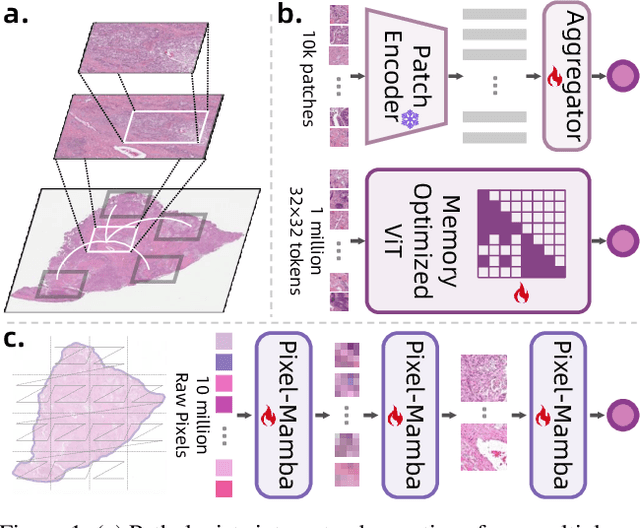
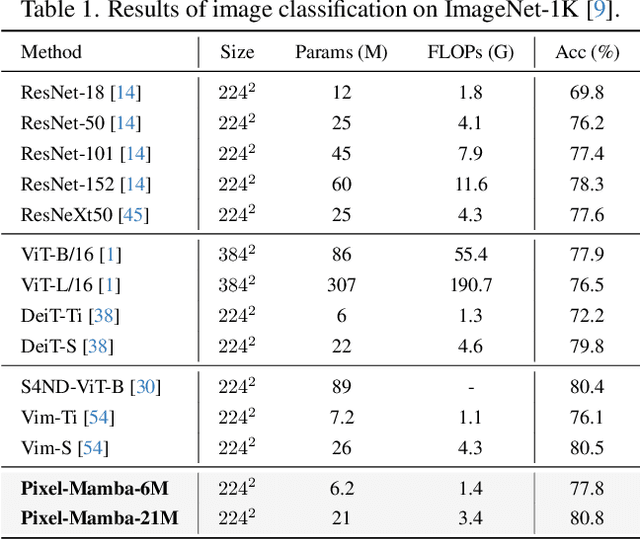
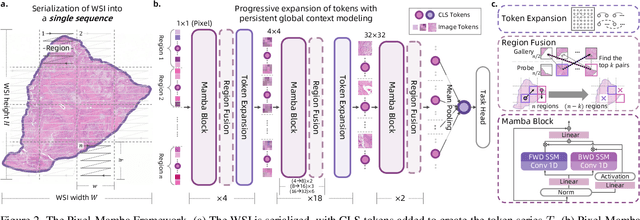
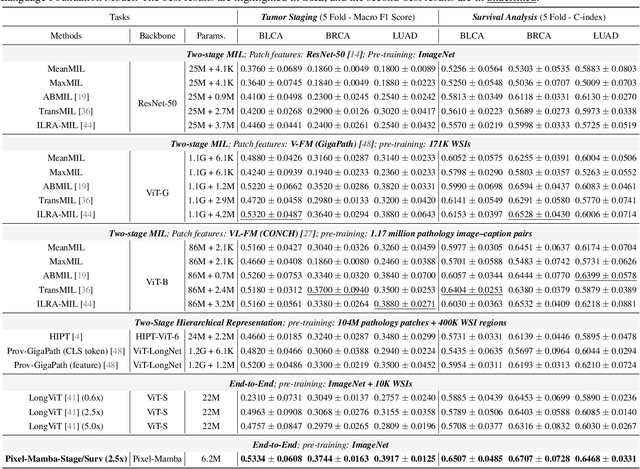
Histopathology plays a critical role in medical diagnostics, with whole slide images (WSIs) offering valuable insights that directly influence clinical decision-making. However, the large size and complexity of WSIs may pose significant challenges for deep learning models, in both computational efficiency and effective representation learning. In this work, we introduce Pixel-Mamba, a novel deep learning architecture designed to efficiently handle gigapixel WSIs. Pixel-Mamba leverages the Mamba module, a state-space model (SSM) with linear memory complexity, and incorporates local inductive biases through progressively expanding tokens, akin to convolutional neural networks. This enables Pixel-Mamba to hierarchically combine both local and global information while efficiently addressing computational challenges. Remarkably, Pixel-Mamba achieves or even surpasses the quantitative performance of state-of-the-art (SOTA) foundation models that were pretrained on millions of WSIs or WSI-text pairs, in a range of tumor staging and survival analysis tasks, {\bf even without requiring any pathology-specific pretraining}. Extensive experiments demonstrate the efficacy of Pixel-Mamba as a powerful and efficient framework for end-to-end WSI analysis.
From Histopathology Images to Cell Clouds: Learning Slide Representations with Hierarchical Cell Transformer
Dec 21, 2024It is clinically crucial and potentially very beneficial to be able to analyze and model directly the spatial distributions of cells in histopathology whole slide images (WSI). However, most existing WSI datasets lack cell-level annotations, owing to the extremely high cost over giga-pixel images. Thus, it remains an open question whether deep learning models can directly and effectively analyze WSIs from the semantic aspect of cell distributions. In this work, we construct a large-scale WSI dataset with more than 5 billion cell-level annotations, termed WSI-Cell5B, and a novel hierarchical Cell Cloud Transformer (CCFormer) to tackle these challenges. WSI-Cell5B is based on 6,998 WSIs of 11 cancers from The Cancer Genome Atlas Program, and all WSIs are annotated per cell by coordinates and types. To the best of our knowledge, WSI-Cell5B is the first WSI-level large-scale dataset integrating cell-level annotations. On the other hand, CCFormer formulates the collection of cells in each WSI as a cell cloud and models cell spatial distribution. Specifically, Neighboring Information Embedding (NIE) is proposed to characterize the distribution of cells within the neighborhood of each cell, and a novel Hierarchical Spatial Perception (HSP) module is proposed to learn the spatial relationship among cells in a bottom-up manner. The clinical analysis indicates that WSI-Cell5B can be used to design clinical evaluation metrics based on counting cells that effectively assess the survival risk of patients. Extensive experiments on survival prediction and cancer staging show that learning from cell spatial distribution alone can already achieve state-of-the-art (SOTA) performance, i.e., CCFormer strongly outperforms other competing methods.
CSOT: Curriculum and Structure-Aware Optimal Transport for Learning with Noisy Labels
Dec 11, 2023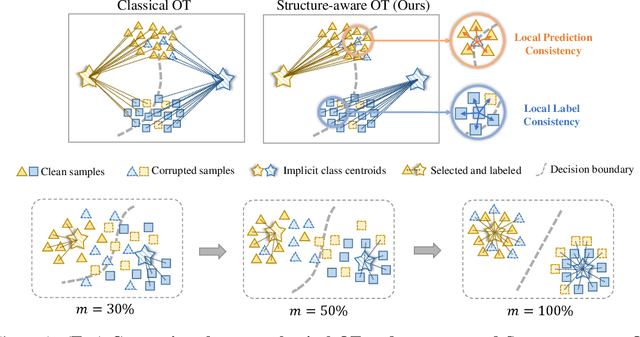
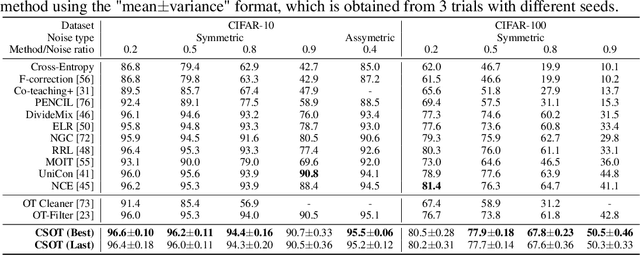
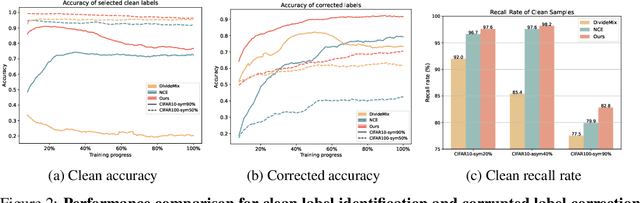
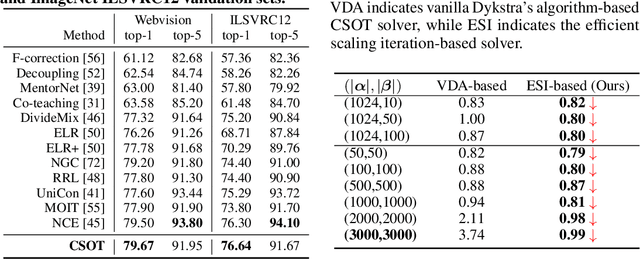
Learning with noisy labels (LNL) poses a significant challenge in training a well-generalized model while avoiding overfitting to corrupted labels. Recent advances have achieved impressive performance by identifying clean labels and correcting corrupted labels for training. However, the current approaches rely heavily on the model's predictions and evaluate each sample independently without considering either the global and local structure of the sample distribution. These limitations typically result in a suboptimal solution for the identification and correction processes, which eventually leads to models overfitting to incorrect labels. In this paper, we propose a novel optimal transport (OT) formulation, called Curriculum and Structure-aware Optimal Transport (CSOT). CSOT concurrently considers the inter- and intra-distribution structure of the samples to construct a robust denoising and relabeling allocator. During the training process, the allocator incrementally assigns reliable labels to a fraction of the samples with the highest confidence. These labels have both global discriminability and local coherence. Notably, CSOT is a new OT formulation with a nonconvex objective function and curriculum constraints, so it is not directly compatible with classical OT solvers. Here, we develop a lightspeed computational method that involves a scaling iteration within a generalized conditional gradient framework to solve CSOT efficiently. Extensive experiments demonstrate the superiority of our method over the current state-of-the-arts in LNL. Code is available at https://github.com/changwxx/CSOT-for-LNL.